Rice or flowers: what to throw at the newlyweds
Rice, petals, bubbles or lavender: what to throw at the newlyweds, which traditions still hold and which suit your ceremony best.
Created with AI assistance and human review. Editorial standards
Puntos clave
- Rice remains the cheapest option, but many churches and venues prohibit or strongly discourage it for safety and cleanliness reasons.
- Flower petals, fresh or dried, are the most photogenic alternative; dried petals cause fewer stains and cost just a few pounds per kilo.
- Biodegradable confetti is the best solution for venues with restrictions: it leaves no lasting residue and can be matched exactly to your wedding colour palette.
- Lavender adds scent and a beautiful boho aesthetic; it works particularly well at rural and countryside weddings.
- Before you decide, confirm what is permitted with the venue, speak to your photographer, and assign someone to hand everything out before the exit moment.
La elección de qué lanzar a los novios es crucial, ya que condiciona la estética y la normativa del espacio y, en ocasiones, también el estado del vestido de novia al terminar. Dura apenas unos segundos, pero la salida de la boda es uno de esos momentos que se quedan grabados en la memoria y en el carrete de todos. Aparece en las fotografías que la pareja enmarcará y en los vídeos que se compartirán durante años. Aquí encontrarás un análisis exhaustivo de cada opción realista, con sus ventajas y sus inconvenientes, para que puedas elegir con seguridad.
Rice: why it endures and why it is fading
Rice has been the default choice at weddings for decades. Its symbolic roots lie in fertility and prosperity, and its cost is negligible. That explains its staying power.
The problem is that many venues, particularly churches and properties with stone or marble floors, have banned or firmly discouraged it. Wet rice is a slip hazard, and dry rice attracts birds that can foul the surrounding area for days. Parishes across the country have been asking couples to switch for years, though the final decision rests with each individual priest.
If your ceremony is a civil one held outdoors or in a private space with no restrictions, rice remains a perfectly workable choice. But before defaulting to it out of habit, the alternatives are worth a proper look.
Flower petals: the most photogenic option
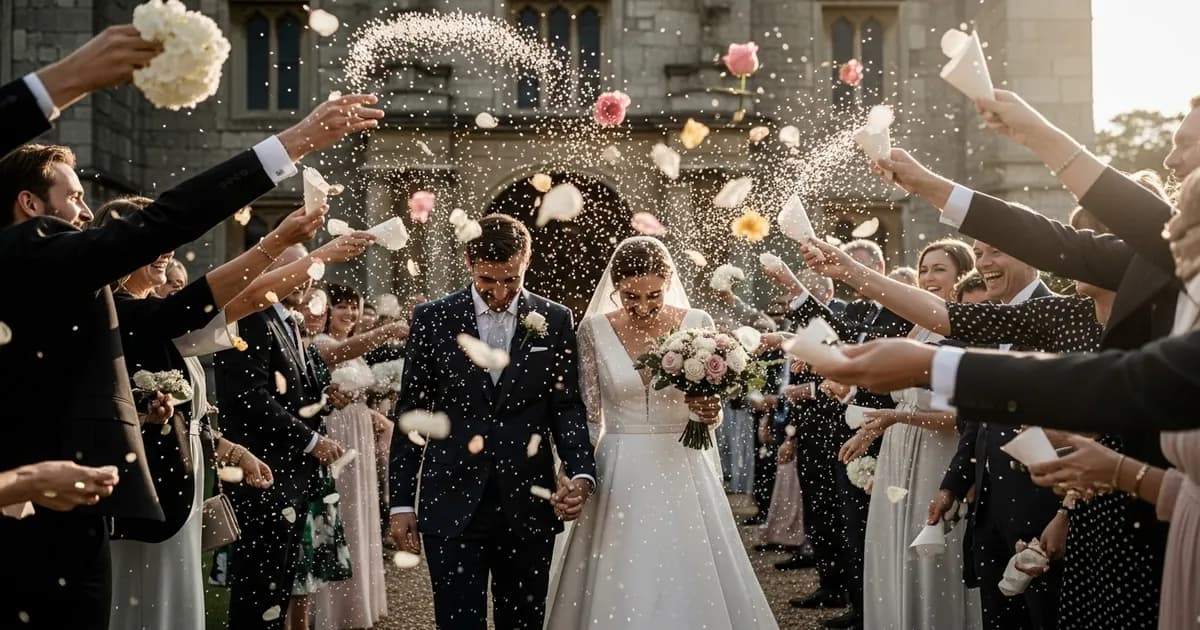
Petals have grown more popular than any other alternative in recent years. At romantic, Provençal or garden-style weddings, the effect is genuinely stunning: the cloud of colour that blooms in the air at the moment of the throw is visually hard to beat.
Fresh or dried: a distinction that matters
Fresh petals produce a beautiful result but come with two drawbacks. The first is cost: for a wedding of a hundred guests, a florist can charge considerably just for the petals, depending on the variety (prices vary widely by season and flower type, so request a quote well in advance). The second is the risk of staining delicate fabrics, particularly with deep red roses or any highly saturated colour.
Dried petals are more manageable, can be prepared weeks ahead and cause far fewer stains. Their look is slightly more rustic, which suits barn conversions, farmhouse venues and any charming countryside setting perfectly. Bought in bulk they tend to be very affordable, and as a rough guide, a kilo and a half is comfortably enough for a hundred guests.
One note for your photographer: white or pale-toned petals photograph best in strong natural light; darker petals work better indoors with flash. It is worth a quick conversation before the day.
Biodegradable confetti: the answer for restricted venues
Many venues that ban rice and fresh petals do permit biodegradable confetti, made from tissue paper or cornstarch that dissolves with rain or moisture within a few days.
The range of shapes and colours is vast: hearts, flowers, stars, leaves. For weddings with a tightly defined colour palette, confetti offers a visual consistency that petals cannot always guarantee.
The cost is very reasonable. A cone of biodegradable confetti per guest works out quite economically (prices vary by supplier and whether personalisation is included), and many couples have them printed with their names and wedding date, turning them into a small welcome detail that guests find at their place setting during the drinks reception or dinner.
That said, always check with the venue that confetti is accepted, even the biodegradable kind. Some properties with manicured gardens prefer to avoid anything that needs to be collected afterwards.
Lavender, wheat and other natural alternatives
Lavender has established a real presence at rural weddings and celebrations with a boho or pastoral feel. The scent it leaves in the air is something no other option can offer, and it photographs beautifully. In regions where the landscape already carries that wild, herbal quality, it feels entirely at home in its surroundings.
Wheat carries similar symbolism to rice, abundance and prosperity, with a more artisanal aesthetic. It tends to appear at autumn weddings or at converted agricultural venues.
Other options that surface with some regularity in wedding decoration trend reports compiled by Gourmet Catering include wildflower seeds that guests can plant at home afterwards, or aromatic elements such as dried eucalyptus leaves and small sprigs of rosemary. These work particularly well when the wedding has a sustainability dimension, or when the couple wants the detail to have a life beyond the moment itself.
Soap bubbles and other residue-free options
For weddings in highly restricted spaces, such as the courtyards of listed buildings or venues with especially sensitive flooring, soap bubbles are the most practical solution. They leave no residue, cause no staining and create a delicate, almost dreamlike visual effect that photographs wonderfully.
The drawback is that they require a little more organisation: bottles need to be distributed among guests before the exit, and not everyone, particularly older guests, takes to them as naturally as a handful of rice.
Paper lanterns are another option for evening exits, though their use is heavily restricted in many areas due to fire safety regulations. Always check with the local authority or venue management before considering them.
What the trends are saying
Bridal decoration trends point towards greater coherence across every element of the wedding, and the exit is no exception. According to findings gathered by Restaurante El Lomo on 2026 trends, personalisation and sustainability are the two principles guiding couples' decisions right now.
In practice, that means exits where the chosen element connects directly to the overall aesthetic of the wedding: if the decor leans heavily on greenery and eucalyptus, dried leaves make perfect sense; if the palette is all white and cream, white petals or ivory confetti are the obvious call.
For weddings with a highly considered visual identity, some photographers and videographers who specialise in editorial-style work, including those whose imagery appears in inspirational features from El País Novias, recommend rehearsing the exit moment with the wedding party or closest family members so that the throw is simultaneous and the mayor impacto visual se consiga en las fotografías.
Protocol by ceremony type
The choice also depends on the type of wedding. At a Catholic wedding, the exit typically takes place at the church porch, a space that many parishes manage according to their own rules. Speak to the priest at least two months in advance.
At a civil wedding, there is considerably more freedom, though the venue still sets the parameters. A register office room has very different constraints from a private estate with gardens.
If your wedding is outdoors, factor in the wind as well. Lightweight petals or tissue-paper confetti on a breezy day can scatter in every direction rather than creating the concentrated, beautiful cloud you are picturing. Your photographer will have a view on this, and it is worth asking.
This article was reviewed by our editorial team. How we create our content
Frequently Asked Questions
Planning your wedding?
Download Wedded and organize all the details of your wedding with the help of AI.
Download on Google Play