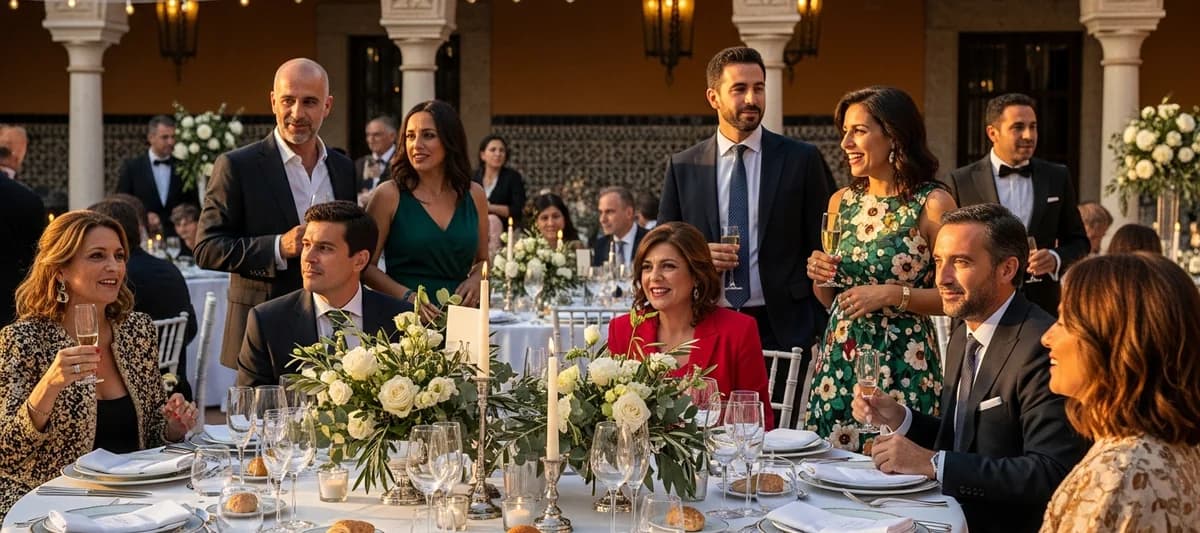
Wedding Seating Plan: the complete step-by-step guide
How to create a wedding seating plan: what it is, when to start, how to assign tables, common mistakes, and templates to organise it without stress.
Created with AI assistance and human review. Editorial standards

Organising the seating plan for a wedding with 150 guests is, without exaggeration, one of the most logistically complex tasks in the entire planning process. Not because of the time it takes, but because of the number of human variables to balance: affinities, ages, languages, personal histories, accessibility needs and, at today's weddings, families from very different backgrounds. According to Spain's National Statistics Institute (INE), 46.1% of marriages celebrated in Spain in 2023 involved at least one foreign spouse, adding an extra layer of cultural management to the table layout.
This guide covers what a seating plan actually is, how to build one from scratch, which templates and tools work best, and the mistakes that come up most often, with concrete solutions for each.

Planning your wedding?
Download Wedded and organize all the details of your wedding with the help of AI.


What is a seating plan and why does it matter
A wedding seating plan assigns each guest to a numbered or named table at the reception. It is usually displayed as a panel at the entrance to the dining room, listed alphabetically or by table number, so each guest can find their place before sitting down.
In its more detailed version, the sitting plan, the exact seat within the table is also specified, using individual place cards. Between 20 and 30% of weddings in Spain use this format, according to Elle España, though for events with more than 150 guests, table assignment alone is usually enough.
Seating plan vs. sitting plan: the practical difference
| Seating plan | Sitting plan | |
|---|---|---|
| What it assigns | Table | Table + exact seat |
| Display | Panel at entrance | Panel + place cards |
| Use in Spain | Majority | 20-30% of weddings |
| When to use | Whenever there is a formal reception | Very formal or small weddings |
Why a good seating plan improves the experience
The reception accounts for between 30 and 40% of a wedding's total budget, according to Vogue España. A poorly resolved layout directly affects that investment: it slows down service, creates queues at the entrance, leaves tables unbalanced and, at worst, seats people with known conflicts next to each other. A well-considered seating plan, on the other hand, keeps the room flowing and makes guests feel genuinely looked after.
When to start and when to finalise
The seating plan timeline has two key moments.
Initial draft: four to six weeks before the wedding, once you have final confirmations. In Spain, approximately 10-15% of guests communicate changes (cancellations or additions) in the final month, according to ¡Hola! Novias, so closing the plan too early creates unnecessary rework.
Final version: two to three weeks before the wedding. That is the standard deadline most venues and restaurants in Spain use to coordinate kitchen logistics, service and special menus, according to Telva Novias. Changing the seating plan on the day itself is one of the most problematic mistakes: it creates confusion in service and errors with dietary-restriction menus (allergies, vegans), according to Vogue España.
The buffer rule
Always leave one or two empty seats per room, distributed across tables that can absorb last-minute changes. If you have 10 tables of 10 and expect 98 confirmed guests, do not fill every table to capacity — leave room for the unexpected.
How to make a seating plan: step by step
The process has five phases. Following them in order saves hours of work.
Step 1: Finalise the guest list
Before touching any table, you need a confirmed, closed list. For each person, include: full name, group (bride's family, groom's family, mutual friends, colleagues, etc.), dietary restrictions or mobility needs, and primary language if there are international guests.
Step 2: Get the venue floor plan
Ask the venue coordinator for the exact floor plan of the dining room, including table dimensions, maximum capacity, and the location of the dance floor, bar, entrances and bathrooms. In Spain, the most common configuration is 8 to 10 guests per round table, according to El País; imperial or rectangular tables seat more but are less flexible for mixing groups.
Step 3: Group guests by affinity
Before assigning tables, create logical groups on paper or in a spreadsheet:
- Bride's immediate family
- Groom's immediate family
- Extended family (aunts, uncles, cousins)
- Childhood friends
- University friends
- Work colleagues
- International guests
- Children (if any)
Each group can fill a whole table or share one with another compatible group. The goal is that no one ends up seated with people they have no connection to.
Step 4: Assign tables with intention
Some rules that work in practice:
- Head table first. Place the couple and decide the format: traditional head table (couple, parents, witnesses), sweetheart table (couple only), or integration with close friends. This is the visual centre of the room.
- Families near the head table. Parents and grandparents on both sides generally prefer to be close to the couple and away from the dance floor.
- Young friends near the dance floor. They will be the ones dancing most; placing them away from the music reduces noise levels at the tables with older guests.
- Guests with reduced mobility, near exits and bathrooms. Around 5-10% of guests may have some accessibility need, according to El País. Coordinating this with the venue service team is essential.
- Children at their own table or with their parents. Separating them from adult tables reduces noise and makes supervision easier.
- International guests, mixed with someone who speaks their language. A table of people who cannot communicate with each other is uncomfortable for everyone.
Step 5: Review and adjust
Once you have a draft, read it with fresh eyes: is there any table with an obvious age imbalance? Any guest who ends up isolated without knowing anyone at their table? Any known conflict (separations, family estrangements) you may have overlooked? This is the moment to adjust before the seating plan is printed or ordered.
Tools and templates for organising the seating plan
There is no single ideal tool; the choice depends on the size of the wedding and how much you want to invest in the process.
Spreadsheet (Excel / Google Sheets)
The most flexible and free option. Create a sheet with columns: name, group, assigned table, special menu. Add another tab with the table layout and the number of people per table. Google Sheets allows you to share it with your partner or the venue coordinator in real time.
Advantage: full control, no learning curve. Disadvantage: floor plan visualisation is limited.
Seating plan apps
There are dedicated tools (some free for small weddings, others paid) that allow you to drag and drop guests onto a virtual floor plan. They are useful for weddings of more than 100 guests, where the volume of changes makes a spreadsheet harder to manage.
Paper and sticky notes
It sounds old-fashioned, but many wedding planners still start this way: a printed floor plan and sticky notes with guest names. It lets you move groups physically and see the whole picture at a glance. Ideal for the draft phase before going digital.
Basic template for 10 tables
This structure works as a starting point:
Table 1 (head table): 8 people — couple, parents, witnesses
Table 2: 10 people — bride's immediate family
Table 3: 10 people — groom's immediate family
Table 4: 10 people — bride's extended family
Table 5: 10 people — groom's extended family
Table 6: 10 people — bride's childhood friends
Table 7: 10 people — groom's childhood friends
Table 8: 10 people — university / work friends (bride)
Table 9: 10 people — university / work friends (groom)
Table 10: 8 people — mutual friends / international guests
Adjust the number of tables and capacity to your venue's actual floor plan.
The seating plan panel: formats and materials
The panel is the visual piece guests see when they arrive at the reception. Its function is practical, but also aesthetic: it is part of the decoration.
Most common formats in Spain
- Single alphabetical panel: the most widely used. All names on one piece, ordered by surname or first name, with the table number alongside.
- Panel by table: each table has its own section listing its guests. More visual, but longer to read if there are many tables.
- Digital / interactive panel: screens or tablets at the entrance where guests search for their name. Still uncommon in Spain, but growing at weddings of more than 200 guests.
Materials and displays
Calligraphy mirror, black chalkboard, wooden frame with tracing paper, floral installation with hanging cards, laser-engraved wooden board. The display must be legible from at least one metre away and well lit if the entrance to the dining room is indoors.
Professional tip: commission the panel from the same calligrapher or printer who creates the place cards and stationery for the wedding. Typographic and material consistency gives the whole thing a unified look and prevents the seating plan from looking like a last-minute addition.
Common mistakes (and how to avoid them)
This list covers the errors that come up most often, according to Elle España, Vogue España and ¡Hola! Novias.
Not grouping by affinity
Seating people who do not know each other is not a problem if they have something in common (similar age, shared background, comparable interests). The problem is mixing without any logic: a table with an 80-year-old grandparent, a couple in their thirties and three teenagers does not have to work.
Solution: use the groups from Step 3 as your base and only mix when there is a specific reason (international guests who do not know anyone else, for example).
Ignoring age differences
Children need space, freedom of movement and supervision. Older guests prefer tables away from noise. Mixing them without consideration is one of the most frequently cited mistakes.
Solution: reserve a dedicated table for children (with their parents nearby) and place the tables for older guests in the quietest area of the room, away from the dance floor and speakers.
Seating people with known conflicts together
Separations, family estrangements, ex-partners: they exist in almost every family. Ignoring them in the seating plan does not make them disappear.
Solution: before closing the draft, review it with your partner and, if necessary, with a trusted person from each family who knows the internal dynamics.
Not accounting for accessibility
Around 5-10% of guests may have some mobility limitation, according to El País. A wheelchair requires space between tables; an older guest with difficulty walking will appreciate being close to the bathrooms.
Solution: flag which guests have special needs in your list and coordinate with the venue service team before finalising the seating plan.
Changing the seating plan on the day
This is the most costly mistake in logistical terms. The kitchen team works with the seating plan to manage special menus (allergies, vegans, children's menus). A last-minute change can result in the wrong menu arriving at the wrong table.
Solution: close the definitive seating plan at least two weeks before the wedding and communicate any subsequent changes in writing to the room manager.
Leaving no buffer for last-minute changes
A wedding of 100 guests with 10 tables of 10 filled to maximum capacity has no margin. If there is a last-minute cancellation or an unexpected addition, the problem is immediate.
Solution: always leave one or two empty seats distributed across tables that can absorb changes without becoming unbalanced.
The head table: options and protocol
The head table involves the most decisions, because it touches the most sensitive family relationships.
Classic format
Couple in the centre, parents on either side, witnesses at the ends. This is the most common format at formal Spanish weddings and the one that best follows traditional protocol.
Sweetheart table
Just the two of you. Gaining popularity at more intimate weddings or when parents prefer to sit with their own families. It has the advantage that the couple can move freely around the room to greet all the tables.
Table with friends
Some couples skip the head table entirely and integrate themselves into a table with their closest group. It is the most informal option and requires the least protocol, but it can create expectations among parents.
Professional tip: whatever format you choose, tell both sets of parents before they discover it on the day. It avoids misunderstandings and gives them time to adjust.
Conclusion
The seating plan is not a bureaucratic formality: it is the social architecture of the reception. A well-considered layout makes guests feel genuinely looked after, allows service to run with precision and gives the celebration the rhythm it deserves. The process has its own logic: start with the confirmed guest list, then the venue floor plan, then affinity groups, and only then table assignments. Closing the definitive plan two to three weeks before the wedding, with a buffer for the unexpected and coordinated with the venue team, is what separates a reception that flows from one that starts with queues and confusion.
Related Reading
This article was reviewed by our editorial team. How we create our content
Frequently Asked Questions
Planning your wedding?
Download Wedded and organize all the details of your wedding with the help of AI.