Wedding Invitations in Spain: Wording, Timing and Cost
What to put on a wedding invitation in Spain, when to send it, what 100 and 150 invitations cost in euros, and ready-to-adapt wording for three styles.
Created with AI assistance and human review. Editorial standards

The invitation is one of the few pieces that reaches every guest with the official details, and one of the few you cannot fix once it is printed: a wrong address or time cannot be repaired with a text message. Spain registered 175,364 marriages in 2024, 1.7% more than in 2023, according to the INE, and almost every one of them went through the same sequence. First decide what the card will say. Then decide when it goes out and what it will cost. If you are marrying in Spain from abroad, there is a third question that locals rarely face: which language the card speaks. We cover all of it, with price ranges in euros for 100 and 150 guests, wording you can adapt, and the RSVP process step by step.
Key points
- What goes on it: the couple's names, full date with the day of the week, city and exact address, the time, and an RSVP request with a deadline. The gift registry never goes on the invitation.
- When to send it: 3 to 4 months before as a rule. For a destination wedding or guests who travel, 5 to 6 months. Never with fewer than 6 weeks to go.
- What it costs: simple printed cards run 1 to 3 euros each, premium 5 euros or more. For 100 guests, the stationery line typically falls between about 100 and 500 euros depending on format, envelope and postage.
- Paper or digital: paper remains the norm in Spain. Digital works as a companion, not a replacement, for families who expect a card.
- RSVP: in writing, with a deadline, through one channel your guests will actually use.
What a wedding invitation must include
The aim is that no guest has to ask you anything. Everything they need, from dress code to the timing of the banquet, belongs on the card. Miss one detail and the messages arrive; add too many and the main information drowns.
| Detail | Required | Notes |
|---|---|---|
| Names of the couple (and parents, depending on who is hosting) | Yes | This sets the wording: "Maria and Jose invite you..." or "Maria and Jose are delighted to announce..." |
| Day of the week and full date | Yes | For example, "Saturday, 12 September 2026". Nobody miscalculates the day. |
| City and exact address | Yes | Venue name, street and town. If the place is hard to find, add a note on parking or access. |
| Ceremony time | Yes | And banquet time if it differs. |
| Dress code | Recommended | "Black tie", "cocktail", "smart casual". One line saves dozens of messages. |
| RSVP request with deadline | Yes | Channel and date. This is the line that protects your budget. |
| Banquet details or practical notes | Optional | Menu, parking, the wedding WhatsApp group. |
One block of information turns up on cards far too often and does not belong there: the gift registry or wedding list link. Share it quietly, by word of mouth or message, with the guests closest to you. The same goes for a thank-you website address and the full menu or open-bar details, which clutter the card. Godparents' names appear only if you want them there.
Who is inviting: the couple, the parents or both
The order of the names and the verb you choose signal who is hosting. These are the formulas that work in Spain:
- The couple only: "Ana and Luis are delighted to invite you to their wedding...". The most common choice when the couple pays.
- Both sets of parents: "Maria Garcia and Jose Perez, together with Carmen Ruiz and Antonio Ruiz, invite you to the marriage of their children Ana and Luis...". Classic when the families share the cost.
- One side only: "Carmen Ruiz and Antonio Ruiz, with their son Luis...". Less common, but valid.
Pick one and apply it to every piece of stationery, from invitation to envelope detail, so the set reads as one wedding and not three separate decisions.
Which language the card speaks
If you are marrying in Spain with guests from two countries, a bilingual card is the cleanest answer: Spanish on one side, English on the other, or two matching cards in the same envelope. Skip the translated text crammed into every line. And if the ceremony itself is in Spanish, say so on the card, so your English-speaking guests know what to expect.
When to send them
The general rule is 3 to 4 months before the wedding. In high season, or when guests have to travel, and above all for a destination wedding, bring it forward to 5 or 6 months. Under no circumstances send invitations with less than 6 weeks of notice: people need to book leave, and sometimes flights. If you plan by calendar, our step-by-step guide to planning a wedding places invitations in exactly this window, between the third and fourth month before the day.
A local wedding is the most forgiving. Three months is enough for guests who live in the same city and only need to clear a Saturday.
June to September is where you should not cut it short. Most weddings compete for the same summer weekends, and if you send late, a good share of your guests will already have committed that weekend to someone else. Four months, no room to manoeuvre.
For a destination wedding, five or six months at minimum. Flights, accommodation and leave are all easier to book early, and prices in high season climb fast. If guests are coming from outside the EU, allow for visa and work-permit planning too: the send date does not drop below 6 months.
A word on the save the date, which creates confusion. It has a different purpose and goes out earlier, 8 to 12 months ahead, with just the date and the city. The formal invitation, the subject of this article, carries the full information and arrives 3 to 6 months before depending on the scenario. The save the date guide covers the earlier notice with message templates.
How much wedding invitations cost
Price depends on the paper and the run, and Spanish printers work to minimum quantities, so ask for them in writing before you commit. These are market references.
| Format | Approx. price per unit | Run of 100 | Run of 150 |
|---|---|---|---|
| Simple print (colour card, standard paper) | 1 to 3 EUR | 100 to 300 EUR | 150 to 450 EUR |
| Premium print (cotton paper, letterpress, engraving, foil) | 5 EUR or more | 500 EUR or more | 750 EUR or more |
| Digital (website, PDF or message) | 0 to 1 EUR handling per guest | 0 to 100 EUR design | 0 to 150 EUR design |
| Envelope, stamping and postage | 0.50 to 2 EUR per additional unit | 50 to 200 EUR | 75 to 300 EUR |
For 100 guests, a realistic stationery line is 100 to 500 EUR between simple and premium print, plus 50 to 200 EUR for envelopes and postage. For 150 guests, 150 to 750 EUR plus envelopes and postage. A wedding website with menu, map and gallery is a separate item that usually runs 100 to 300 EUR.
To put the figure in context, a cover in a Spanish wedding runs 60 to 150 EUR per guest according to Cronoshare, which puts 100 standard-design invitations at around 200 EUR and personalised ones at about 250 EUR. Stationery is a small share of the total budget, which is exactly why it gets left until the end.
How many spares to print
Print 5 to 10 spare units above your real count. They cover the changed address and the last-minute guest who accepts, plus envelopes you may want for sending details or the wedding website. An urgent extra order comes with a handling fee and a lead time that are not worth it.
Paper or digital
In Spain, paper is still what most guests expect, and not only for etiquette: the card arrives in an envelope, works as a keepsake and gets kept. Cotton paper with foil or letterpress are the premium options and the price per unit rises accordingly. The weak point is obvious: changing a detail at the last minute, the time or the address, means a second print run.
Digital solves cost and flexibility: you share it by WhatsApp or website, update any detail without reprinting, and add an RSVP form behind a QR code. For the older guests in many families, though, paper carries more weight, and a digital message slips easily down the wedding group chat.
Many couples settle on a mix: a digital save the date plus a paper invitation, or a physical card with a QR code opening the wedding website with menu, map and RSVP form. Paper is the keepsake, digital carries the practical load, and the card stays uncluttered.
All included
- Banquet venue
- Wedding Planner
- Marriage Paperwork
- Photographer
- Décor
- Flowers
- Master of Ceremonies
- Deejay
- Open Bar
Choosing the design and the printer
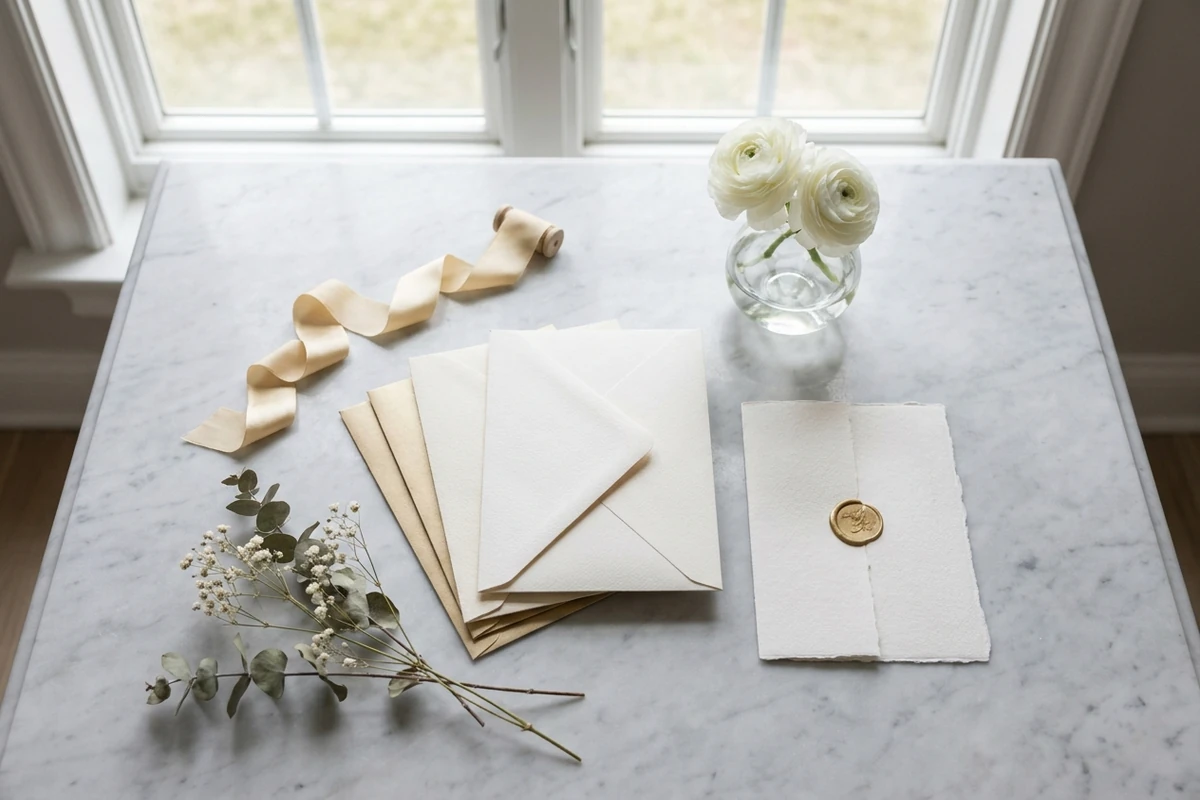
The invitation sets the tone for all the stationery, and the paper decides both the feel and the price.
Criteria, in the order you would apply them before ordering anything:
- Consistency with the palette and style of the day. If the wedding is rustic, a minimalist letterpress card in blue screen print does not fit. Look at the venue's website, the dress photos and the flower palette before opening the stationery file, or start with how to choose your wedding venue if it is not settled yet.
- Paper and finish. Paper defines touch and price. A 300 g cotton paper with gold foil looks and costs nothing like a 250 g offset card. Ask for paper samples before the design is locked.
- The printer's lead time. Ask how long it takes from artwork approval to dispatch. If the wedding is 4 months away and the printer needs 5 weeks, you still have a 2-month cushion. With only 3 weeks of margin, it is too tight.
- A printed proof. Always request a physical proof before the full run. That is where you see the inks, the foil centring and the real weight of the paper. A centring error is invisible on screen and multiplied by 150 in the run.
- A closed quote for the whole run. Ask for one total, card, envelope, postage and spares, not a per-unit price with no minimums. Most printers work to minimum runs and the discounts shift with quantity.
How to ask for the RSVP
Without a clear reply, the banquet is calculated by guesswork. And the venue does not take anything off the bill for guests who never show up. The RSVP is where the stationery budget is best protected.
What the invitation should say
Ask for a written reply, not just a "we're coming". Name the channel: a short URL, a QR code to a form, a WhatsApp number you trust, or a phone number. One main channel, a second if you like. Set the deadline at 2 to 4 weeks before the wedding. And say what information you want: names and number of children, plus any dietary restriction or allergy, so the caterer can plan the wedding menu properly.
Reply channels
| Channel | Advantage | Limitation |
|---|---|---|
| Web form via QR | Structured, cross-checks with your list, no phone calls | Needs a website or form. Older guests find it less direct |
| Physical reply card | Matches the paper set, elegant | Has to be posted back, and many get lost |
| Direct, natural in Spain, quick replies | Hard to structure. You note answers by hand | |
| Phone call or voice message | Works for older relatives | With 100 guests that is 100 calls |
In practice, many couples put a QR code on the invitation for those who prefer to type, and keep WhatsApp or a call for those who do not. A clear deadline and a plan B for non-responders matter more than the channel itself.
Chasing the ones who have not replied
At the deadline, open your attendee list and mark who has not answered. Call or send a personal message, never a group one. With 2 to 3 weeks in hand, a reminder two or three days before the deadline closes most cases. At 48 hours, phone whoever is still silent and lock the final number for the venue, which is also the basis of your seating plan. And if you still need the list itself, our guide to finalising the guest list is the starting point: it determines how many invitations you print and the total cost of the stationery.
Wording you can adapt
Change the names and details. Three tones for three kinds of wedding.
Classic
Maria Garcia and Jose Perez have the honour of inviting Carmen Ruiz
to the marriage of their children Ana and Luis
on Saturday, 12 September 2026, at 5:30 pm, at the Church of San Miguel, Valencia. Banquet to follow at the Parque de Viveros, Valencia, with cocktail and dinner at 8:30 pm.
Dress code: cocktail. Please reply before 1 September 2026 on +34 600 123 456 or at www.ana-luis-boda.es.
We look forward to celebrating with you.
Warm and informal
We're getting married!
Ana and Luis will celebrate on 12 September 2026 and we would love you to be there.
Ceremony at 5:30 pm at San Miguel, Valencia, then we meet at Parque de Viveros, cocktail and dinner from 8:30 pm.
Come as you are, but come ready to enjoy it. Save your seat before 1 September by WhatsApp or through the QR code.
With love.
Destination wedding
Ana and Luis are delighted to invite you to their wedding in Formentera, 25 July 2026.
Civil ceremony at 7:00 pm in Es Pujols, with cocktail and dinner on the beach until midnight.
Travel, accommodation and the return journey are organised by the couple: we will email the details, the ferry from Ibiza and the room booking once you have confirmed.
Please reply before 30 May 2026 at www.ana-luis-boda.es or by WhatsApp.
Thank you for coming all the way across the sea.
On an island, logistics are part of the invitation: Formentera can only be reached by boat, according to its Wikipedia entry, with ferries from Ibiza. Count the crossing in your timetable and say whether you are arranging the ferry.
Common mistakes
- Sending late. At 4 to 6 weeks from the wedding, guests who travel no longer have room. The 3 to 4 month rule (5 to 6 with travel) exists for this reason.
- Overloading the card. Menu, open bar, godparents, gift website, playlist... all of that goes on the wedding website or in your guest gifts and details. The invitation should be readable in 20 seconds.
- No plan for the RSVP. Without a deadline and a clear channel, the banquet is estimated with a round number and the venue does not refund it.
- Printing with no margin. Five or ten spares avoid an urgent order with a handling fee and a lead time you will not like.
- Changing the design at the last minute. Every design round costs. Lock the design before ordering the proof, not after.
- Letting the printer set the timeline. If the printer needs 5 weeks and the wedding is in 8, order the proof with 5 weeks in hand. Not 2.
Conclusion
Most of a wedding can move a little. The invitation cannot: it carries a printed date and address, and your guests arrange their lives around that card. The version that works best is not the prettiest, it is the clearest: names, day of the week, exact address and a single channel to reply. And when the time comes to send it, look at the reply deadline before the design. That date decides how many real places the banquet has, and it is the number the venue uses to close the bill. You choose the design. The calendar does not negotiate.
Related reading
This article was reviewed by our editorial team. How we create our content
Frequently Asked Questions
Not sure which one suits you?
Try every silhouette on your own photo with Wedded's virtual try-on. The first 5 try-ons are free.