Wedding safety: a complete practical guide
Everything you need to know to ensure safety at your wedding: capacity limits, emergencies, hiring security staff and essential protocols.
Created with AI assistance and human review. Editorial standards
Puntos clave
- Legal requirements for licensed security staff vary by jurisdiction and venue type; below the relevant threshold, the legal obligation may fall away, but the civil liability of the venue operator remains fully intact.
- The capacity stated on the venue's licence is the real ceiling: exceeding it can invalidate the venue's insurance and expose organisers to legal consequences.
- An emergency plan for a wedding can fit on a single laminated sheet; what matters is that one specific person knows they are responsible for carrying it out.
- Every supplier (catering, fireworks, live music) must provide proof of their own public liability insurance before the wedding day.
- The venue's insurance covers the venue operator. Event organisers are not included in that cover, and taking out a dedicated event insurance policy is strongly advisable.
More than 170,000 weddings take place in Spain each year, according to the INE (2023 data), and the vast majority pass without any serious incident. Behind the ones that go smoothly, there is almost always someone who asked the uncomfortable questions early enough. This guide covers the essential measures, hiring specialist staff and how to build an emergency protocol that fits on a single page.
What the law considers security at a private event
Spain's Private Security Act (Ley 5/2014, BOE, 2014) requires that events with more than 250 attendees in enclosed venues have licensed security officers present. Below that threshold the legal obligation disappears, though regional public entertainment regulations suman exigencias que varían según la comunidad autónoma.
In the UK, the Security Industry Authority (SIA) licensing framework means that anyone working as a door supervisor at a licensable event must hold a valid SIA licence. The Licensing Act 2003 also places conditions on premises licences that venue operators are obliged to meet, including capacity limits and safety requirements.
The civil liability of the venue operator applies in almost every scenario. If the venue holds an activity licence for events, it is required to observe the authorised maximum capacity and to maintain emergency signage and basic first aid equipment. Before signing any contract, ask for written confirmation of the authorised capacity certificate and the venue's emergency management plan.
For weddings at private estates without an events licence, the regulatory framework is looser, but the moral and civil responsibility of the hosts does not disappear. A family garden with 120 guests is still a space where an accident can happen.
Capacity: the first number you need to know
The maximum capacity is the legal ceiling, calculated on the basis of available floor space, emergency exits and the venue's evacuation capacity. Exceeding it can invalidate the venue's public liability insurance and, in the event of an accident, expose organisers to legal consequences.
When you visit a venue, always ask for the capacity authorised on the premises licence rather than the "comfortable" figure the sales team quotes you. The difference can be 30 or 40 people, and that matters.
If your guest count is close to that limit, bear in mind that service staff (waiters, the DJ, the photographer, coordinators) are often counted within capacity calculations. Add them up before you confirm.
Security staff: when to hire them and what profile to look for
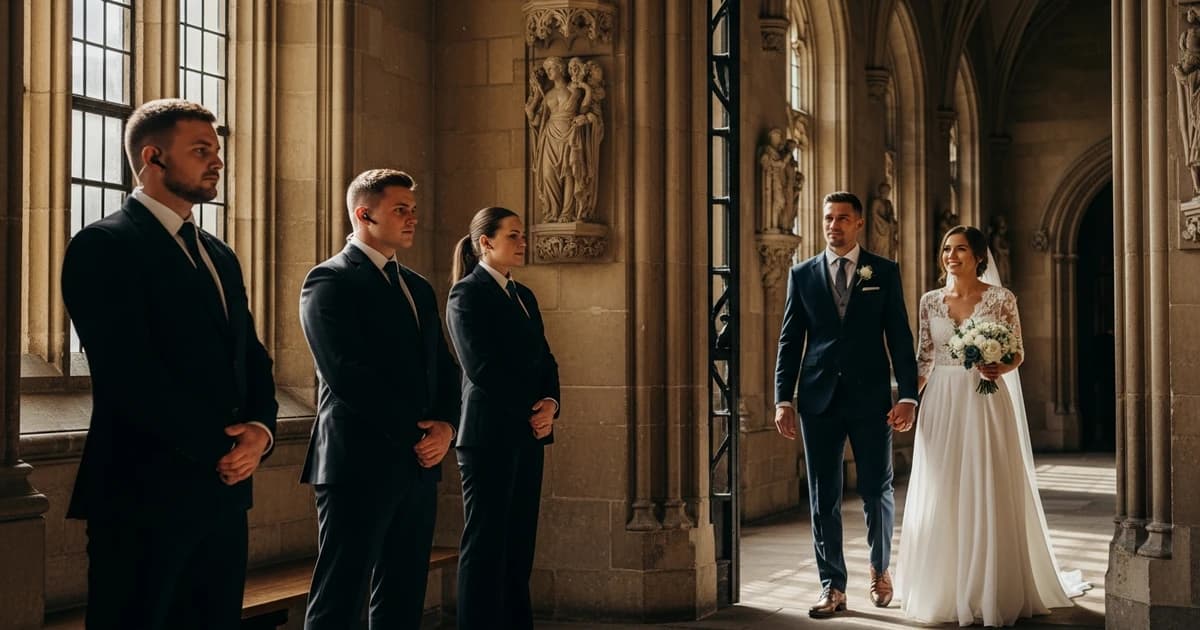
For weddings of up to 80 guests at a private enclosed venue, professional security staff are not strictly necessary. From around 100 guests upwards, the situation changes: a wedding with an open bar, access from a public road or an unfenced external car park is a setting where a security officer resolves problems before they escalate.
Licensed security officers and access control staff: two very different profiles
This is worth being clear about before you book anyone. A licensed security officer holding a valid SIA door supervisor licence and an unlicensed "host" or "doorman" with no accreditation are entirely different roles. Only the former can lawfully carry out searches, detain someone in the event of a flagrant offence or act in coordination with the police. Hiring the latter under the assumption that you have covered the former is a classic and potentially costly mistake if things go wrong.
For a wedding of between 150 and 200 guests, two licensed officers cover a reasonable minimum: one on the entrance and one moving through the venue. If there is an external car park or the event runs past midnight, adding a third is advisable.
What to include in the contract with your security company
Ask the contract to specify the number of staff, shift hours (many weddings run for ten hours or more) and the procedure for handling disturbances. The communication channel with the event coordinator should also be set out in writing. A reputable company will also ask for the venue floor plan in advance.
First aid kit, AED and first aid provision
Any venue licensed for events must have a first aid kit. That said, what actually counts is having one that is up to date and in an accessible location. During your site visit, physically locate the first aid kit and check that nothing in it has expired. It sounds obvious until you find that it has.
The automated external defibrillator (AED) is another point to check. Requirements vary: in England, the Health and Safety (First Aid) Regulations 1981 set out general obligations, and the British Heart Foundation strongly recommends AEDs at large public gatherings. For smaller events they are not legally required, but their presence is advisable if any guests are elderly or have known cardiac conditions.
On this point, the article on how to look after older guests at your wedding covers accessibility and health considerations in detail.
The emergency plan on one page
For a wedding, an emergency plan does not need to be a twenty-page corporate document. A single laminated sheet covering the following is enough:
- The number for emergency services and the exact address of the venue (with GPS coordinates if it is a rural estate).
- Evacuation points identified on the floor plan.
- The name and phone number of the designated emergency coordinator (this can be the wedding planner, the maitre d' or a trusted family member).
- The location of the first aid kit and, if one is present, the AED.
This sheet should be visible in the service area and the coordinator should have read it before the day. At many weddings, nobody has designated that person until a problem arises, and by then it is too late to improvise.
Outdoor weddings: specific risks
Open-air celebrations introduce variables that an enclosed venue does not have. Strong wind can bring down structures, extreme summer heat creates health risks, and uneven ground raises the likelihood of falls. For weddings in gardens or rural estates, the emergency plan should also include a weather contingency. This is covered in detail in the article on a rain plan B for your wedding.
Marquees and awnings installed for the occasion must be anchored according to the supplier's instructions and, if forecast wind speeds exceed 60 km/h, the structure should be inspected or taken down. Always ask the structure supplier for the installation certificate and the maximum wind load rating.
Traffic, parking and access
This is the aspect most consistently left to the last minute, and it almost always shows. A traffic jam at the end of a wedding with 200 cars can become a serious problem if there is an emergency and emergency vehicles cannot get through.
Speak to the local authority if the venue is accessed via a minor road or rural track. Some councils require temporary signage or even a traffic officer for larger events. The cost of that process is minimal compared with the risk of blocking access.
If the venue has its own car park, designate someone (a family member or a coordination assistant works well) to manage vehicle entry and exit during the busiest moments: guest arrival before the ceremony and departure at the end of the evening.
Public liability insurance: the safety net nobody wants to use
Any venue or event space with a licence should have
This article was reviewed by our editorial team. How we create our content
Frequently Asked Questions
Planning your wedding?
Download Wedded and organize all the details of your wedding with the help of AI.
Download on Google Play