Catholic wedding protocol: complete guide
Everything you need to know about Catholic wedding protocol: order of ceremony, roles, documentation and timing. No surprises on your wedding day.
Created with AI assistance and human review. Editorial standards
Key points
- The marriage file must be opened three to six months in advance; many parishes in larger cities ask for up to a year, so it is worth calling before you assume anything.
- The processional entry follows a fixed order: guests, groom with his mother or best man, the sponsors of the coins and rings, and finally the bride.
- The Rite of Marriage turns on three canonical moments: the declaration of freedom and fidelity, the exchange of consent, and the blessing and presentation of the coins, rings and lasso.
- Music during Mass must be sacred; pop songs may only be played during the entrance or recessional, and always with the priest's approval.
- Signing the registers takes between five and ten minutes and is a key moment for the photographer.
- A full nuptial Mass runs to around 60 to 75 minutes; without Mass, between 30 and 45, depending on the priest and the number of readings.
The first time a couple sits down with their parish priest to plan the ceremony, the conversation almost always circles back to the same question: who goes where and when? Catholic wedding protocol is the product of centuries of liturgy, codified in the Code of Canon Law and in the Rite of Marriage. This guide breaks down the complete order of the ceremony, who does what and the real timings you need to share with your photographer, musicians and family.
Documentation, before anything else
No amount of careful planning matters if the wedding has not been canonically authorised. The marriage file must be opened at the parish with enough lead time: three to six months is usually sufficient, though many priests in larger cities ask for up to a year. The core documents are a recent baptismal certificate (issued within the previous six months), a confirmation certificate, a civil birth certificate and a certificate of freedom to marry.
If one of the parties belongs to a different diocese or is not baptised, the documentation expands and so do the timescales. You will find the full details in the Catholic wedding documentation guide.
The order of the processional entry
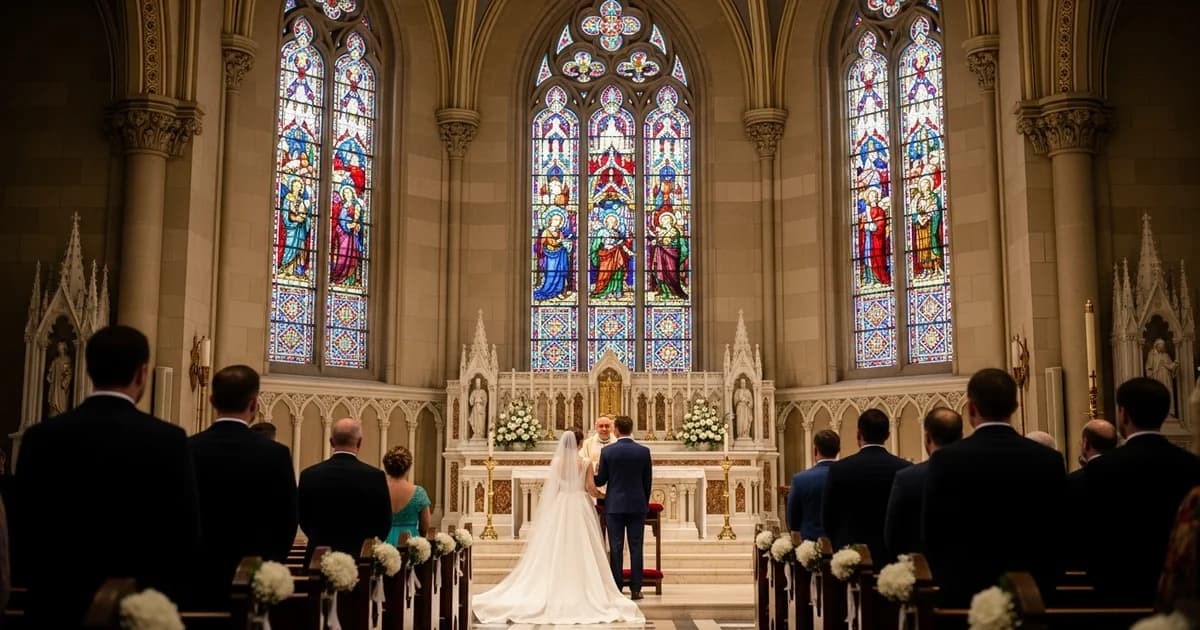
The processional entry sets the tone for the entire ceremony. The usual order is as follows.
Family and friends of the couple enter first and take their seats. By tradition, the groom's family sits to the right of the altar and the bride's family to the left, though many couples choose to do away with this separation entirely.
The groom then enters, accompanied by his mother (or his best man, depending on what has been agreed with the priest), and takes his place at the prie-dieu on the right-hand side of the altar. The sponsors of the coins, rings and lasso follow, if there are any, and sit in the reserved pews beside the sanctuary.
The bride enters last, accompanied by her father, her mother or both. The entrance music plays at this moment. The priest and servers wait at the altar or come to receive her at the door, according to the custom of each parish.
Coordinate with the organist or musical ensemble on the cue to begin. A signal from the master of ceremonies or an usher is all it takes to prevent the music from starting before the bride is ready.
How long does a church wedding last?
A full nuptial Mass runs between 45 and 75 minutes: 60-75 when communion is open to all guests, 45-60 when it is restricted. Without Mass, using only the Rite of Marriage, the ceremony takes 20-30 minutes. Add 10-15 minutes for signing the registers and the recessional.
The parts of the nuptial Mass
The Liturgy of the Word
After the priest's opening greeting and the penitential act, the nuptial Mass includes two readings and a responsorial psalm before the Gospel. The first reading is usually taken from the Old Testament or the apostolic letters; the Gospel is always proclaimed by the priest or deacon.
Readers should be people with clear diction and, ideally, some experience of reading in public. A poorly projected reading in a church with difficult acoustics will disconnect guests at precisely the moment before the ceremony's centrepiece, so do not leave it to someone who has not prepared the text well in advance. You will find suitable texts and guidance on choosing them in the article on Catholic wedding readings.
The homily
The priest delivers the homily after the Gospel. Its length varies considerably from one priest to another: anywhere between five and fifteen minutes is typical, though some run longer. If you have preferences about the tone, or would like something specific from your story to be mentioned, raise it during your preparation meetings. Most priests welcome this, and frankly, personalised homilies are the only ones guests still remember the following day.
The Rite of Marriage
This is the canonical heart of the ceremony. Three distinct moments make up what happens here.
The declaration of freedom and fidelity. The priest asks each party whether they are entering the marriage freely, whether they commit to conjugal fidelity and whether they are prepared to welcome and raise the children God may give them. Both answer aloud.
The exchange of consent. The couple join right hands and speak the words of matrimonial consent. This is the legal and sacramental moment of the marriage: without consent freely expressed, there is no valid marriage under canon 1057 of the Code of Canon Law. The priest receives it on behalf of the Church and declares the marriage contracted.
The blessing and presentation of the coins, rings and lasso. The thirteen coins symbolise the sharing of goods and life. The rings are blessed and exchanged as a sign of fidelity. The lasso or veil is placed over the shoulders of the couple during the nuptial blessing, though not every parish includes this by default: it must be requested expressly.
All included
- Banquet venue
- Wedding Planner
- Marriage Paperwork
- Photographer
- Décor
- Flowers
- Master of Ceremonies
- Deejay
- Open Bar
Music: when it plays and who decides
Liturgical music has its own rules. According to the guidelines of the Catholic Church, hymns and songs must be appropriate for worship. Pop songs, however emotionally meaningful they may be, have no place within the Mass itself; at the entrance and recessional the priest may authorise them, but the repertoire during the liturgy is sacred without exception.
The usual musical moments are: the bride's entrance, the offertory, communion, the signing of the registers and the recessional. With a string quartet or an experienced organist, each of those moments can last between three and eight minutes. Plan the timings with your musician before the ceremony. More on choosing repertoire in the article on Catholic wedding music.
Signing the registers
Immediately after the Rite of Marriage, and before continuing with the Mass if there is one, the couple sign the parish marriage register alongside the priest and witnesses. This is also the moment when the civil registration document is signed, if the couple have opted for a canonical marriage with civil effects.
Witnesses must be adults and present in the church. They are usually the godparents, but any person designated by the couple may serve in this role. The signing takes between five and ten minutes: the photographer needs that space free of interruptions to work properly, so it is worth flagging this in advance.
Roles and figures in the protocol
The godparents accompany the couple and serve as witnesses to the sacrament. Traditionally, the godfather is the groom's father and the godmother is the bride's mother, though this has changed considerably and today any trusted person can take on the role.
The sponsors of the coins, rings and lasso are secondary figures, usually children or young family members, who carry the symbolic elements on small cushions or trays. They have no canonical function, but they add a great deal visually to the ceremony. Make sure you rehearse with them the day before.
The master of ceremonies or usher is the person, usually a designated family member or friend, responsible for coordinating the entry of guests, managing the reserved pews and giving cues to the musicians at key moments. At larger weddings, this role is essential for preventing chaos during the processional.
The recessional: a detail that gets improvised too often
The couple's exit from the church is frequently planned less carefully than it deserves, despite its importance for the photographer and videographer. Guests wait outside with petals, rice or soap bubbles (whatever has been decided), while the photographer needs to be in position before the doors open.
Agree with the priest whether the exit will be through the main door or a side entrance. Confirm with the photographer and videographer where they will be standing. Let guests know, through the master of ceremonies or a note in the order of service, what they will be throwing and when. It is also worth deciding in advance whether the couple will pause on the steps for a moment or move straight through the crowd.
The time between the end of Mass and the couple actually exiting is usually ten to fifteen minutes, including the register signing if it has not already been done. Add this to your run-of-day timeline.
Plan your wedding with Wedded
Wedded is the free app for planning your wedding: a checklist organised by phase, a personalised budget by city and a guest list manager. Stay on top of every detail, from the parish paperwork to the recessional. Download it free.
This article was reviewed by our editorial team. How we create our content
Frequently Asked Questions
Not sure which one suits you?
Try every silhouette on your own photo with Wedded's virtual try-on. The first 5 try-ons are free.


