Wedding Photo Booth: The Complete Guide to Getting It Right
The photo booth is one of the most memorable extras for wedding guests. We cover types, prices, props and how to incorporate it into your wedding.
Created with AI assistance and human review. Editorial standards
Key takeaways
- For many guests, a printed strip they take home that same evening carries more emotional weight than a digital gallery shared afterwards. The physical object tends to stay with them in a way a link rarely does.
- There are five main formats (classic closed booth, open booth, magic mirror, 360 and GIF/boomerang); the open booth is the most popular at venues with a considered aesthetic.
- Indicative prices for 2025 range from €400 to over €1,800 depending on format, hours and included extras.
- Placement and timing matter as much as the equipment itself: the cocktail hour, clear access and a position away from the dance floor.
- Four questions to your supplier will help you assess their professionalism: backup equipment, real examples, template customisation and the attendant's role on the day.
There is one detail that appears in almost every wedding album from the past ten years: a slightly overexposed black-and-white photo strip featuring two or three people holding a cardboard moustache. The photo booth has long been part of the furniture at Spanish weddings, yet it remains one of the extras that generates the most uncertainty during planning. Is it worth the expense? Which format suits each type of venue? How do you incorporate it so it feels intentional rather than like a last-minute addition?
Here is everything you need to make an informed decision: available formats, realistic price ranges, how to choose your supplier and which props are the difference between a booth that gets used for ten minutes and one nobody wants to leave.
Why the photo booth still works
Professional wedding photography documents the moments the couple wants to preserve. The photo booth captures the ones guests take for themselves. The two services operate on entirely different logic, and that complementarity is precisely why they coexist without getting in each other's way.
A printed strip that a guest takes home that same night has a physical quality that even the most beautifully curated digital gallery simply cannot replicate. According to FESPA's Print and Visual Communications Industry Outlook report (2023), 74 per cent of consumers consider printed photos to carry greater emotional value than digital ones. At a wedding, that perception is amplified because the image is tied to a specific moment and a specific person.
The photo booth also acts as a social catalyst during transitional moments: the time between the cocktail hour and being called into the dining room, the quiet stretch between dessert and the first dance. Filling that space with something that invites active participation is, quite simply, good management of a celebration's pace.
The formats available today
The market has moved on considerably since the classic four-shot strip booth. These are the formats most commonly booked at weddings right now.
Classic or closed booth
The curtained booth with a seat and a photo strip in analogue or digital format. It produces between two and four shots per session, usually in a vertical strip. While it offers a sense of intimacy (guests tend to let their guard down when they feel they are "alone" inside), its main drawbacks are the floor space it requires and the fact that it cannot accommodate large groups.
Open booth or open-air photo booth
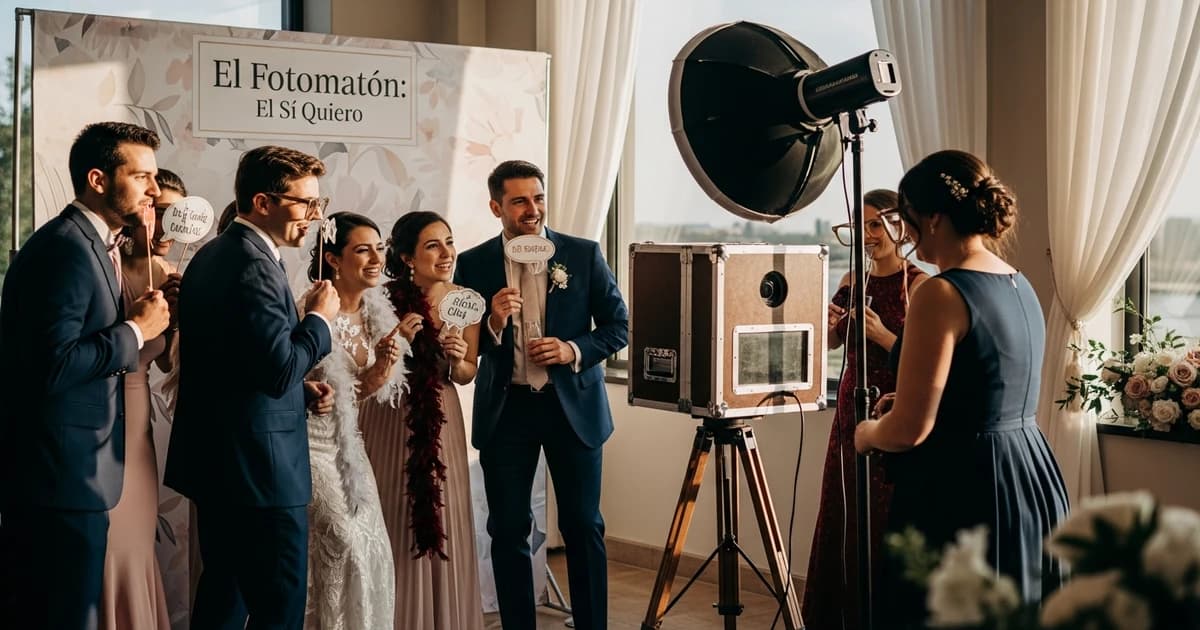
A decorative backdrop and a camera on a tripod, with no walls or curtain. Groups of eight or ten people can be photographed at once, and the backdrop can be designed to match the wedding's colour palette. This is the most popular format at venues with a considered aesthetic because the set itself becomes part of the decor.
Magic mirror
A full-length mirror touchscreen that guides users through the process with animations and personalised frames, printing in square or A5 format. It takes up very little floor space and is well received by guests of all ages thanks to its intuitive interface.
360 photo booth
A rotating platform with an arm that circles the subject while recording a slow-motion video clip. The result is a ten-to-twenty-second video sent via WhatsApp or shared directly to social media. There is no printing involved, so if you want a physical keepsake you will need to pair it with another format. It is ideal for couples who prioritise digital content over printed mementos.
GIF or boomerang booth
Similar to the 360 but simpler: it captures a burst of images that become an animated GIF. The cost is lower and the result is instantly shareable. It works well as a complement to a main photo booth rather than as a standalone option.
What it costs and what the price includes
Prices vary considerably depending on region, season and supplier, but these are the indicative ranges for 2025:
- Classic or open booth: between €400 and €800 for four hours, with unlimited printing and a basic props set.
- Magic mirror: between €600 and €1,000 for four hours.
- 360 photo booth: between €800 and €1,500, depending on whether an attendant and LED backlighting are included.
- Premium packages with a personalised backdrop, a signing book and a private digital gallery: these can exceed €1,800.
Most base packages cover setup and breakdown, a technical attendant on site, unlimited printing during the contracted hours and a digital gallery of all shots. Additional hours (typically between €80 and €150 per hour), bespoke custom props, personalised vinyl backdrops and a physical signing book are usually quoted separately.
Before signing any contract, clarify who covers the cost if the equipment fails during the celebration. A serious supplier will have backup equipment or a substitution protocol in place. For more on how to evaluate any wedding supplier, see this guide on choosing wedding vendors.
All included
- Banquet venue
- Wedding Planner
- Marriage Paperwork
- Photographer
- Décor
- Flowers
- Master of Ceremonies
- Deejay
- Open Bar
Props: what works and what to leave out
Props are the accessories guests hold or wear for the photo. Hats, sunglasses, moustaches, signs with phrases, crowns, cardboard frames. Their purpose is to break the ice and give people permission to be silly, which is exactly what someone who has no idea how to pose needs.
The props that genuinely deliver are physical ones, made from card or fabric, large enough to read clearly in the shot. Signs with specific references to the wedding ("Team Bride", "I've been dancing since 10pm", the wedding year) land better than generic ones. Wide-brimmed hats and oversized sunglasses are classics that never disappoint.
On the other hand, props that are too small to register in the image and cheap plastic accessories that break within the first hour add nothing and create clutter on the table. One reasonable request: ask that the supplier's logo, if it appears at all, be discreet or placed only on the reverse of the print rather than on a cardboard frame taking centre stage in every shot.
An option more couples are choosing: commissioning a personalised props set with elements that actually mean something to them. If you met on a trip to Japan, a set of fans and manga-style glasses tells more of a story than a generic moustache. The additional cost is usually between €80 and €200.
Where and when to position it
Placement is almost everything. A poorly positioned photo booth is a photo booth that does not get used.
The basic rules: it needs at least three metres of clear depth and good lighting (natural or neutral artificial light, never coloured lighting that distorts skin tones). Access should be easy and direct, without guests having to cross the dance floor or walk through the kitchen. At venues with a garden, an outdoor setup works very well during the cocktail hour if the weather cooperates, but always with an indoor backup plan.
The ideal activation moment is the cocktail hour. Guests are on their feet, in the mood to move around and not yet experiencing the energy dip that comes in the final hours of the evening. If you are only booking the service for the reception dinner, make sure the booth is active from the start of the meal rather than waiting until the dancing begins, by which point some guests will already be heading home.
For weddings with a large guest count, consider booking two photo points or extending the service to six hours. With a single booth and many guests, waiting times can put off anyone who arrives at the back of the queue.
The cocktail hour, as a space within the celebration, deserves its own careful planning. More on that here: reception cocktail hour guide.
How to integrate it into your wedding aesthetic
A well-considered photo booth does not clash with the surroundings: it becomes a corner with its own decorative weight. A poorly resolved one looks like a piece of rented hardware abandoned in a corner. Everything comes down to the backdrop and the signage.
For weddings with a neutral palette (white, cream, sage green, terracotta), unprinted linen or cotton fabric backdrops work effortlessly. For more structured weddings featuring floral arches or flower walls, the backdrop can simply be the floral arch you had already planned, provided the lighting is right.
Signage matters enormously: a small sign in a typeface that matches
This article was reviewed by our editorial team. How we create our content
Frequently Asked Questions
Not sure which one suits you?
Try every silhouette on your own photo with Wedded's virtual try-on. The first 5 try-ons are free.


