Live Music for the Wedding Drinks Reception
Discover which live music formats work best at the wedding drinks reception, how much they cost, and how to choose the right act for that moment.
Created with AI assistance and human review. Editorial standards
Key points
- The drinks reception is the moment music is most demanding: guests have not yet loosened up and the atmosphere is built entirely from scratch.
- The most popular formats are the acoustic duo (from around £500) and the string quartet (from around £1,000), though the jazz trio, from around £800, has gained considerable ground in recent years.
- Before signing anything, ask for a video recorded in real wedding conditions and confirm exactly what is included in the price: travel, sound equipment, and how breaks are managed.
- Musicians need access to the space at least one hour before guests arrive. Confirm this in writing with the venue.
- The hybrid format (a live set at the start followed by a curated playlist) is a perfectly valid option when the budget is tight.
The drinks reception is the first moment guests genuinely relax. The ceremony is over, the formal photographs are done, and everyone is looking for a glass of something and a familiar face to talk to. Whatever plays in that space during the next hour and a half shapes, to a significant degree, how the entire wedding is remembered.
Here, we cover the live music formats that work best at the drinks reception, their approximate price ranges, and the questions worth asking any act before committing to a contract.
Why the drinks reception is the most musical moment of a wedding
When planning a wedding, the instinct is usually to focus on the evening dancing first, but the drinks reception music presents an even greater challenge. By the time the dancing starts, guests are already in the mood to move and the DJ or band has half the job done. At the drinks reception, music has to create atmosphere without dominating, and encourage people who may not know each other to start talking, all at the same time.
A live act achieves something no playlist can: a focal point. Guests drift over and linger. That breaks the ice in a completely organic way.
According to the INE, more than 163,000 weddings took place in Spain in 2023, and the drinks reception features in virtually every celebration with a sit-down meal. Against that backdrop, there has been a growing appetite for acoustic formats and jazz during that part of the day, particularly among couples who want every moment of their celebration to feel considered.
The formats that work best
Acoustic duo
The most versatile option and the most accessible in terms of price. Guitar and vocals, two guitars, violin and guitar, or even ukulele and cajon: the combinations are endless. They work well in mid-sized spaces, require minimal sound equipment, and their repertoire tends to be broad, from contemporary pop covers to jazz standards and bossa nova.
Approximate pricing sits between £500 and £1,000 for a 90-minute set, though this varies by location and the calibre of the musicians.
String quartet
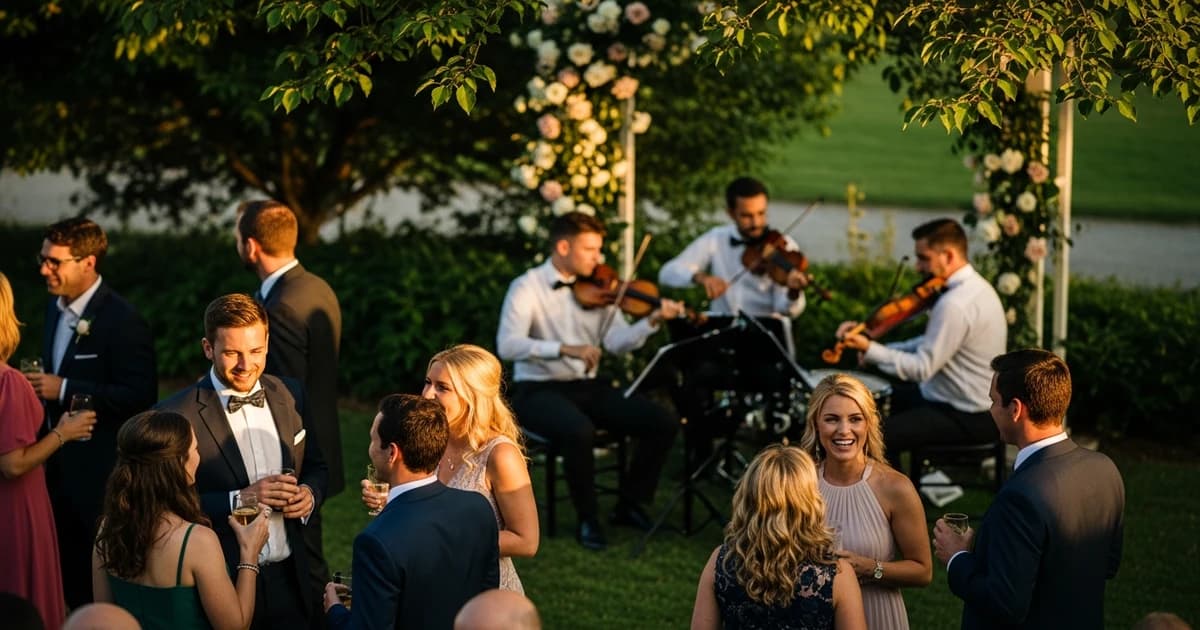
Two violins, viola, and cello. If the wedding has a classical feel, or the venue is a stately home, a manor house, or a church with a courtyard, a string quartet is almost unbeatable. They can move from Bach to string arrangements of Coldplay or Radiohead, which invariably surprises guests who are not expecting it.
The drawback is logistical: they need enough space for four music stands and four chairs, and the instruments are sensitive to humidity and extreme heat, which can be a real consideration for outdoor summer receptions.
Jazz trio or quartet
The format that consistently generates the most positive comments from guests after the wedding. Piano, double bass, and brushed drums, with or without saxophone or trumpet. Jazz has the quality of feeling sophisticated without being intimidating, and the moderate volume of brushed percussion means guests can hold a conversation without raising their voices.
One thing to check: for outdoor spaces or venues with poor acoustics, confirm that the group works with a high-quality electric piano, or that the venue has an acoustic piano available. Moving a grand piano to a wedding is possible but adds cost.
Cover band or pop-rock group
Five or six musicians, guitars, bass, drums, keys, and vocals. This is the most expensive format and the one that requires the most space and volume. It can work brilliantly at the drinks reception if the space is large and the couple wants that part of the day to already carry a party energy. The risk is that it overwhelms a smaller space, or feels mismatched if the majority of guests are older.
Pricing for a full band covering the drinks reception alone, not including an evening set, can range from around £1,800 to £4,000 or more.
What to actually budget
Prices vary considerably by format, but these approximate ranges provide a useful planning framework:
- Acoustic duo: £500 to £1,200
- String quartet: £1,000 to £2,200
- Jazz trio: £800 to £1,800
- Five or six-piece band: £1,800 to £4,000
These figures typically include travel within a reasonable radius, basic sound equipment, and a set of between 60 and 90 minutes. What is usually not included: travel beyond roughly 60 miles, accommodation for destination weddings, or a second set if the reception runs long.
When requesting a quote, always ask what happens if the drinks reception starts late because the photographs have overrun. Some acts charge for additional time from the first minute of delay; others include a 30-minute grace period.
All included
- Banquet venue
- Wedding Planner
- Marriage Paperwork
- Photographer
- Décor
- Flowers
- Master of Ceremonies
- Deejay
- Open Bar
What to ask before booking
Hearing the act in person is non-negotiable. No YouTube video replaces seeing them perform live, even at another event or in a small venue. If that is not possible, ask for a video recorded in real wedding conditions, not in a studio.
Beyond that, four specific questions are genuinely decisive:
What is your core repertoire, and can you add specific songs? Some acts charge for arranging new material; others include it if given sufficient notice.
What sound equipment do you bring, and how many guests is it set up for? A rig designed for 80 people does not perform the same way in a garden for 200.
Do you carry public liability insurance? This is not a minor detail. Many venues require it as a condition of the contract.
How do you handle breaks? A professional act has background music ready for any pauses. One that has not thought about it leaves awkward silences, and those are more noticeable than they might seem.
For more on how to plan the drinks reception as a whole, beyond the music, read the complete guide to the wedding drinks reception.
Jazz, pop, or classical: matching the musical style to the wedding
The musical style of the drinks reception does not need to mirror the ceremony or the evening dancing exactly, but there should be an internal logic. A ceremony with a string quartet followed by a rock band at the drinks reception can work beautifully if the couple has decided that is what they want and guests are expecting it. What feels jarring is accidental incoherence: the kind nobody consciously chose.
A simple way to think about it: the drinks reception is the transition. If the ceremony was intimate and understated, soft jazz or an acoustic duo maintains that register and allows the energy to build naturally towards the evening. If the ceremony was intensely emotional, a lighter and more upbeat repertoire at the drinks reception acts as a release.
For couples weighing up whether a DJ could serve the same purpose, here are the reasons to hire a DJ for your wedding and the moments when it makes more sense than live music.
Key logistics for the musicians
Musicians need to arrive well before guests do. A string quartet needs between 45 minutes and an hour to set up, tune, and run a sound check. A five-piece band may need up to two hours.
That means coordinating with the venue on early access and parking for vehicles carrying equipment, as well as a space where the musicians can leave their cases and have something to eat or drink while they wait. This sounds like a minor detail until the day itself, when the venue coordinator does not know that six people with instruments need to be let in two hours before guests arrive.
The practical solution is simple: include the setup schedule, venue access arrangements, and whether catering for the musicians is covered by the couple in the contract. For weddings running six hours or more, it is standard for the couple to provide this.
Hybrid options for drinks reception music
Some acts offer a hybrid format: 45 minutes of live performance at the start of the drinks reception, followed by a carefully curated playlist for the remainder of the time. The cost is lower than a full set and the result can be excellent if the playlist is well put together. It is particularly useful when the budget is stretched but the couple still wants the visual and sonic impact of live musicians in the room.
This article was reviewed by our editorial team. How we create our content
Frequently Asked Questions
Not sure which one suits you?
Try every silhouette on your own photo with Wedded's virtual try-on. The first 5 try-ons are free.


