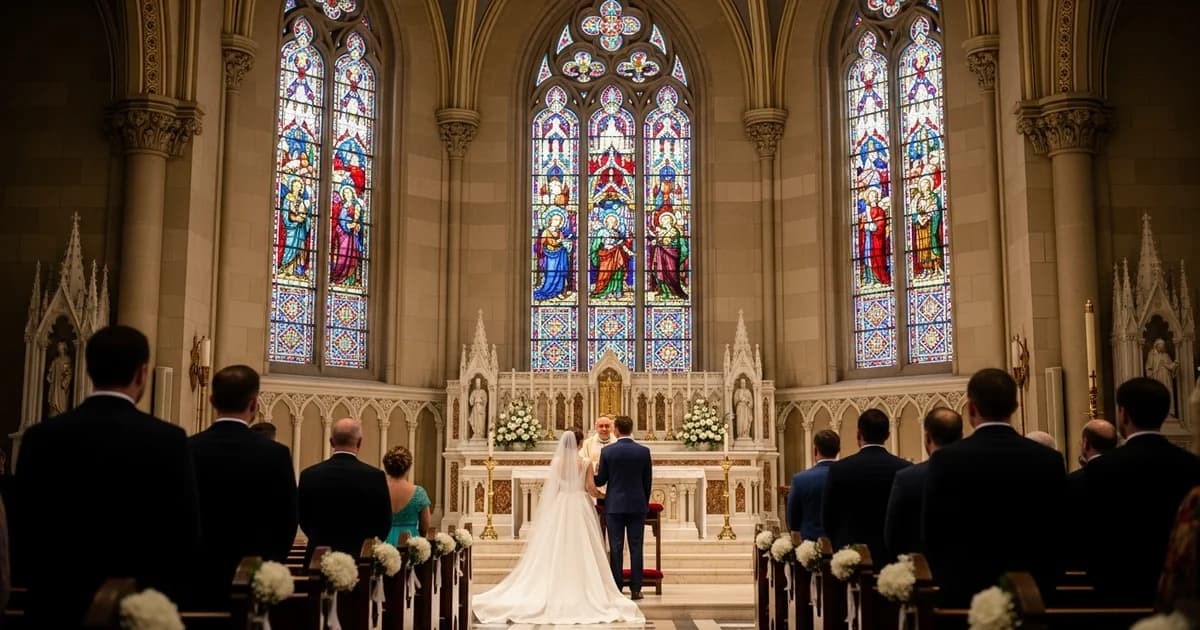
Church, chapel, cathedral or basilica: which suits your wedding?
Real differences between a church, chapel, cathedral and basilica for a Catholic wedding in Spain: requirements, cost, capacity and atmosphere.
Created with AI assistance and human review. Editorial standards
Key points / Puntos clave
- The parish church is the default canonical space: the paperwork is more straightforward, the timelines are shorter and the cost is generally under 400 euros (fees vary by diocese and this figure reflects what we have typically seen across several Spanish dioceses).
- Marrying in a chapel requires identifying who owns the building and verifying that it holds an active worship licence; you will also need to bring your own priest. Allow at least twelve months.
- Cathedrals require demonstrable diocesan ties. Depending on the diocese, use of the building can cost between 800 and 2,500 euros, and available dates are set by the bishop.
- "Minor basilica" is a papal honorary title. It does not correspond to a size category, and the title says nothing about capacity or canonical requirements. There are more than fifty recognised in Spain (according to the Spanish Episcopal Conference register) and each has its own rules for weddings.
- Acoustics, natural light and photography restrictions vary enormously from one church to the next: check them before you book your photographer.
Did you know that where you marry in a Catholic ceremony can have a huge impact on your paperwork, your budget and your overall experience? It is not just a question of aesthetics. Here is a clear breakdown of the real differences between a parish church, a chapel, a cathedral and a basilica, so that your decision is grounded in facts rather than Pinterest daydreams.
The parish church: the canonical default
The parish church is, canonically speaking, the natural place to marry. The Code of Canon Law establishes that the faithful marry in the parish of their domicile or quasi-domicile, or in that of the other party. This has one very practical consequence: if you want to marry in any other building, you need a licence from your own parish priest "delegating" competence to the priest at the chosen venue.
From a purely logistical point of view, the parish church is also the most accessible option. In most cases we have seen, processing the matrimonial file takes around three to four months when all the documentation is in order. Date availability tends to be greater than at cathedrals or basilicas, and the cost of using the building is, in most cases, a suggested donation that rarely exceeds 400 euros (though this varies by diocese, so always ask directly).
The parish church rarely offers architectural grandeur, however. If the space fits your vision of the day, it is absolutely worth considering. If it does not, the other options deserve a closer look, with all the conditions laid out clearly.
The chapel: intimacy with extra paperwork
Few scenes are more romantic than a bride crossing a wheat field towards a seventeenth-century stone chapel. The difficulty is that the image comes with administrative requirements worth knowing before you commit to it.
Ownership and worship licence
Chapels in Spain answer to a wide range of owners: religious brotherhoods, local councils, regional authorities or the diocese itself. The first step is identifying who manages the building and whether it holds an active worship licence. A chapel that only opens for the local patron saint's feast day cannot host a canonical marriage without a special authorisation from the bishop. Obtaining one is possible, but it adds weeks to the process (based on cases followed by our team, usually between two and four, though this depends on the diocese) and is not always granted.
The officiating priest
Chapels rarely have an assigned parish priest. That means you bring your own, which involves coordinating their availability and arranging the formal delegation of competence. If the chapel is in a remote rural location, travel costs are an additional practical detail that can complicate the day more than expected.
Why it can still be worth it
With all of that said: for couples looking for a ceremony of fewer than eighty guests, with an intimate atmosphere and a natural setting that no urban church can replicate, the chapel is genuinely in a league of its own. The key is to start the process at least twelve months before the date you have in mind.
The cathedral: grandeur on its own schedule
A cathedral is, above all, the seat of the diocesan bishop: a liturgical space in permanent use with a schedule that does not revolve around weddings. That defines everything else.
Most Spanish cathedrals do accept weddings, but on specific terms. Burgos Cathedral, Santiago de Compostela Cathedral and Seville Cathedral, to name three with publicly known policies, require that at least one of the couple has ties to the diocese that can be demonstrated, or that the matrimonial file is processed through the relevant episcopal vicariate. In some cases, the bishop reserves certain time slots for weddings and does not accept requests outside those windows.
The cost of using the building is considerably higher than at a parish church. Depending on the cathedral, it can range from 800 to 2,500 euros for use of the space alone (each diocese sets its own fees, so treat these figures as a rough guide), not including flowers, music or other services. Many cathedrals also have strict regulations on floral decoration: structures that might damage historic pews are not permitted, and the height of arrangements may be restricted to avoid any interference with the heritage interior.
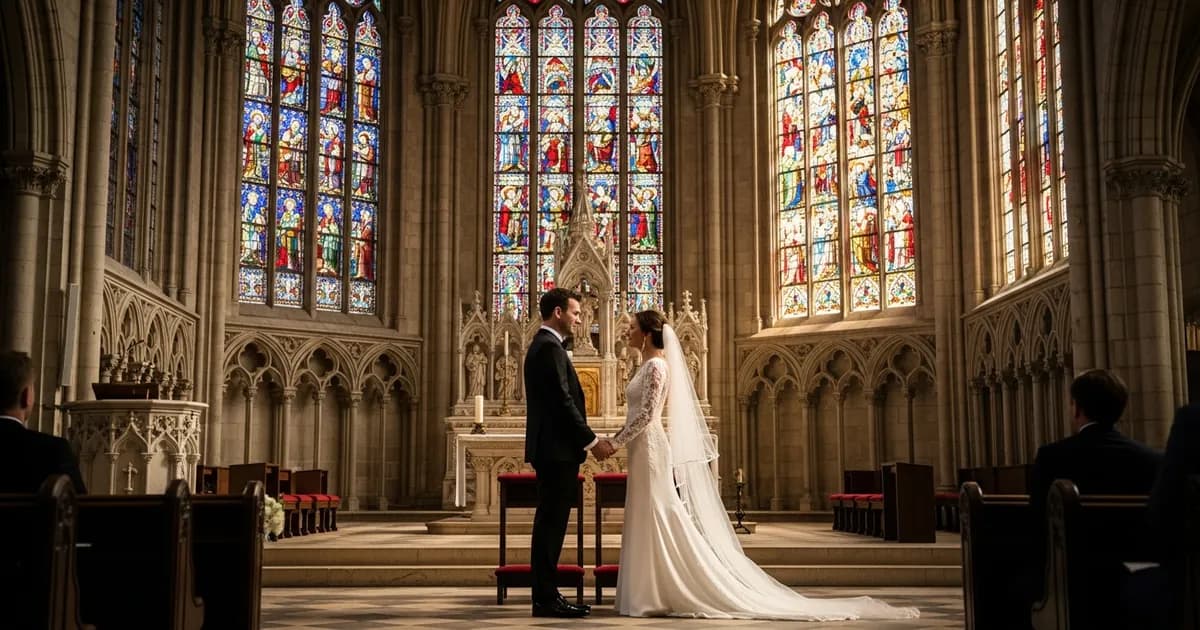
What a cathedral offers in return is hard to beat in terms of visual impact and acoustic quality. A Gothic cathedral with a working organ delivers a sonic experience that no speaker system can come close to reproducing. For weddings of more than two hundred guests who want a ceremony of genuinely monumental scale, it is the right space.
All included
- Banquet venue
- Wedding Planner
- Marriage Paperwork
- Photographer
- Décor
- Flowers
- Master of Ceremonies
- Deejay
- Open Bar
The minor basilica: the title that causes confusion
The word "basilica" generates more confusion than it should. A minor basilica is simply a church to which the Pope has granted an honorary title in recognition of its historical or devotional significance. The title says nothing about its size or its canonical requirements.
There are more than fifty recognised minor basilicas in Spain, according to the Spanish Episcopal Conference register, from the Basilica of Santa Maria del Mar in Barcelona to the Basilica of Covadonga in Asturias. Some are medium-sized parish churches; others are pilgrimage shrines with a highly formalised approach to liturgical events.
For a wedding, the relevant questions are whether the basilica has its own parish priest or depends on a religious community, and whether it accepts marriages for couples from outside. Many basilicas linked to religious orders (Franciscan, Dominican, Augustinian or Carmelite) have their own protocols and can be more flexible on dates and decoration than a diocesan cathedral. Others, particularly the great Marian shrines, have waiting lists of up to two years, so do not leave it late.
A practical comparison: what to expect from each space
| Aspect | Parish church | Chapel | Cathedral | Minor basilica |
|---|---|---|---|---|
| Core paperwork | Matrimonial file | File plus authorisation | File plus diocesan licence | Varies by ownership |
| Recommended minimum lead time | 6 months | 12 months | 12 to 18 months | 9 to 18 months |
| Use of building (rough guide) | Donation / up to 400 euros | Donation / up to 700 euros | 800 to 2,500 euros | 300 to 1,500 euros |
| Average capacity | 100 to 300 guests | 30 to 100 guests | 300 to 1,000 guests | 150 to 600 guests |
| Music regulations | Flexible | Very flexible | Strict | Variable |
All cost ranges are rough guides and can vary significantly depending on the diocese, the time of year and the specific conditions of each building.
The paperwork: the same at the core, with variations
Regardless of the building you choose, the heart of the matrimonial file is the same: recent baptismal certificates, a certificate of freedom to marry, a certificate of good standing and the banns. What changes is who processes it and to whom it is submitted.
At your own parish church, the parish priest handles it directly. At a cathedral or basilica in another diocese, the file is opened at your home parish and then forwarded to the vicariate of the place where the wedding will take place. That transfer adds time and, in some cases, administrative fees on top.
More detail on which documents you need and in what order to obtain them is available in documentation for a Catholic wedding.
Acoustics, light and photography: details that shape the result
There are three practical aspects that are often overlooked and that are well worth checking before you commit to any venue: acoustics, natural light and photography rules.
Acoustics. Large cathedrals and basilicas have long reverberation times, often of several
This article was reviewed by our editorial team. How we create our content
Frequently Asked Questions
Not sure which one suits you?
Try every silhouette on your own photo with Wedded's virtual try-on. The first 5 try-ons are free.