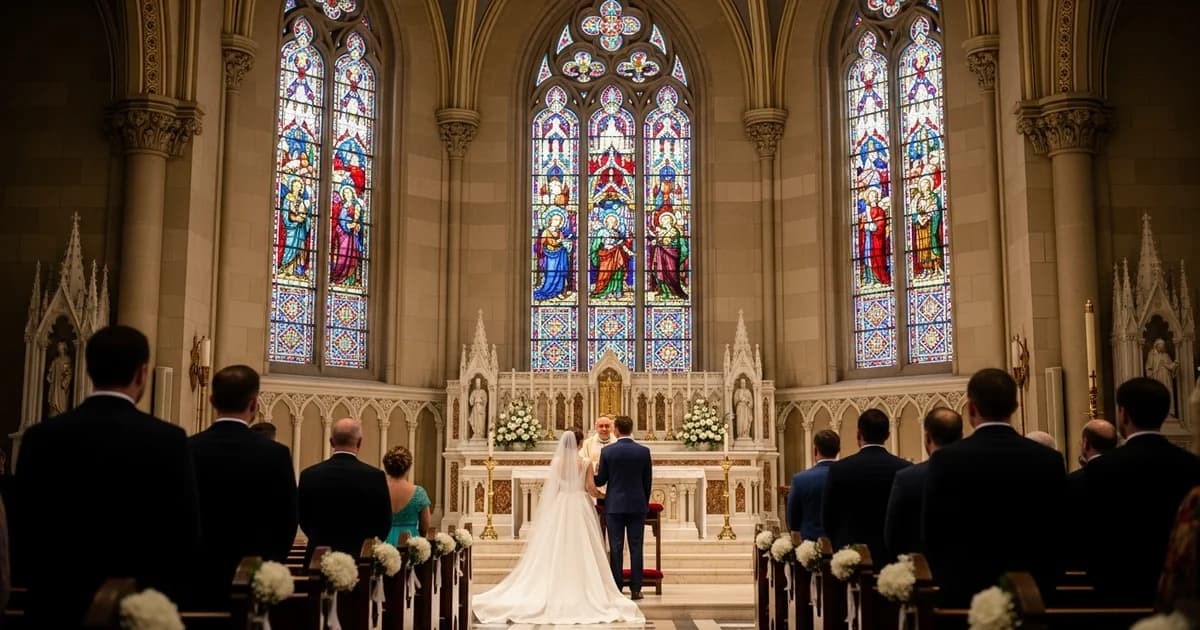
Civil wedding protocol: a complete step-by-step guide
Everything you need to know about civil wedding protocol: the order of the ceremony, who enters first, what witnesses do and how to organise the wedding party.
Created with AI assistance and human review. Editorial standards
Key points
- More than 70% of marriages in Spain are civil ceremonies (INE, 2023).
- The legally required protocol comes down to four steps: identification, reading of the Civil Code, exchange of consent and signing of the register.
- The order of the processional (who enters first and with whom) is a social convention with no legal force behind it.
- Witnesses only need to sign the register; any additional participation is entirely voluntary.
- Everything else is decided by the couple: the music, personal vows, the décor and any other elements they choose to include.
- The degree of personalisation available varies depending on the type of officiant. A notary offers considerably more flexibility than a first-instance court.
Each year, more than 70% of weddings in Spain are civil ceremonies, according to the INE's 2023 marriage statistics. Very few couples, however, know exactly what happens inside the room during those twenty to forty minutes: who speaks, in what order everything is signed, when readings can be added and what scope for personalisation genuinely exists. Here we walk through the complete civil wedding protocol, phase by phase, so that the day holds no surprises.
Before the ceremony: the preparation nobody sees
The protocol starts much earlier than most couples expect. Well before the entrance music plays, once the date has been confirmed with the registry office, the town hall or, where applicable, the notary, the couple must gather the required documentation: birth certificates, proof of address and, in some cases, a certificate of marital status. The full detail on this is in the article on documentation for a civil wedding.
With the paperwork in order, the next step is choosing the venue. A local register office, a town hall, a private venue with a travelling registrar or a notary's office each carry different implications. The duration, the capacity and the options for personalisation all vary depending on the setting. Each choice has its own practical considerations, and it is worth understanding them before making a booking. More than one couple has arrived at this stage assuming the registry office was simply "the quickest option," only to be caught off guard by the lead times involved.
The processional: who enters, in what order and with whom
The wedding processional at a civil ceremony is not governed by any fixed liturgy. There is, however, a structure that works well and that most officiants tend to expect.
The usual order
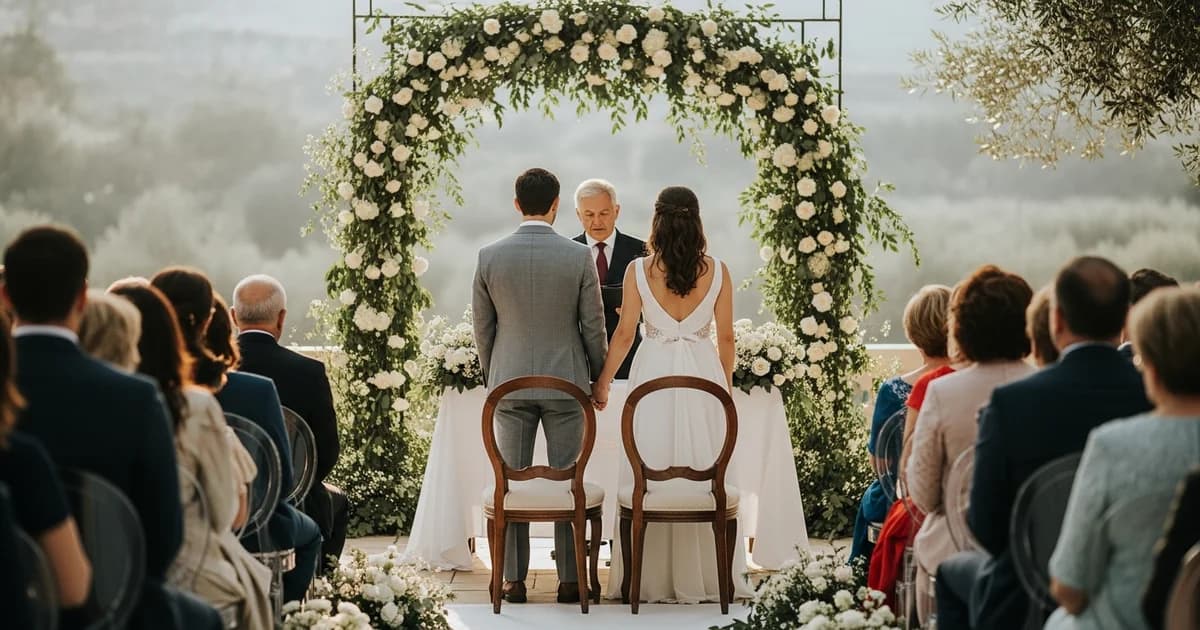
The most common approach in Spain is for the groom to enter the ceremony space first, accompanied by his mother or a close family member, and to take his position beside the officiant's table. The bride then enters, typically on the arm of her father, mother or another person of her choice. The witnesses take their places on either side of the couple.
No legal rule imposes this order. Same-sex couples, couples who prefer to enter together, and those who would rather dispense with a family escort are entirely free to do so without any additional formality. The processional protocol is a social convention that many families appreciate, though it can be set aside without any drama.
Bridesmaids and flower girls
Unlike Anglo-American tradition, bridesmaids do not form part of the official protocol of a civil ceremony in Spain. Their role is primarily one of logistical and emotional support throughout the day. If you want to include them in the processional, they can precede the bride in pairs or follow behind her. The same applies to flower girls: their moment is usually the carrying of the rings or the bouquets, and they do not have a fixed position during the ceremony itself.
The legal structure of the ceremony
Once everyone is in place, the officiant opens the proceedings. The legal framework runs as follows, and in this order:
Opening and identification. The registrar, mayor or notary declares the ceremony open, identifies the couple by their full names and confirms that the witnesses are present. This step has full legal validity and cannot be skipped.
Reading of the Civil Code. Articles 66, 67 and 68 of the Spanish Civil Code are read aloud. These set out the rights and duties of spouses: equality of rights, mutual respect and the shared interest of the family. The reading is mandatory and cannot be removed, though the officiant may contextualise it in their own words. Some officiants turn it into a genuinely moving moment; others dispatch it in ninety seconds. It is worth asking in advance how yours approaches it.
Personal moment (optional). Many officiants allow readings, poems or words from family and friends to be inserted at this point, along with any other element the couple wishes to include. This is the most flexible part of the entire ceremony.
Exchange of consent. The officiant asks each partner, separately, whether they accept the other as their spouse. The affirmative answer is the legal heart of the marriage. Without this moment, there is no valid wedding.
Exchange of arras and rings (optional). The arras are thirteen coins symbolising the willingness to share one's assets; the rings represent the commitment. Neither is legally required at a civil wedding, but both have become widely established custom.
Declaration of marriage. The officiant pronounces the couple legally married.
Signing of the marriage register. Both partners, both witnesses and the officiant all sign. This signature is the act that gives the marriage its legal standing in the register.
All included
- Banquet venue
- Wedding Planner
- Marriage Paperwork
- Photographer
- Décor
- Flowers
- Master of Ceremonies
- Deejay
- Open Bar
The witnesses: their actual role and the protocol
Witnesses at a civil wedding have a specific and clearly defined function: to confirm the identities of the couple and attest that the marriage has been conducted in accordance with the law. They must be adults in full possession of their faculties and must bring valid photo ID on the day of the ceremony.
More on their responsibilities and how to choose them is covered in the guide to wedding witnesses.
Witnesses are not required to do anything beyond signing the register. They make no vows and have no texts to read as part of the protocol. If the officiant invites them to share a reading, that gesture enriches the ceremony, but it falls entirely outside the legal act. In other words, if your best friend freezes at the microphone, nothing is invalidated.
Personalisation: how far can you go
Civil weddings have a reputation for feeling cold or impersonal, and it is easy to understand where that idea comes from. Many ceremonies take place under time pressure in registry offices with very little room to breathe. When the ceremony is held in a town hall with a dedicated room, at a private venue with a travelling registrar, or before a notary in a space chosen by the couple, the scope for personalisation is considerable.
Music
The entrance music, the signing music and the recessional can all be chosen freely. If the space allows, music can also be added during the exchange of arras, or you can even have live musicians. At registry offices, it is worth confirming with the responsible official whether there are any acoustic or time restrictions.
Readings and personal vows
The Civil Code does not prevent the couple from reading personal vows after the official exchange of consent. In fact, many officiants actively encourage it. The vows must complement the legal consent question rather than replace it.
Decorating the space
In a registry office or town hall chamber, the options for decoration are limited. At a private venue, the couple can transform the space entirely: floral arches, a runner, lighting, the arrangement of the guests. The protocol has nothing to say about aesthetics; that is entirely the couple's territory, along with whoever is helping them plan the day.
Differences depending on the type of officiant
Getting married before a first-instance judge, a local registrar or a notary are three quite different experiences. The differences affect the tone and the time available, but above all they affect the real flexibility of the ceremony.
A first-instance judge tends to preside over weddings at the court with a more formal protocol and tighter timings. A local registrar, particularly in smaller towns, tends to be warmer and more accommodating. A notary offers the greatest freedom of venue and personalisation, though this comes with an additional cost.
You can compare these three options in detail in the article on civil weddings at a registry office, town hall or notary.
The recessional and what comes next
The couple's exit marks the end of the civil ceremony and the beginning of the celebration. The usual protocol is for the couple to leave first, followed by the witnesses and then the guests.
This article was reviewed by our editorial team. How we create our content
Frequently Asked Questions
Not sure which one suits you?
Try every silhouette on your own photo with Wedded's virtual try-on. The first 5 try-ons are free.