How Long Does a Wedding Last? Real Timings by Stage
How long does a wedding last in Spain: civil ceremony (15-30 min), Catholic (45-75 min), cocktail hour (90-120 min), reception (4-5 h), total 7-11 h depending on type.
Created with AI assistance and human review. Editorial standards

There is a short answer and a long one. The short answer: between 7 and 11 hours. The long answer is what turns that number into something you can actually plan around.
| Stage | Typical duration |
|---|---|
| Civil ceremony | 15-30 min (up to 60 min with personalisation) |
| Catholic ceremony | 45-75 min (full nuptial mass: 60-75 min) |
| Cocktail hour | 90-120 min |
| Wedding reception | 4-5 h (up to 6 h with extended open bar) |
| Total civil wedding | ~7-8 h |
| Total religious wedding | ~9-11 h |
These are the ranges that event coordinators in Spain work with. But the numbers on their own say very little unless you understand what stretches or compresses each stage.
The civil ceremony: shorter than you think, longer than it looks
Fifteen minutes. That is all the strict legal protocol of a civil wedding actually requires when it takes place at a first-instance court: identification of the couple, reading of articles 66, 67 and 68 of the Civil Code, exchange of consent and signing of the register. The total running time sits between 20 and 30 minutes because every officiant needs a little breathing room between steps.
When the ceremony moves to a private venue with a visiting justice of the peace or notary, the dynamic changes. The couple has real time to work with and almost always uses it: family readings, handwritten personal vows, live music during the entrance. In those cases, 40-60 minutes is the norm. Some ceremonies reach 75 minutes, though beyond that point guests begin to feel the time passing.
The most common start times in Spain are 12:00-13:00 for a lunchtime wedding, or 18:00-19:30 for an evening one.
For the exact sequence of each moment in the ceremony, who does what and how much genuine freedom you have to personalise it, the civil wedding protocol guide breaks it down phase by phase.
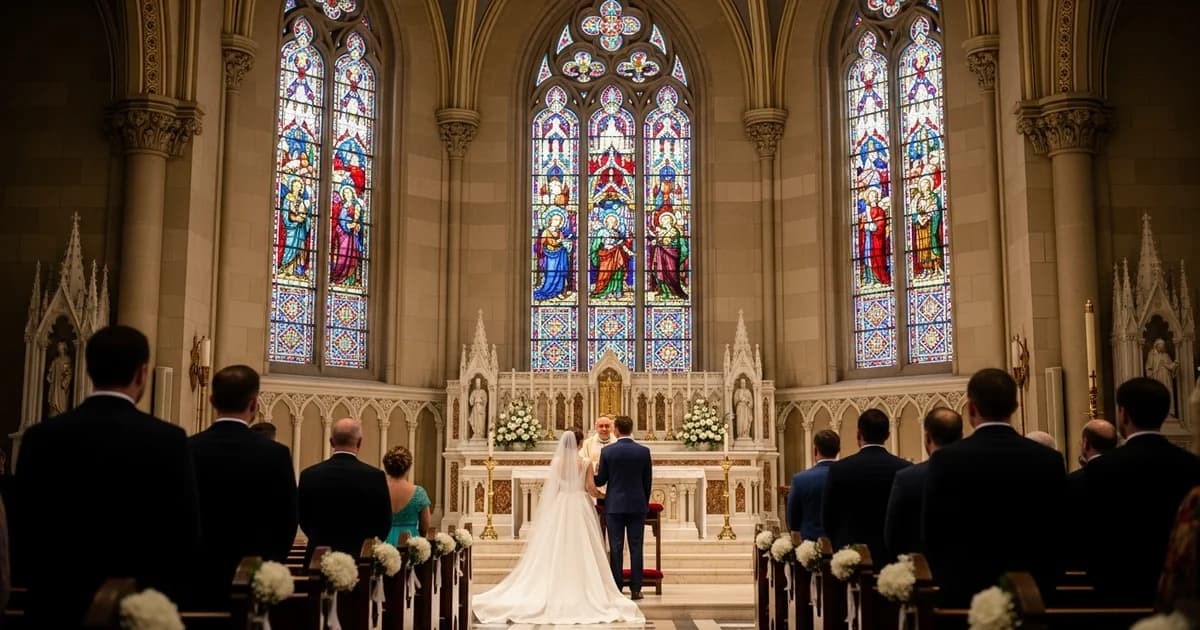
The Catholic ceremony: a structure that does not bend
A full nuptial mass runs 60-75 minutes. Without the mass, just the wedding rite, it comes down to 45-50 minutes. That twenty-minute difference seems modest but shows up in the cocktail hour planning.
The internal structure runs as follows:
- Processional: 5-10 minutes
- Liturgy of the Word (readings and homily): 15-20 minutes
- Rite of Marriage (consent, rings, coins): 10-15 minutes
- Eucharistic Liturgy (communion): 15-20 minutes
- Final blessing and recessional: 5-10 minutes
With a choir or a soloist, the musical moments add another 10-15 minutes without anyone consciously deciding to lengthen things. Cathedrals and larger venues tend to have slower transitions between movements, which also adds time.
One detail that disappears from almost every wedding timeline: the rehearsal. It usually takes place the day before and runs 30-60 minutes. It does not count towards the wedding day itself, but it does need to be in the diary for the week.
If you are still weighing the civil versus religious question, the civil vs religious wedding comparison covers requirements, timelines and costs for both options. And if the church is already decided and you want to understand every moment of the day itself, the Catholic wedding protocol guide takes you from the processional to the recessional.
The cocktail hour: the stage that holds everything together
Ninety minutes is the sensible minimum. With more than 80 guests, it is really the lower bound. A 60-minute cocktail with 120 people tends to feel rushed: appetiser stations take time to circulate, groups take time to form and the couple needs that buffer to spend time with the photographer without vanishing from their own party entirely.
With 150 or more guests, 120 minutes is standard practice.
The cocktail hour serves a logistical function that does not always get named plainly enough: it absorbs the ceremony delay (which almost always exists) and gives the couple time for portraits while guests eat. When the photo location is away from the cocktail space, that journey is built into the cocktail hour whether you plan for it or not.
The wedding cocktail reception guide covers how to structure the appetiser stations, which flow works best and how to schedule the portrait session so the couple does not lose the entire cocktail hour.
The reception: where the afternoon disappears
Four to five hours. Often more. The reception is by far the longest stage of the day, and its actual duration depends on a variable most couples forget to ask when booking a venue: the kitchen-to-cover ratio.
A kitchen designed for 100 covers managing 180 guests will inevitably stretch the time between courses. Not because the service is poor, but because a kitchen does not scale linearly. It is worth asking directly before signing the contract.
The standard Spanish reception structure:
- Seated appetisers and settling in: 30-45 minutes
- First course: 25-35 minutes
- Second course: 30-40 minutes
- Speeches and toasts: 15-30 minutes, depending on how many people take the microphone
- Cake cutting and dessert: 30-45 minutes
- Dancing, entertainment and open bar: 60-90 minutes minimum
Speeches are the hardest element to control. When there is no agreed time limit and several relatives want to speak, 15 minutes becomes 45 without anyone noticing. That is not a protocol problem; it is a coordination problem best solved before the day.
For the financial side, the article on wedding cost per guest in Spain provides current price ranges by region and menu type.
All included
- Banquet venue
- Wedding Planner
- Marriage Paperwork
- Photographer
- Décor
- Flowers
- Master of Ceremonies
- Deejay
- Open Bar
The end time: counting backwards
The finish time does not depend on what the couple wants. It depends on when the ceremony starts.
Lunchtime wedding (ceremony between 12:00 and 13:00): the reception begins between 14:30 and 15:30. With 4-5 hours of celebration, the evening winds down between 19:00 and 22:00. This format is most common at large family weddings with guests of different generations.
Evening wedding (ceremony between 18:00 and 19:30): the cocktail hour ends around 21:00 and the reception gets underway at 22:00. With 5-6 hours of celebration, the close comes between 1:00 and 3:00 in the morning. This is the preferred format for summer weddings where the midday heat is a practical concern.
There is one element that sets a ceiling on all of this regardless of the couple's plans: local noise ordinances. Many Spanish municipalities impose a limit of 23:00 or midnight for amplified music at outdoor events. Venues with a special permit can extend that; it is something to check in the contract, not on the wedding day itself.
The daytime vs evening wedding guide looks at both formats from the point of view of light, cost and the real experience for guests.
What no timeline ever includes
This is where most couples get caught out. There are stages that take real time on the wedding day and appear in almost no planning document.
The ceremony delay. Few Spanish weddings start exactly on time. A 15-20 minute delay is statistically normal. A 30-40 minute delay is not unusual when waiting for late family members or when getting the bride out of the house takes longer than planned. That delay cascades through every stage that follows.
The couple portraits. Depending on the photographer and what has been agreed, the portrait session can run 45-90 minutes. If the chosen backdrop is away from the cocktail space, add the travel time too.
The transfer between venues. If the ceremony and reception are in different places, account for organising the departure, the journey and the arrival. With a guest shuttle, coordinating the boarding alone can take 20-30 minutes.
The receiving line. At weddings with more than 100 guests, greeting everyone individually can take 30-60 minutes if it happens in one concentrated block. Many couples spread it across the reception entrance and the gaps between courses. That tends to work better.
Conclusión
A wedding timeline is not a sum of durations; it is a chain where every delay pushes the next one forward. A 25-minute civil ceremony at the registry office, a 90-minute cocktail hour and a 4-hour reception give a theoretical total of just under 6 hours. With transfers, portraits and the buffer that real-world logistics always consume, that becomes 8. That is not a problem. That is a wedding working the way it is supposed to.
What changes when you understand this upfront is the mindset. When the couple knows the cocktail hour needs 120 minutes and not 60, they stop rushing. When they know the ceremony will likely run 20 minutes late, they stop feeling behind. The most honest timeline is the one that already includes the margin rather than the one that discovers it on the day.
Related Reading
- Civil vs religious wedding: key differences in timelines, costs and protocol
- Civil wedding protocol: order, witnesses and personalisation
- Catholic wedding protocol: from the processional to the recessional
- Wedding cocktail reception: how to organise it so it actually works
- Daytime or evening wedding: which format suits your wedding best
This article was reviewed by our editorial team. How we create our content
Frequently Asked Questions
Not sure which one suits you?
Try every silhouette on your own photo with Wedded's virtual try-on. The first 5 try-ons are free.