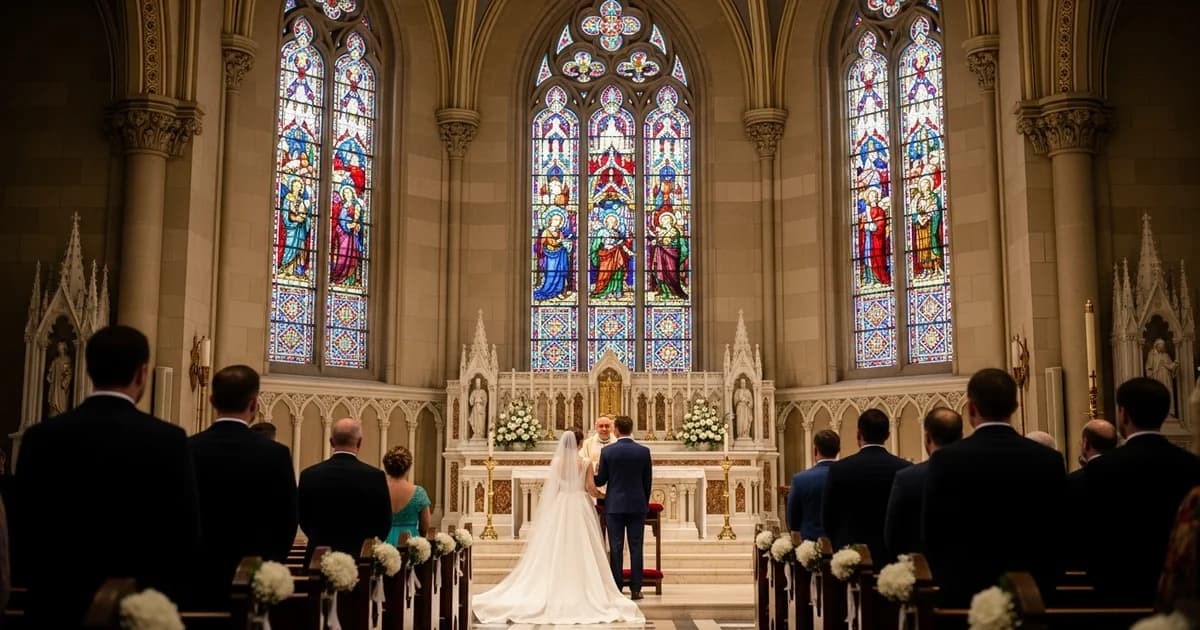
Orchestra at Your Wedding Ceremony: Cost, Format, Repertoire
String quartet or full ensemble? What live ceremony music actually costs, which format fits your space, and the contract clauses that protect you if things go wrong.
Created with AI assistance and human review. Editorial standards

Few decisions in the ceremony planning process carry as much sensory impact as live music, and few are left as late. By the time couples think seriously about it, the venue, caterer and photographer are already signed, and the best ensembles are already committed elsewhere.
The word "orchestra" in a wedding context covers a wide range. It can mean a violin-and-guitar duo playing softly as guests take their seats, or a ten-piece chamber group filling a cathedral nave. The format that makes sense for your ceremony depends primarily on the size and acoustics of the space, and secondarily on budget. Below, we look at what the main formats actually are, what repertoire works at each moment in the ceremony, what things cost, and what a contract needs to include so you are protected.
The formats: what you are actually hiring
String quartet
Two violins, viola and cello. This is the industry standard for a reason. A quartet produces sufficient volume for venues of up to about 200 guests without any amplification, which matters both for sound quality and for the logistics of setting up in a church or historic estate. The repertoire available is essentially unlimited: every major classical piece has a quartet arrangement, and most contemporary songs that couples want have been arranged as well.
In major Spanish cities, a full-ceremony quartet (prelude, entrance, ceremony, signing and exit) costs between 1,200 and 2,500 euros. Outside the capitals, prices are meaningfully lower. That range assumes travel within about 50 km is included; beyond that distance, most groups add a mileage charge.
The setup footprint is modest, roughly 3 by 2 metres. That said, placement matters: the ensemble needs to be positioned where sound projects well without blocking the processional path.
Duo or trio
A violin-and-piano duo, or violin and classical guitar, is the most common alternative when the quartet budget is not available. It works particularly well in intimate spaces with fewer than 80 guests, and in venues where the architecture produces a lot of reverb, since fewer instruments often means more clarity. A duo runs between 400 and 900 euros; a trio between 700 and 1,400.
Wind instruments
A woodwind or brass option gives the ceremony a completely different character. A brass quintet (two trumpets, horn, trombone and tuba) suits outdoor ceremonies and monumental spaces with classical or formal wedding styles. Flute and harp is less common but extraordinarily delicate in the right setting. Both options require more logistical coordination than strings, particularly for outdoor events where weather affects tuning.
Piano solo
Where the venue has a quality instrument on-site, a solo pianist can handle the entire ceremony with considerable range. The problem is that few venues own a grand piano, and renting and tuning one for an outdoor event is expensive and complicated. Worth investigating if the space has one; rarely worth importing if not.
Repertoire: the four moments that matter
A ceremony typically has four distinct musical blocks, each with a different function.
The prelude runs while guests arrive and take their seats, lasting anywhere from 20 to 40 minutes. This is the most flexible slot. Baroque pieces, instrumental versions of contemporary songs, film soundtracks: almost anything works here, because the music is ambient rather than focal. It sets tone without demanding attention.
The entrance carries the highest symbolic weight. The traditional options are Mendelssohn's Wedding March and Wagner's Bridal Chorus, but many couples today choose instrumental versions of songs with specific personal meaning: "Can't Help Falling in Love" and "A Thousand Years" by Christina Perri are consistently among the most requested. Pieces by Hans Zimmer have become more common over the past several years, and when the space suits them, they work very well.
During the ceremony itself, music functions as background during readings or while wedding rings are exchanged. The musicians play quietly and need to follow cues from the officiant, which is worth discussing in advance so there is a clear system for when to adjust volume.
The exit calls for energy. Mendelssohn's Wedding March is the historical favourite, but "Signed, Sealed, Delivered" and "Here Comes the Sun" in quartet arrangement both generate a more festive atmosphere and work equally well. This is the moment most guests remember, so it is worth being deliberate about it.
For Catholic wedding ceremonies, the repertoire operates under additional restrictions that vary by parish and diocese, and it is essential to confirm approved pieces with the priest before committing anything to the musicians.
Civil versus religious ceremonies: the practical difference
In a civil ceremony, there are no liturgical constraints on repertoire. The civil officiant almost never imposes conditions on the music, which opens up more personal and experimental choices: video game soundtracks, jazz standards, anything that has meaning for the couple.
In a religious ceremony, the situation depends heavily on the individual parish. Some Spanish parishes allow instrumental arrangements of contemporary songs, provided the original lyrics are not profane in spirit; others apply much stricter criteria. If you are having a civil or religious ceremony and have not yet decided, the musical freedom question is worth factoring in alongside the paperwork and timeline differences.
The rule is always the same: agree the programme with the priest before signing anything with the musicians.
What to write into the contract
Hiring musicians without a written contract is the most common mistake couples make in this area, and also the one that tends to be most expensive when something goes wrong.
The contract should specify the full names of the musicians who will actually perform. Some ensembles send substitutes on the day without warning, which is both common and frustrating for couples who selected a group based on seeing them play. If you want the musicians you auditioned, their names need to be in writing.
The agreed repertoire should be listed, with a note of which pieces are fixed and which are options, and whether any arrangements that need to be learned specifically for you carry an additional cost.
The setup and teardown schedule should be explicit. String instruments are sensitive to temperature changes, particularly outdoors, and musicians typically need at least 45 minutes to set up and tune before the ceremony begins.
For outdoor ceremonies, a contingency plan for adverse weather is not optional. Humidity and heat affect string instruments significantly. Any professional ensemble will have a backup arrangement; if a group does not raise this point proactively, that is worth noting.
Cancellation terms in both directions should be clear: what you owe if you cancel within 30 days, and what the ensemble commits to if they cancel, including whether they cover finding a replacement.
All included
- Banquet venue
- Wedding Planner
- Marriage Paperwork
- Photographer
- Décor
- Flowers
- Master of Ceremonies
- Deejay
- Open Bar
The transition to the drinks reception
This is consistently underplanned. After the ceremony, guests move and congratulate the couple while photographers work, a process that easily runs 20 to 30 minutes. If the ceremony ensemble finishes and the drinks reception entertainment has not started, that gap is audible and awkward.
Two solutions work well. One is negotiating with the ceremony ensemble to move to the drinks reception space and play for the first 30 minutes: this extends their booking but eliminates the gap entirely. The other is having a carefully curated playlist ready to run automatically from the moment the ceremony concludes.
For what actually works well during the drinks reception itself, there is more detail in the live music for the wedding drinks reception guide.
When to book
The best ensembles, meaning those with real video of live performances (not studio demos) and strong references from other couples, fill their peak-season calendar 10 to 14 months out. Peak season in Spain runs from May to October and accounts for the majority of weddings. For low-season or weekday dates, six months is usually enough time.
Finding the right group through a direct referral from another couple or a wedding coordinator remains the most reliable method. Watching a real-performance video rather than a studio recording tells you far more: you see how the musicians handle the unexpected moments, how they communicate with each other when something does not go to plan.
Before committing, ask for a brief call or video meeting. A group that does not have 20 minutes to speak with you before you sign will not have more time on the day of the wedding if something needs adjusting.
Conclusion
The ceremony ensemble is the one musical memory that does not blur into the general noise of the day. Guests remember exactly what was playing when the doors opened. Getting the format right, choosing musicians you have actually heard play, and protecting yourself with a proper contract are all steps that take time but none of them are complicated. Where most couples lose ground is in leaving this decision until the venue and other suppliers are settled. The ensembles worth hiring are booked long before that point. Start earlier than feels necessary.
Related Reading
- What music is permitted in a Catholic ceremony and why: Catholic wedding music guide
- How civil and religious ceremonies differ on paperwork, costs and timelines: civil vs religious wedding
- Live music options for the drinks reception after the ceremony: live music for the wedding drinks reception
- The rings, the arras and what each moment in the ceremony actually means: wedding rings and arras
This article was reviewed by our editorial team. How we create our content
Frequently Asked Questions
Not sure which one suits you?
Try every silhouette on your own photo with Wedded's virtual try-on. The first 5 try-ons are free.