Orchestra at a wedding ceremony: the complete guide
Hiring an orchestra for your wedding ceremony transforms the moment. We cover repertoire, formats, pricing and everything you need to know before you decide.
Created with AI assistance and human review. Editorial standards
Key points
- A string quartet is the standard format for ceremonies of up to 200 guests: it needs no amplification and the available repertoire is virtually limitless.
- Ballpark pricing ranges from £350 to £800 for a duo up to £1,600 to £3,000 for a quintet or ensemble, with travel included within a 50-mile radius.
- The most sought-after ensembles book up 10 to 14 months in advance during peak season (May to October).
- Your contract must specify the names of the musicians, the agreed repertoire, the setup schedule and a contingency plan for adverse weather.
- For religious ceremonies, check with your officiant before finalising the repertoire: every diocese has its own guidelines.
There are weddings where the silence between the "I do" and the first round of applause lasts barely a second yet feels like forever. Other times, a string quartet fills that instant with something no playlist can replicate: the physical presence of musicians, that quality of shared breath and tuning that no algorithm can imitate. Live music at the ceremony can transform how that moment is remembered, yet it is often planned late, once the photographer, catering and venue are already locked in.
In this article we walk through the most common formats, what repertoire works at each point in the ceremony, what it costs and which clauses must appear in the contract.
Which ensemble format suits your ceremony
The word "orchestra" in the context of a wedding covers everything from a violin and piano duo to a ten-piece ensemble. The right format depends primarily on the capacity and acoustics of the space, and secondarily on the available budget.
String quartet
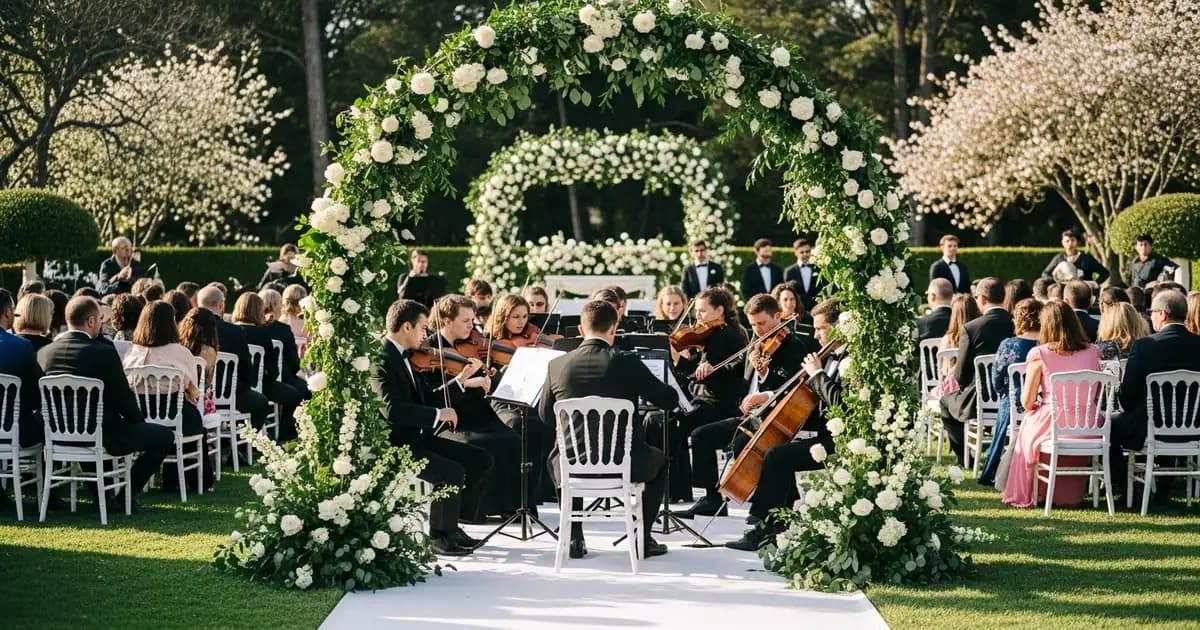
This is the industry benchmark, and for good reason. Two violins, viola and cello generate enough volume for spaces of up to 200 guests without amplification, and the available repertoire is virtually limitless (from Bach to Coldplay, almost any piece has an arrangement for string quartet). They also set up discreetly without requiring dedicated staging.
The only real drawback is the price: in major cities it typically ranges from £1,000 to £2,500 for a full ceremony (prelude, processional, signing and recessional). Outside of capital cities, prices drop noticeably.
Duo or trio
A violin and classical guitar duo, or violin and piano, is the most common option when the budget does not stretch to a quartet. It works particularly well in intimate spaces with smaller guest counts, typically below 80 people, and at civil ceremonies in smaller venues where a more delicate sound is an asset. In interiors with a lot of reverb, fewer instruments usually means greater clarity.
Woodwind or brass
A flute, oboe or brass quintet brings an entirely different colour. Brass (trumpet and trombone, for instance, or a full section with French horn) works especially well outdoors and lends a ceremonial quality that suits more traditional weddings or grand architectural settings. Flute and harp is a less common combination but one of extraordinary delicacy.
Solo piano
If the venue has a quality grand or upright piano, a pianist can cover the entire ceremony with great effect. The challenge is logistical: few venues own their own instrument, and hiring and tuning a grand piano for an outdoor event is both expensive and complicated.
Repertoire: the three moments that define ceremony music
A typical ceremony has four distinct musical sections, each with a different purpose.
The prelude is the music playing as guests take their seats. It can last anywhere from 20 to 40 minutes. Almost anything works here: Baroque pieces, instrumental versions of pop songs, film scores. The aim is to set the atmosphere without drawing attention.
The processional (the entrance of the bride, groom or couple, depending on the ceremony format) carries the greatest symbolic weight. The classic choices are Mendelssohn's Wedding March or Wagner's Bridal Chorus, but in recent years many couples have opted for instrumental versions of songs with personal significance. "Can't Help Falling in Love" by Elvis and "A Thousand Years" by Christina Perri are among the most requested. Some couples choose film score pieces, particularly by Hans Zimmer, with results that work beautifully when the setting supports it.
During the ceremony, if there are readings or the exchange of rings, musicians typically play softly in the background. The best approach is to agree with them in advance on a signal to raise or lower the volume in line with the officiant's timing.
The recessional calls for energy. Mendelssohn's Wedding March is the perennial favourite, though "Signed, Sealed, Delivered" by Stevie Wonder or "Here Comes the Sun" by The Beatles in a string quartet arrangement create a more joyful atmosphere and work just as well.
For religious ceremonies, repertoire comes with additional considerations. For a full breakdown, see our guide to music for a church wedding.
Ballpark pricing and what it includes
The ranges below are our own estimates based on rates listed on specialist platforms such as Bark.com and Alive Network, as well as the published pricing pages of active ensembles based in London, Manchester and Edinburgh, consulted during the first half of 2025. There is no official updated industry study, so treat these as a starting point and always request a personalised quote.
| Format | Average duration | Ballpark price |
|---|---|---|
| Duo | 1 to 1.5 hours | £350 to £800 |
| Trio | 1 to 1.5 hours | £600 to £1,200 |
| String quartet | 1.5 to 2 hours | £1,000 to £2,500 |
| Quintet or ensemble | 1.5 to 2 hours | £1,600 to £3,000 |
These prices typically include travel within a 50-mile radius. Beyond that distance, most ensembles charge mileage or a travel supplement. Always ask whether the price includes rehearsal time for any bespoke arrangements: some groups charge extra to learn a specific piece.
What must appear in the contract
Booking musicians without a written contract is the most common mistake couples make, and also the most costly when something goes wrong. These are the points that cannot be missing.
Full names of the musicians who will perform. Some ensembles send substitutes without notice; if you want the group you heard in the showreel, insist it is stated in writing.
Agreed repertoire with a clear note of which pieces are confirmed and which are optional. If any song requires a bespoke arrangement, it must be clear who is responsible for it and whether there is an additional cost.
Setup and breakdown schedule. Musicians need time to arrive and tune up, especially outdoors where temperature affects string instruments. Allow at least 45 minutes for setup before the ceremony begins.
Contingency plan for adverse weather. As mentioned in the FAQs: for outdoor weddings this is non-negotiable.
Cancellation terms for both parties. If the wedding is cancelled fewer than 30 days before the date, it is reasonable for the ensemble to retain a portion of the deposit. If they cancel, they must commit to finding a replacement or returning the full payment.
The transition between ceremony and drinks reception
An often overlooked detail: the musical transition between the ceremony and the drinks reception can easily stretch to 20 or 30 minutes, during which guests are moving around, congratulating the couple and photographers are working. If the ceremony ensemble finishes and the drinks reception entertainment has not yet started, the gap can feel oddly flat.
There are two common solutions. The first is to negotiate with the ceremony ensemble to move to the drinks reception space and play for the first 30 minutes. The second is to have a carefully curated playlist ready to begin automatically as the ceremony ends.
For guidance on what music works best during the drinks reception, see our guide to live music for the wedding drinks reception.
Civil vs. religious ceremonies: practical differences
At a civil ceremony, repertoire is entirely unrestricted. There are no liturgical constraints, and a civil celebrant rarely imposes conditions on the music. This opens the door to more personal and unexpected choices: video game soundtracks, film scores
This article was reviewed by our editorial team. How we create our content
Frequently Asked Questions
Planning your wedding?
Download Wedded and organize all the details of your wedding with the help of AI.
Download on Google Play