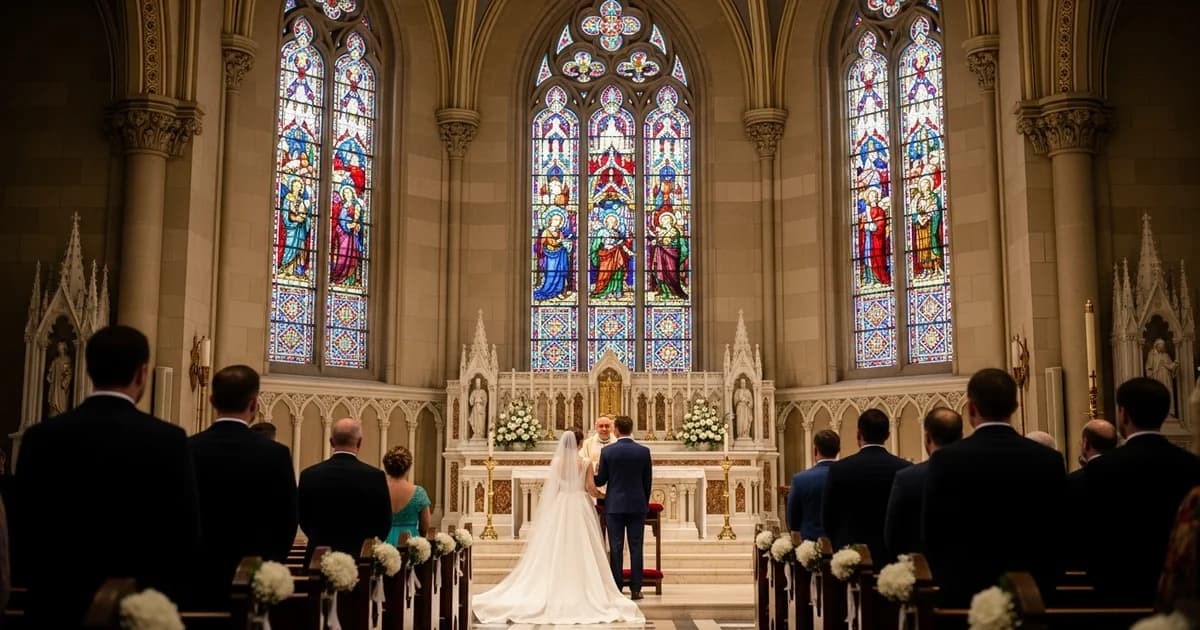
Civil wedding: courthouse, town hall or notary
Getting married civilly in Spain: courthouse, town hall or notary. Differences in cost, timelines and protocol so you can choose with confidence.
Created with AI assistance and human review. Editorial standards
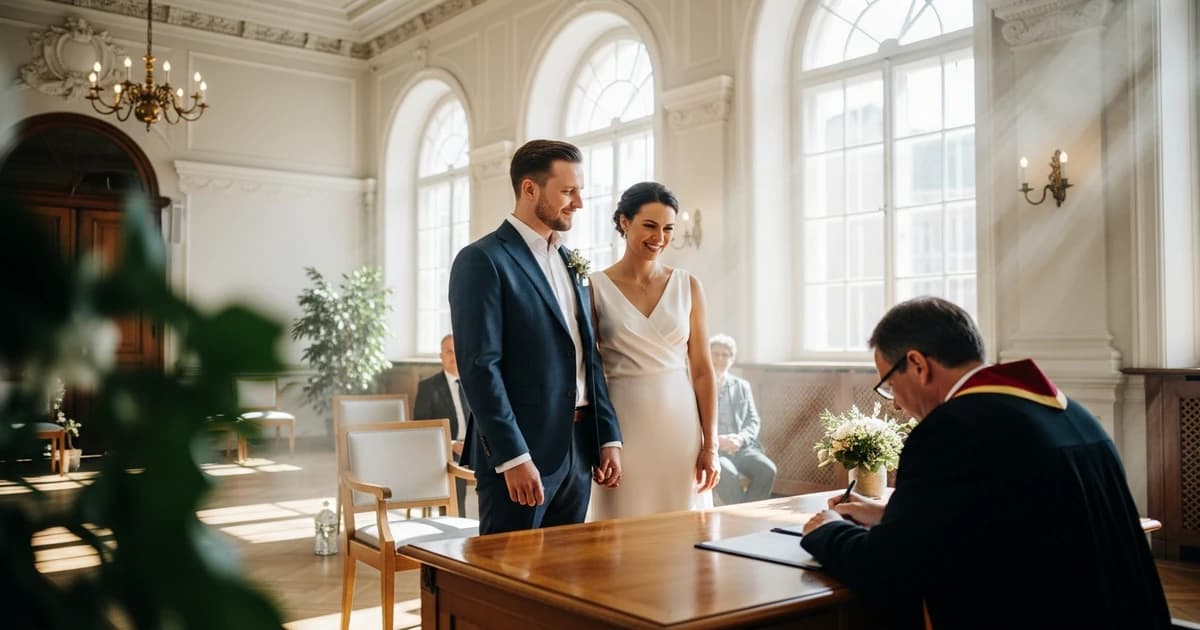
The same legal outcome, three very different paths to reach it. Getting married civilly in Spain can be done at the courthouse, the town hall or before a notary, and the difference between one option and another goes far beyond price: it affects the kind of ceremony you can have, the timelines involved and how much paperwork falls on your shoulders. Here is a clear-eyed look at the real differences between the three routes: timelines, costs, protocol and what kind of ceremony each one actually allows.
Key points (TL;DR)
- Three legal routes: courthouse, town hall or notary. The legal outcome is identical; the experience and the cost change considerably depending on which you choose.
- The prior marriage file is compulsory in every case. The realistic minimum timeline, once all documentation has been submitted, tends to be around three months (longer if foreign documents are involved).
- The courthouse is free, though the ceremony is functional and offers very little room for personalisation.
- The town hall is the most popular option: it allows you to personalise vows and readings, and the cost varies widely by municipality, from nothing to €600.
- The notary offers greater flexibility with scheduling and allows you to finalise both the marriage and the matrimonial property regime in a single appointment; the regulated fee sits between €200 and €350.
- During peak season (May to October), in-demand town halls book up as much as a year in advance.
- After the ceremony, the marriage must be registered at the Civil Registry before you can obtain the official marriage certificate.
The prior marriage file: a compulsory requirement
Before we talk about municipal halls or notary offices, one thing needs to be clear from the outset: regardless of where you plan to marry, you need to open a prior marriage file. This procedure, governed by Law 15/2015 on Voluntary Jurisdiction, certifies that there is no legal impediment to the marriage.
Since 2015, the file can be opened at the Civil Registry, before a notary or before a court clerk. The realistic minimum timeline, once all documentation has been submitted, is typically three months, though it can extend further if foreign documents are involved or any complications arise. I cover the basic documentation you will need here: documentation for a civil wedding in Spain.
Without the resolution or deed that closes that file, no official or notary can conduct the ceremony. It is the first milestone in your planning calendar and, in many cases, the one that accumulates the most delays.
Getting married at the courthouse: the most stripped-back option
When people picture a civil wedding with a certain no-frills quality, they are usually thinking of the courthouse. Until the 2015 reform, it was practically the only civil route available. It remains entirely valid today and, above all, free.
First Instance Court or Justice of the Peace
In smaller municipalities, the Justice of the Peace handles the ceremony. In provincial capitals or mid-sized cities, it falls to the First Instance Court or the Civil Registry. The judge or court clerk officiates in the room designated for the purpose.
The space is exactly what it sounds like: functional, without any particular decoration and with very limited capacity. The ceremony lasts between ten and twenty minutes. There is no real scope to personalise the wording beyond what the official form prescribes. If your priority is completing the formality discreetly and without additional expense, the courthouse does the job perfectly well. Anyone wanting a ceremony with emotional or aesthetic weight will need to look elsewhere.
Cost: free. Timelines: subject to the court's diary, which in larger cities can be heavily booked. It is worth enquiring at least six months in advance.
Getting married at the town hall: the most popular option
The majority of civil weddings in Spain today take place at the town hall. The mayor or a delegated councillor officiates, and many municipalities have spaces specifically set aside for the purpose: the council chamber, the courtyard of a historic building or the municipal gardens, depending on what each town hall has to offer.
What this option gives you
The main difference from the courthouse is the scope for personalisation. Within the legal framework, the couple can propose readings, their own vows and music. The setting tends to be more photogenic. And for many families, having the mayor officiate carries a symbolic weight that the courthouse simply cannot provide.
Some town halls in mid-sized and larger cities have turned their civil ceremonies into something genuinely considered: they attend to the lighting, the order of proceedings and even coordination with the photographer. Others remain fairly rigid. It is worth calling ahead before you book and asking exactly how they manage the ceremony.
Costs and availability
This is where variability enters the picture. Smaller town halls charge nothing, or a nominal administrative fee. Tourist municipalities or those with high demand can ask for between €150 and €600 for use of the space and administrative handling. Madrid, for instance, publishes its fees in the annual fiscal ordinance; it is worth checking before assuming anything.
Availability during peak season (May to October, Saturdays in particular) is exhausted well in advance. In coastal municipalities or those close to popular wedding venues, Saturday diaries have been known to fill up more than a year ahead. Booking that far in advance is not excessive if you have a specific date in mind.
All included
- Banquet venue
- Wedding Planner
- Marriage Paperwork
- Photographer
- Décor
- Flowers
- Master of Ceremonies
- Deejay
- Open Bar
Getting married before a notary: the most recent and least known option
Law 15/2015 introduced the possibility of conducting a civil marriage before a notary, and it remains the route that fewest couples are aware of. The notary officiates the full ceremony, draws up the deed and, if the couple wishes, incorporates the chosen matrimonial property regime into the same appointment. It is considerably more than a signing formality.
Concrete advantages
The notary office offers greater scheduling flexibility than the courthouse or town hall. It does not depend on an elected official's diary or the availability of a municipal room. If one of the parties is a foreign national or the documentation situation is complex, the notary can manage the file directly, which sometimes speeds things up.
The matrimonial property agreement can be signed in the same appointment, meaning you choose between separation of assets or community of property without needing an additional visit. If this is relevant to you, there is more detail here: separation of assets or community of property.
What to bear in mind
The notarial fee for the marriage deed ranges from €200 to €350, plus possible file management costs, making this the route with the highest direct outlay. It is not a prohibitive sum, but it needs to be factored in.
The notary office is not designed for ceremonies with guests. Some couples choose to sign at the notary with two witnesses and hold the celebration separately, which makes complete sense for a larger wedding. For an intimate ceremony with very few people present, it can actually feel more personal than a municipal hall.
A quick comparison: the criteria that matter most
Not every couple weighs the same things. These are the variables that tend to drive the decision.
Cost. The courthouse is free. The town hall charges between €0 and €600 depending on the municipality. The notary applies a regulated fee of between €200 and €350 plus administration. In financial terms, the real gap between the latter two options is smaller than it might first appear.
Personalisation. The courthouse offers no flexibility: the wording is fixed, full stop. Both the town hall and the notary allow for some adaptation, though in different ways: the town hall lets you shape readings and vows within the legal framework, while the notary can draft a deed with slightly more flexibility in language, albeit within the constraints of the physical space.
Availability. In-demand town halls during peak season are the hardest to secure; in some coastal municipalities, Saturday slots fill up a year in advance. The notary tends to have more openings, but the prior marriage file sets the pace in every case equally.
If you want to explore the differences between a civil and a religious ceremony before making any decisions, that is covered here: civil wedding versus religious wedding.
The day itself: what to expect in each scenario
At the courthouse
You arrive with your witnesses (two, both of legal age), the ceremony is conducted in the designated room and the court clerk or judge reads the legal declaration. The whole thing is over in under twenty minutes. There is no music, no readings and no scope for personal touches. Some couples bring flowers; beyond that, the room dictates the atmosphere. The signed register entry serves as provisional proof until the Civil Registry inscription is complete.
At the town hall
The format varies considerably from one municipality to another, but the general shape is consistent. You arrive with your witnesses and guests, the mayor or delegated councillor opens the ceremony with a brief address, the couple exchange their vows (which may include personalised texts agreed in advance), the legal declaration is made and the act is signed. Depending on the town hall, the ceremony can last between twenty minutes and three-quarters of an hour. Some municipal spaces allow a small drinks reception on the premises afterwards; others do not. Always confirm this when you book.
Before the notary
The notary reads the marriage deed, which sets out the legal declaration and any agreed provisions regarding the matrimonial property regime. The couple confirm their consent, the witnesses sign and the notary authorises the deed. The atmosphere is formal but unhurried, and because the appointment is private, there is no queue of other couples waiting. The deed is sent to the Civil Registry for inscription, and the notary provides a certified copy as proof of marriage.
A note on foreign nationals
If one or both of you holds a foreign nationality, the prior marriage file requires additional documentation: an apostilled certificate of single status issued by the country of origin and, in some cases, a sworn translation into Spanish. Depending on the country involved and the efficiency of the relevant consulate or registry office, this can add one to three months to the overall timeline.
The notary route can be more agile here because the notary manages the file directly and is accustomed to handling international documentation. That said, no route bypasses the requirement entirely: the documents still need to be obtained, apostilled and, where necessary, translated before the file can be closed.
Before you book: the questions worth asking
Whichever route you are leaning towards, these are the practical questions that will save you time and frustration.
For the town hall: What spaces are available and what is the capacity? Can we propose our own vows and readings? What is the exact fee and what does it cover? Is there a coordinator we can speak to in advance? What is the cancellation policy?
For the notary: Which notaries in the area conduct civil marriages? What is the full fee including file management? Can the appointment be scheduled outside standard office hours? How long after the ceremony will the Civil Registry inscription be completed?
For the courthouse: Which court handles civil marriages in this municipality? How far in advance should we contact them? Is there any flexibility on the date once the file is closed?
The answers will tell you a great deal, not just about logistics but about how much care each institution puts into the process. That, in itself, is useful information.
This article was reviewed by our editorial team. How we create our content
Frequently Asked Questions
Not sure which one suits you?
Try every silhouette on your own photo with Wedded's virtual try-on. The first 5 try-ons are free.