Wide-brim hat or fascinator: a wedding guest guide
Wide-brim hat or fascinator for wedding guests: when to wear each, which silhouettes they flatter, and how to choose based on wedding type and dress.
Created with AI assistance and human review. Editorial standards
Something happens every wedding season without fail: thousands of guests stand in front of the mirror with the dress already sorted and wonder whether what they are wearing on their head finishes the look or ruins it. The wide-brim hat and the fascinator are the two great protagonists of that dilemma, and the answer is never universal. It depends on the time of day, the venue, the neckline and, above all, what the guest wants to project. Here are the key considerations for getting it right, most common mistakes included.
Key points
- Wide-brim hat for outdoor midday weddings. It works at country estates, in gardens or at beach weddings with strong natural light. Indoors, it blocks the view of whoever is sitting behind you.
- Fascinator for indoor and evening events. More practical in churches and reception rooms, and more in keeping with the atmosphere of evening celebrations.
- The dress comes first. Choose your outfit before you choose your headpiece, never the other way around.
- Silhouette matters. A wide-brim hat calls for an open neckline and clean lines at the top; with heavily structured shoulders, it overloads the look.
- Material defines the season. Straw and natural sinamay in summer; felt and velvet in autumn and winter.
- Your hairstyle shapes everything. A wide-brim hat flattens any updo; decide on your hair before you buy the hat.
- A rough guide to prices. Handmade fascinator: £120 to £400. Bespoke wide-brim hat: £180 to £600. Rental is a genuine option from around £40.
What actually sets a wide-brim hat apart from a fascinator
A wide-brim hat is a hat with a broad brim, generally between 40 and 70 centimetres in diameter, with a low or medium crown. Its origins are unmistakably rural, and its association with Royal Ascot gave it the veneer of elegance it still carries today. A fascinator, by contrast, is a broad category that encompasses everything from a small tilted hat to a headband, a comb, a feather clip or any piece that attaches to the hair without covering the whole head.
The defining difference is volume: a wide-brim hat occupies physical space on all sides, while a fascinator sits close to the head. That distinction shapes where and when each option is appropriate.
When the wide-brim hat is the right call
Outdoor midday weddings are the natural home of the wide-brim hat. A ceremony at a country house in June, with the sun bearing down on the gardens, is precisely the context this style was designed for: it shields you from the sun and sits comfortably within the scale of open spaces.
Beach weddings and garden cocktail receptions also welcome wide-brim hats, particularly those in woven straw or raffia with a grosgrain ribbon. Material matters as much as shape: a black felt wide-brim hat in August under direct sun reads as out of place however impeccable the silhouette.
There is an unwritten rule worth knowing: the more formal the wedding, the more considered the hat should be. At a black-tie outdoor wedding, a sinamay hat with a floral applique or feather trim is exactly right. At an informal vineyard wedding, a plain natural straw hat with no embellishment is more than enough.
Which dress styles work best with it
A wide-brim hat calls for clean lines at the top of the body. A column dress or a soft A-line lets the hat take centre stage without competition; a straight midi works just as well. Bardot necklines and shirt-style dresses also pair naturally because the neckline stays open and uncluttered.
Dresses with volume at the shoulders or heavy detail across the bust create too much visual information in the upper half. In those cases, a wide-brim hat adds noise where structure is already doing the work.
When the fascinator takes the lead
Indoor weddings, particularly those held in churches or reception rooms with limited space, are fascinator territory. The reason is straightforward and comes down to consideration for others: a wide-brimmed hat in a church pew blocks the view of everyone seated behind. A fascinator, by its very nature, does not.
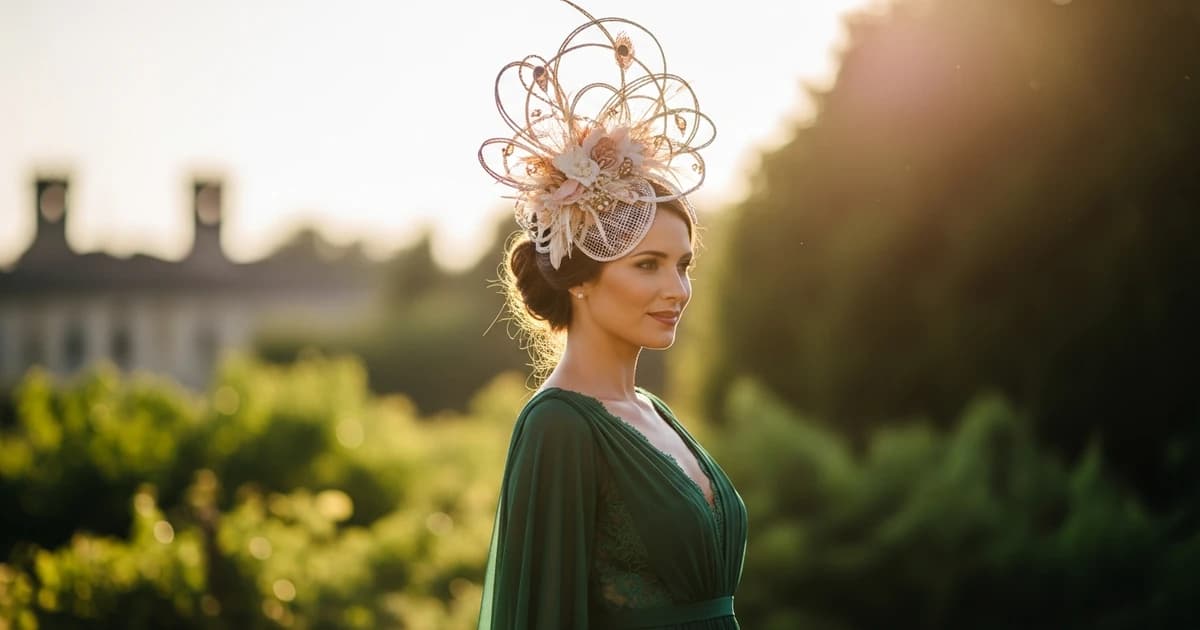
Evening weddings also favour the fascinator. Under artificial light and with more formal fabrics in play, a night-time celebration calls for headpieces of greater intricacy even if they are smaller in scale. A fascinator of dyed feathers or a sinamay pillbox with a short veil makes far more sense at nine in the evening than at noon in a garden; a jewelled headband does too.
The fascinator is also the more versatile choice for guests with long hair who want an elaborate updo: it integrates with the hairstyle, completes it and, in many cases, becomes part of it. A wide-brim hat flattens any updo and requires hair to be worn down or in a very low bun, which significantly limits what the hairdresser can do on the day.
All included
- Banquet venue
- Wedding Planner
- Marriage Paperwork
- Photographer
- Décor
- Flowers
- Master of Ceremonies
- Deejay
- Open Bar
The unspoken protocol
At British weddings, the wide-brim hat is most at home at events with a country house or racing tradition. At more urban or contemporary celebrations, the fascinator tends to be the choice of the most polished guests.
That is not to say a wide-brim hat jars at a city wedding. The hosting family's aesthetic sets the tone for what reads as appropriate, and it is worth paying attention to the details. If you are unsure, look at the style of the invitation: an engraved card with classic typography usually signals a wedding where a wide-brim hat fits perfectly. A more graphic, contemporary design suggests lighter fascinators or, in some cases, no headpiece at all.
On the question of colour, there are broader rules that apply beyond the headpiece itself. You can read more about which shades to avoid as a guest in colours to avoid as a wedding guest.
Materials, season and care
Spring and summer
Sinamay and straw dominate the warmer months. Sinamay, a fibre made from abaca, is the most widely used material in wedding headpieces because of its lightness and its ability to hold complex shapes. It takes dye precisely and accepts floral or feather trims without losing structure; with a veil attached, it gains in formality. Raffia also lends itself well to wide-brim hats with a more relaxed finish.
Woven straw is the classic material for a summer hat. Higher-quality varieties have a finer texture and a more even finish than imported coarse-straw hats. The price reflects that difference: expect to pay between £80 and £350 for a mid-to-high quality hat.
Autumn and winter
Wool felt, velvet and sinamay in deeper tones take over in the colder months. Pheasant feather or marabou fascinators come into their own at autumn weddings. Metal headbands set with crystals or pearls work across all seasons but are particularly well suited to winter weddings with dresses in heavier fabrics.
Care and storage
Both wide-brim hats and fascinators should be stored in hat boxes, never crushed. Sinamay can be reshaped with gentle steam; straw responds to a slightly damp cloth. Feather headpieces should be kept away from direct light to prevent the colour from fading.
Common mistakes worth avoiding
The first is choosing the headpiece before the dress. The hat or fascinator should respond to the silhouette, and doing it the other way around almost always ends badly. Many guests fall in love with a wide-brim hat in January and then spend weeks searching for a dress to match it, with inconsistent results.
The second mistake is not considering the intended hairstyle in advance. A wide-brim hat requires knowing beforehand whether your hair will be worn down, in a low chignon or in a plait. Arriving at the hairdresser on the morning of the wedding with the hat in hand and asking for a high updo is a contradiction that cannot always be resolved.
The third, and perhaps most frequent, mistake is misjudging scale relative to body proportion. A petite guest wearing a hat with a 65 cm brim risks being overwhelmed by the hat itself. A useful rule of thumb: the brim should not visually exceed the width of the shoulders. When it does, the hat dominates rather than completes.
The fourth mistake is ignoring the wind forecast. An outdoor spring wedding on the coast can turn a hat with no internal fixings into an incident. Internal combs, an elastic band or millinery pins are essential if wind is expected.
For guidance on whether the dress you have chosen calls for a long or short length before you even think about the headpiece, here is the guide on short versus long dresses for wedding guests.
The mother of the bride and wedding guests: a necessary distinction
The mother of the bride occupies a different ceremonial position from that of other guests, and that distinction extends to headpieces. The Spanish mantilla, historically reserved for the mother of the bride at religious ceremonies, is incompatible with a wide-brim hat and with most contemporary fascinators. If you are the mother of the bride and wondering how to wear a mantilla, the style guide for the mother of the bride with a mantilla covers the current options in full.
Wedding guests, by contrast, have considerably more freedom. The one clear protocol is not to compete with the bride for attention: nothing
This article was reviewed by our editorial team. How we create our content
Frequently Asked Questions
Not sure which one suits you?
Try every silhouette on your own photo with Wedded's virtual try-on. The first 5 try-ons are free.