Colours to Avoid as a Wedding Guest
White, pure black, bold red... these are the colours worth steering clear of as a wedding guest and why, with nuances depending on the type of wedding.
Created with AI assistance and human review. Editorial standards
There is a question that appears in almost every wedding guest group chat before the big day: "Can I wear this colour?" Behind that doubt lies a tangle of unwritten rules that mix protocol, family superstition and a little visual logic. Here is a look at which colours cause the most friction, why, and when the rule has legitimate exceptions.
Key points
- White and its pale variants (ivory, cream, champagne, off-white) are the only colours with a near-universal rule: avoid them unless the couple explicitly asks otherwise.
- Black depends on context: at daytime religious ceremonies or with a traditional family it remains problematic; at an urban evening civil ceremony with a cocktail or black-tie dress code it is perfectly valid.
- Bright primary red draws the eye in photographs; a deep burgundy or terracotta does not pose the same problem.
- Very metallic gold and silver can feel excessive at daytime or semi-formal ceremonies.
- The bridesmaids' colour: if you know it in advance, avoid it or choose something sufficiently far along the spectrum.
- The golden rule: when in doubt, ask the couple directly. It never offends.
White and its variants: the most universal rule
White is the only colour that almost every bridal etiquette guide flags as problematic for guests. The reason is straightforward: in most Western weddings, white belongs symbolically to the bride. Arriving in a white dress creates unnecessary confusion on her day, even when the intention is entirely innocent.
What complicates the rule is the range of shades that fall under that umbrella. Optical white, off-white, ivory, cream and very pale champagne all sit in risky territory; warm bone white does too, however distinct it may look on the hanger in a shop. In photography, the difference between an ivory guest dress and a bridal gown can disappear entirely depending on the light. If a dress falls into any of those tones, the most straightforward course of action is to check with the couple beforehand.
Printed dresses with a white background are a different matter. A floral dress where white coexists with pinks, greens, blues and yellows does not create the same visual effect as a plain white dress. The practical test: if in a group photo someone could mistake you for the bride, change the dress.
Black: the debate that never quite closes
Black has a complicated history at weddings. For decades it was the colour of mourning, and arriving in black was read as a bad omen. That interpretation has lost much of its force among younger generations, particularly in cities, but in many traditional or regional families it is still viewed unfavourably. The debate remains open, even if certain magazines have declared it settled.
The practical rule today works more by context than by absolute prohibition:
Daytime religious ceremony, small town or village setting, traditional family. All-black still attracts comments. The couple's family may read it as insufficiently festive or, among older generations, as a lapse in taste.
Urban evening civil ceremony with a cocktail or black-tie dress code. Black is not only acceptable but often the most elegant choice. A black cocktail dress with gold accessories or a pop of colour is entirely appropriate.
The middle ground that tends to work well: black paired with a colourful accessory. A coral fascinator or an emerald green clutch breaks the severity of the outfit without abandoning the colour entirely; nude-gold shoes do the same with less effort.
Red: an intensity that competes
Bright primary red draws the eye almost automatically. At a wedding, that attention should be directed at the couple, and a vivid red dress in the photographs can become an unplanned centre of visual attention. It is pure visual physics.
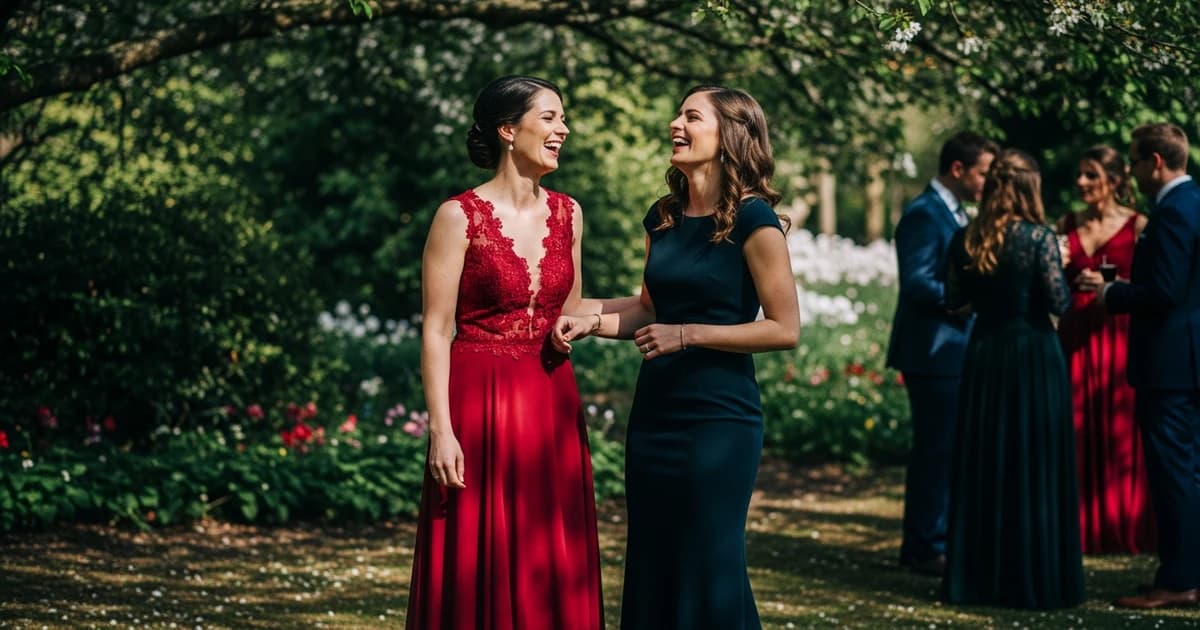
That does not mean red is universally off-limits. A deep wine red or a muted burgundy has a far more contained presence and rarely causes conflict. Warm terracotta does not tend to pose a problem either. The issue is specifically with bright primary red at weddings where the protocol is strict or the aesthetic is considered.
At weddings with a festive dress code, or at celebrations where the couple has explicitly asked for bold colours, red can be a perfectly fitting choice. Context decides everything.
All included
- Banquet venue
- Wedding Planner
- Marriage Paperwork
- Photographer
- Décor
- Flowers
- Master of Ceremonies
- Deejay
- Open Bar
Other colours worth thinking through carefully
Very bright gold and silver
Intensely metallic gold and silver share a trait with red: their visual effect is disproportionate within the overall photographic composition. At a formal evening wedding they are valid choices, but at a daytime or semi-formal ceremony they can feel excessive.
The muted version, a matt champagne gold or pale silver, poses no problem at all.
Lime green, fluorescent orange and neon yellow
Neon or fluorescent colours are not prohibited by any specific convention, but they clash visually with most bridal aesthetics. If the couple has chosen a colour range for their décor and floristry, a neon dress can jar in group photographs.
The same colour as the bridesmaids
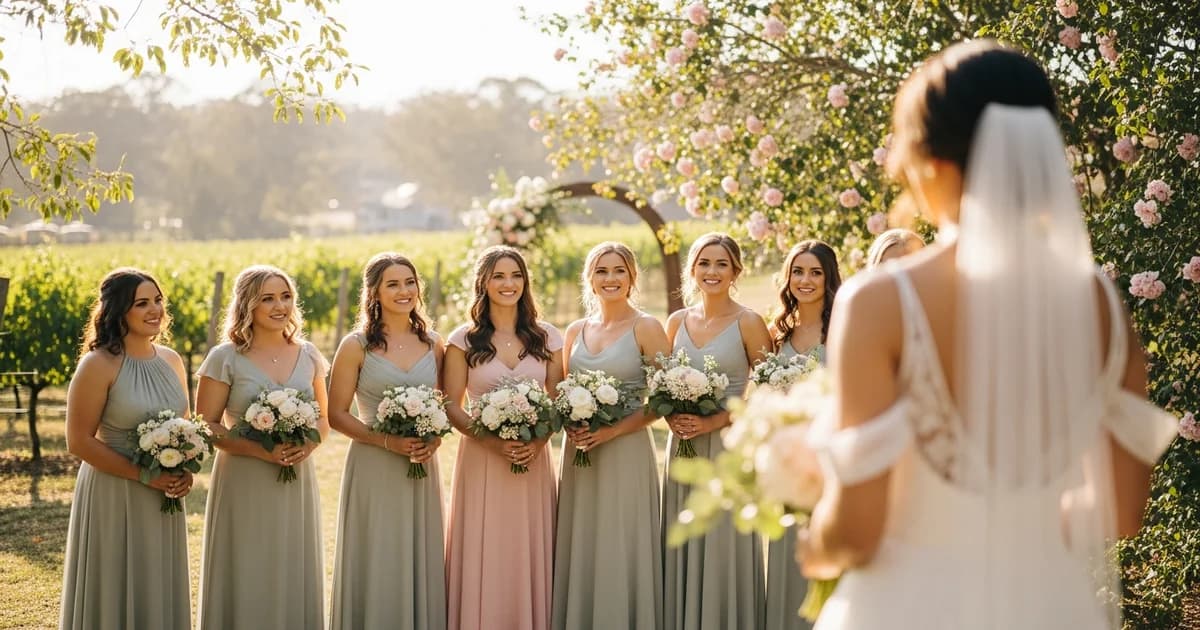
This is a mistake that happens more often than people expect. If the couple has chosen a colour for their bridesmaids and you arrive in a dress in that same shade, the visual confusion in the photos is inevitable. If you know the bridesmaids' colour in advance, avoid it or at least move far enough along the spectrum to be clearly distinct.
For more on the role of bridesmaids and their looks, see the complete bridesmaids guide.
When the rules have real exceptions
Colour conventions are social habits that shift with generation, geography and the type of celebration. There is no written law. There are weddings where the couple explicitly asks guests to wear white. There are couples who have decorated their wedding entirely in black and genuinely welcome guests who match that aesthetic.
The only way to know whether the rules apply at a specific wedding is to read the invitation carefully, pay attention to any stated dress code and, if there is any doubt, ask the couple directly or check with someone close to them. Arriving in the wrong colour can create an awkwardness that outlasts the celebration, and avoiding it costs nothing more than a message.
At weddings with an explicit dress code (black tie, cocktail, garden party, boho), that code carries more weight than any general colour rule. A formal evening black-tie wedding practically invites black and gold. A daytime garden party calls for light tones and florals, where white remains the one exception.
What wedding photographers say
Wedding photographers have a specific perspective on this that goes beyond protocol. The problem with certain colours also has a technical dimension. In a group shot, the human eye goes directly to the point of highest contrast or the most saturated colour. If that point is not the bride, something is visually off.
That does not mean guests should dress in muted neutrals. There is a difference between a dress that adds to the overall image and one that distorts it. Mid-tone blues work well, as do sage greens, dusty mauves, powdery pinks and terracotta, which appears increasingly in wedding photographs without bothering anyone.
How to choose a colour without getting it wrong
Before buying or renting a dress, these are the questions worth asking:
Does the dress code on the invitation give any clue about the expected colour range? A spring garden wedding and a December black-tie gala in a five-star hotel call for entirely different combinations.
Do you know the colour of the bridal gown? If it is ivory white and you are wearing champagne, the risk is real. If the bride is wearing a pale blue dress and you arrive in white, the conflict is different but equally uncomfortable.
Do you know the bridesmaids' colour? Avoid it or move far enough along the spectrum to be clearly distinct.
Is the wedding daytime or evening? Evening weddings allow for more chromatic intensity and carry less risk with black.
Whether the dress you have in mind is long or short also influences how the colour reads: short or long dress for a wedding guest has more detail on that decision.
And if you are thinking about a hat or fascinator to complete the outfit, the colour of the accessory can either compensate for or amplify the effect of the dress: more on that here: hat and fascinator guide for wedding guests.
Conclusion
The debate around wedding colours has spent too long circling the fear of getting it wrong, when the underlying question is far simpler: who should be drawing the eye on that day? Once that is the starting point, most colour decisions make themselves.
This article was reviewed by our editorial team. How we create our content
Frequently Asked Questions
Not sure which one suits you?
Try every silhouette on your own photo with Wedded's virtual try-on. The first 5 try-ons are free.