Exchanging Vows: A Complete Guide to the Ceremony
Everything you need to know about exchanging vows: types, structure, tips for writing them, and the differences between a civil and a religious ceremony.
Created with AI assistance and human review. Editorial standards
Puntos clave
- Vows are the act of matrimonial consent: without them, there is no legally valid marriage.
- There are two main formats: a fixed formula (civil or religious) and personalised vows written by the couple.
- In a Catholic wedding, the canonical formula cannot be altered, though the celebrant may permit additional personal words.
- Personalised vows work best when they start from specific details rather than generic declarations.
- Time yourself before the day: read aloud, accounting for pauses, and the text will always take longer than it appears on the page.
- Reading directly from a written text takes nothing away from authenticity. It prevents blank-mind moments and ensures you say exactly what you intended.
- The rings and the vows are distinct parts of the ritual, though in most civil ceremonies they follow one directly after the other.
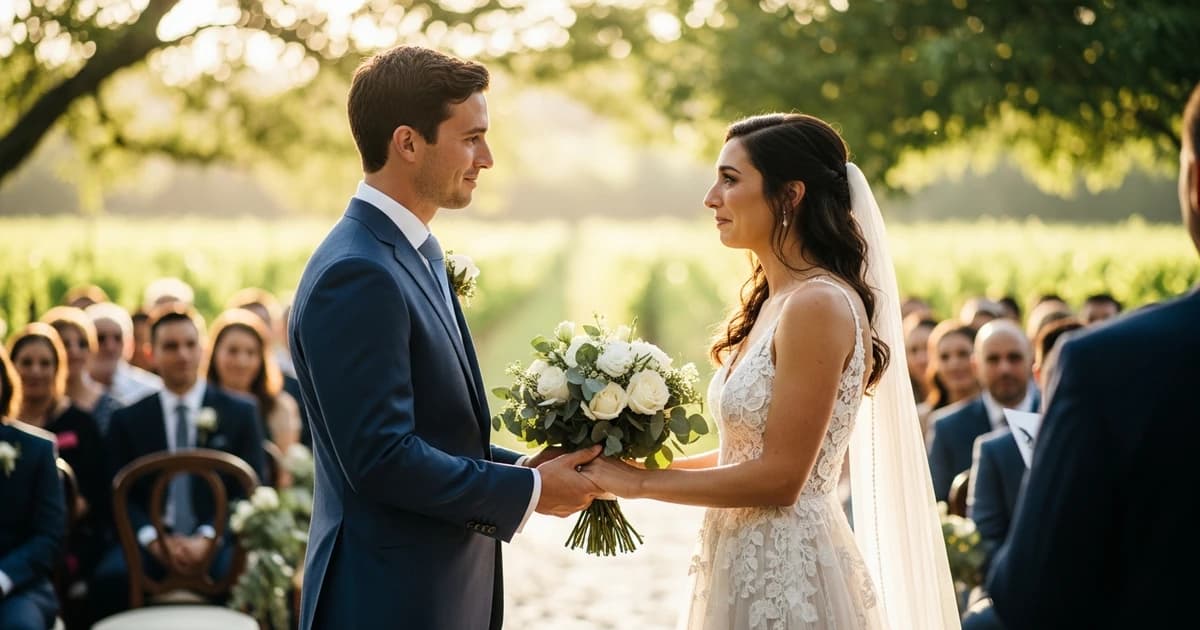
There are weddings where the photographer lowers the camera mid-vow exchange, knowing that no image will surpass what is happening in that instant. That moment, brief and almost always unexpectedly intimate, is the nucleus of the ceremony. Everything else orbits around those words: the dress, the dinner, the dancing, and all the other details that filled months of planning.
Below, we look at the different types of vows, how to structure personalised ones if you decide to write your own, what civil and religious ceremonies each require, and when improvising is not the wisest idea.
What Exchanging Vows Actually Means
Vows are the public, reciprocal declaration of intent to marry. From a legal standpoint, the expression of matrimonial consent before the registrar or relevant official is the act that gives a marriage its legal validity. Without that express consent, there is no marriage.
That said, vows carry a dimension that goes far beyond the legal. They are the only moment in the wedding when the two people at the centre speak directly to each other in front of everyone who matters to them. That combination of intimacy and witnesses is what makes them so difficult to forget.
The Two Main Formats: Fixed Formula or Your Own Words
Vows with an Established Formula
Both civil and religious ceremonies have their own formulas. In a civil wedding, the registrar or official asks each party whether they freely consent to marry and whether they accept the other as their spouse. The affirmative answer constitutes the vow. The formula is brief and leaves no room for personalisation within the formal act itself.
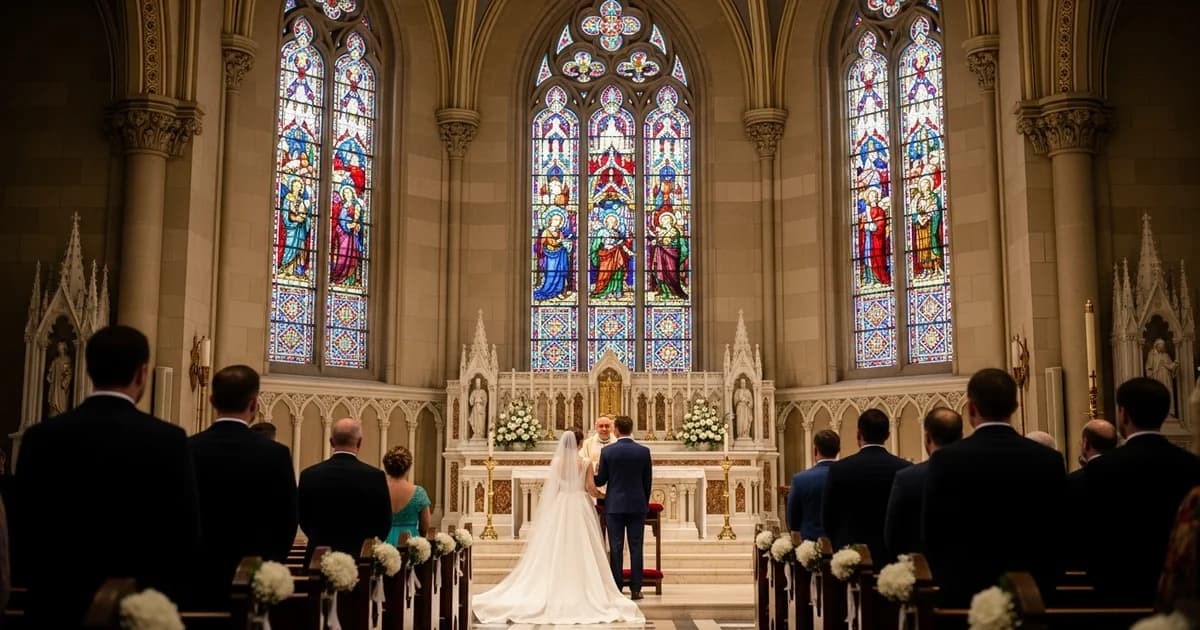
In a Catholic wedding, the canonical formula is more extensive. Each party declares that they receive the other as husband or wife and promises faithfulness in prosperity and in adversity, in sickness and in health, for all the days of their life. This formula cannot be modified because it forms part of the sacrament. What can be added, with the celebrant's permission, is personal words before or after.
For a thorough understanding of the full protocol for each type of ceremony, you will find everything in the civil wedding protocol guide and the Catholic wedding protocol guide.
Personalised Vows
These are vows the couple writes entirely themselves. Their popularity has grown considerably in civil weddings and symbolic ceremonies. According to the INE Marriage Statistics for 2023, ceremonies held exclusively at the registry office or before a registrar now account for a majority that surpasses 60 per cent of the total, and the rise of symbolic ceremonies in private venues has gone hand in hand with this practice.
Writing personalised vows brings a clear benefit: you can say exactly what you want to say. The difficulty lies in knowing what that actually is, which is where most couples spend the most time.
How to Write Vows That Do Not Sound Like a Template
This is where most couples get stuck. A blank page with the heading "my vows" can be genuinely paralysing. These are the approaches that actually work.
Start with the Specific, Not the Abstract
"I love you with all my heart" is true, but anyone could say it. "I remember the first time I watched you cook something, you burned the rice and laughed so hard your glasses fell off" belongs only to you. The best vows contain at least one detail so specific that the guests in the third row do not quite follow it, and that is precisely as it should be.
Structure Around a Clear Arc
You do not need to be a writer for your vows to have coherence. A structure that works: open with the past (how you arrived at this moment, or what you have learned from this person), move into the present (who they are to you today), and close with a concrete promise about the future. It does not need to be labelled or explicit, but that temporal movement gives the text a backbone.
The Tone Should Reflect Your Personality
If you are someone who makes jokes when things feel heavy, your vows can have humour in them. If you are more reserved, there is no need to force effusiveness. Vows that ring false are almost always the ones that imitate a register that does not belong to the person reading them. Write them in your own voice, the one you use when you are being honest rather than performing.
A Word on Length
Time yourself. Read aloud, accounting for pauses and the emotion of the moment, and the text will always run considerably longer than it looks on the page. If you have written too much, edit. If you have written too little, do not pad it out.
Vows in a Civil Ceremony: What the Law Allows
A civil wedding before a registrar or justice of the peace follows a legal script whose substantive elements cannot be altered. Consent must be expressed freely and clearly. What can happen is that, in civil weddings held in private venues (country houses, hotel gardens and similar settings) with a celebrant hired for the symbolic element, personalised vows can take up as much space as the couple wishes.
The important distinction: if the wedding has legal effect, the legal act can be brief and separate (for example, signing at the registry office a few days before), while the emotionally resonant ceremony with longer vows is the symbolic part. Many couples combine both. More on the differences between these two models in the article on civil vs. religious weddings.
All included
- Banquet venue
- Wedding Planner
- Marriage Paperwork
- Photographer
- Décor
- Flowers
- Master of Ceremonies
- Deejay
- Open Bar
The Rings and Their Relationship to the Vows
Rings and vows share a ritual, but each carries its own weight. In most civil ceremonies, the rings are exchanged immediately after the vows, as a physical seal on the promise that has just been spoken. In a Catholic ceremony, the rings form part of the nuptial rite and are blessed separately.
Some couples weave the rings into the vows themselves, referencing them explicitly: "with this ring I promise you..." Others prefer to keep them separate so that each moment holds its own weight. Neither approach is more correct than the other. For a deeper look at the symbolism of rings and the arras, everything is explained here.
What to Do If Public Speaking Fills You with Dread
Not everyone feels comfortable speaking in front of fifty or two hundred people. That does not make vows impossible, but it does change the strategy.
Reading directly from a written text is entirely valid. It prevents blank-mind moments and guarantees that you say exactly what you meant to say. Another option is to agree with the celebrant that they will read the words aloud while the couple responds with a yes, though this significantly limits personalisation.
What does not work is attempting to memorise a long text without having practised it aloud, ideally at different times of day and at least once in front of someone you trust.
Vows When Children Are Present or in Blended Families
More and more weddings include the children of one or both partners in the ceremony. In these cases, some celebrants suggest vows addressed to the children as well, in which the adult joining the family makes an explicit promise. It can be a genuinely meaningful gesture, provided it is done naturally and with the agreement of all the adults involved.
There is no standard formula for this. The important thing is that it does not feel forced or turn the children into the protagonists of a moment they did not ask for.
Conclusion
Exchanging vows has one real requirement: that whoever speaks them recognises themselves in the words. The legal formula, with its brevity, has its own quiet dignity. Handwritten vows, with all their imperfections, have theirs too. Everything else is secondary. Start with something specific that only you could say, and the rest follows naturally.
Related Reading
- The meaning and tradition of rings and the arras: anillos-arras-simbolos-amor
- Step-by-step civil wedding protocol: guia-protocolo-boda-civil
- Everything about the Catholic nuptial rite: guia-protocolo-boda-catolica
- Civil or religious? The differences that matter: boda-civil-vs-religiosa
This article was reviewed by our editorial team. How we create our content
Frequently Asked Questions
Not sure which one suits you?
Try every silhouette on your own photo with Wedded's virtual try-on. The first 5 try-ons are free.