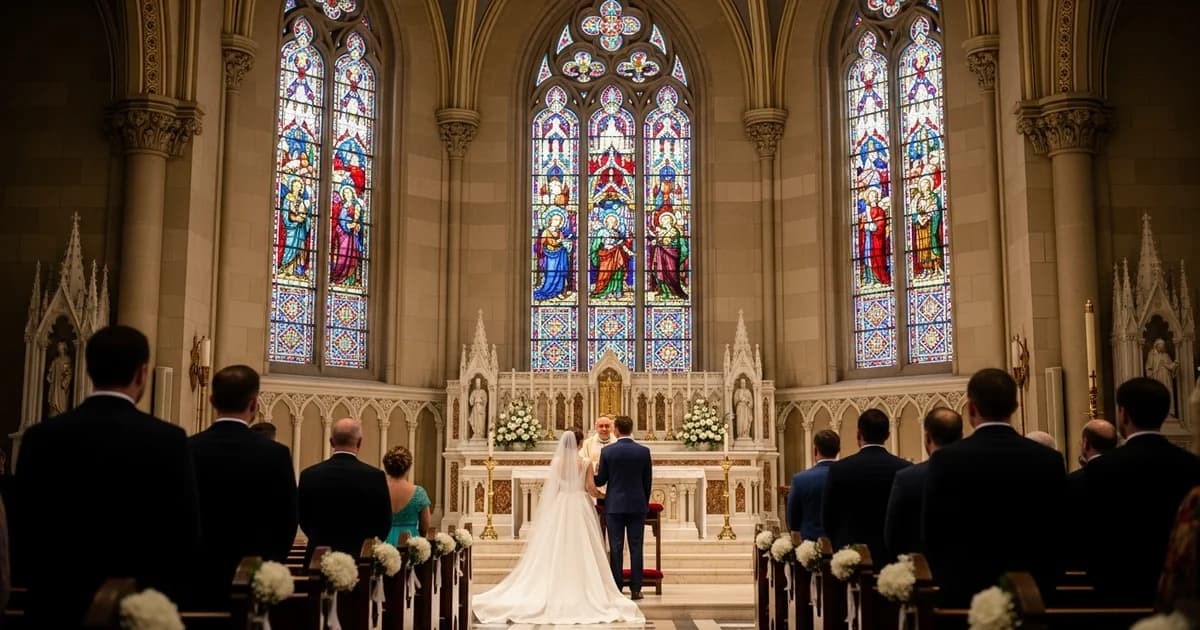
Wedding rings and arras: symbols of love at your ceremony
Wedding rings and arras are the most meaning-laden gestures in any wedding. Discover their origins, their differences, and how to choose them thoughtfully.
Created with AI assistance and human review. Editorial standards
Puntos clave
- The wedding ring symbolises eternity and fidelity; the arras symbolise shared assets and a life built together. They are distinct gestures with distinct meanings.
- The majority tradition in Spain is to wear the wedding band on the ring finger of the right hand.
- Arras are required at a Catholic wedding and optional at a civil one.
- 18-carat yellow gold remains the most common material for wedding bands, though white gold and platinum are increasingly popular.
- Using heirloom family rings is perfectly valid; have the size and condition checked by a jeweller at least three months before the wedding.
- After the wedding, the arras deserve a considered place in your home, not the bottom of a drawer.
Which moment at a wedding truly stays with you? Every couple has their own answer, but two gestures appear in almost all of them: the instant two people slide a metal band onto each other's finger and, a few seconds before or after, pour thirteen coins into an open palm. These are gestures that have been repeated for centuries in churches and registry offices across Spain, and yet every couple experiences them as though for the first time. Here is what wedding rings and arras actually mean, where they come from, and how to choose them with care.
The wedding ring: a circle with no beginning and no end
The circular shape of the wedding ring has an explanation that reaches back a very long way. In ancient Egypt, the circle symbolised eternity precisely because it has no start or finish. The Romans adopted the custom and called it the anulus pronubus; the Church incorporated it into the marriage rite during the Middle Ages, and since then the exchange of rings has been one of the most recognisable gestures in any Western wedding.
In Spain, according to the INE Estadística de matrimonios 2023, 168,405 marriages were registered that year. In the vast majority of them, regardless of whether the ceremony was civil or religious, the couple exchanged rings. It is the one element that has survived virtually unchanged across the centuries.
What the rite says about the ring
At a Catholic wedding, the priest blesses the rings before the couple exchanges them. The words that accompany the gesture vary by diocese, but the most widely used formula in Spain is: "Receive this ring as a sign of my love and fidelity." The Ritual del Sacramento del Matrimonio of the Conferencia Episcopal Española includes this blessing as a structural part of the ceremony, with its own weight within the rite.
At a civil wedding, the registrar or mayor does not bless the rings, but many couples incorporate them all the same as a personal gesture outside the legal protocol.
Material, design and budget
18-carat yellow gold is the material most commonly seen in Spanish jewellers when a couple comes in to choose wedding bands, though white gold and platinum have been gaining ground for years. Titanium and surgical steel appear as alternatives for those looking for a lower price point or who have an allergy to precious metals.
Width and finish determine the price almost as much as the material itself. A plain 3mm 18-carat gold band typically costs between €200 and €500 per ring at an independent jeweller; platinum versions or those set with a diamond pavé can exceed €1,500 per piece. The sensible approach is to budget for both rings together rather than choosing them separately, because the visual coherence between the two bands matters more than it might seem in photographs.
If you are unsure how to coordinate your wedding band with your engagement ring, you will find more on that decision here.
The arras: thirteen coins with eight centuries of history
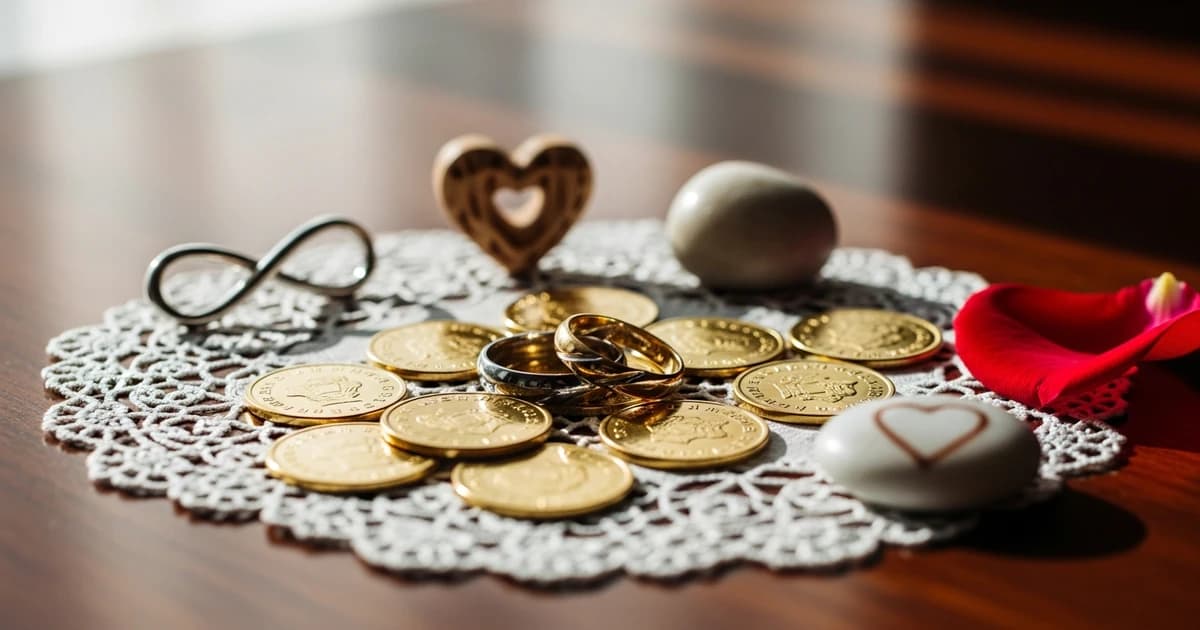
The arras are one of the most distinctly Hispanic elements of the wedding ceremony. They are documented in Visigothic law and their presence in the Spanish Catholic marriage rite became established around the twelfth century. The number thirteen has its own logic: twelve coins represent the twelve months of the year, and the thirteenth symbolises the groom or, in other interpretations, Christ as witness to the commitment.
The gesture carries a double meaning. The groom hands the coins to the bride as a sign that he shares all his worldly goods with her. She accepts them and returns them to their joined hands, indicating that those goods will be managed together. Put that way it sounds very solemn, but at its heart it is a public pledge of financial trust made in front of everyone who matters.
Arras at a civil wedding
The Spanish civil wedding does not include arras in its official protocol, but nothing prevents a couple from incorporating them as a symbolic gesture. Many couples do so during the moment when the registrar invites them to speak their personal vows. If you want to include them, it is worth letting the registrar know in advance so the moment fits naturally into the ceremony.
How to choose your arras
The market offers everything from sterling silver cases with minted coins to designer pieces featuring semi-precious stones or personalised engraving. A few practical considerations:
- Material: sterling silver 925 is the most common choice for its price and durability. 18-carat gold raises the cost but turns the arras into a piece of jewellery that can be kept or even transformed into something else afterwards.
- Personalisation: many jewellers offer engraving of both names and the date on the reverse of each coin. In the jewellers we have consulted, engraving typically adds between €30 and €60 to the final price, though it is worth asking for a written quote as it varies considerably from one workshop to another.
- The case: the container matters more than it might seem, because it appears in photographs and in video. Velvet or aged leather cases are considerably more photogenic than gold-coloured plastic ones. If the coins themselves are beautiful, make sure the case does them justice.
All included
- Banquet venue
- Wedding Planner
- Marriage Paperwork
- Photographer
- Décor
- Flowers
- Master of Ceremonies
- Deejay
- Open Bar
The difference between a wedding band and arras (and why it matters)
Some couples confuse the two elements or assume they are interchangeable. The wedding band speaks of fidelity and mutual belonging. The arras speak of shared assets and a life built in common. They are different things. They can and do coexist within the same ceremony, and in a Spanish Catholic wedding it is standard for both gestures to appear, but each has its own moment and its own meaning.
In practice, the usual sequence at a religious wedding is: the couple exchanges their vows, the arras are presented, and the rings follow last. The priest guides each step. At a civil wedding that includes both elements, the couple decides the order with whoever is officiating.
Heirloom rings: when family history enters the ceremony
More and more couples are choosing to use family rings rather than buying new bands. The emotional dimension is obvious, and the financial one is far from negligible. Before making that decision, have a trusted jeweller check the condition of the metal and the exact size for each finger. The surface finish may also need polishing or rhodium plating in the case of white gold.
If the ring has sentimental value but does not fit well, forcing it risks damaging the piece. A professional resizing at a reputable jeweller costs between €30 and €80 and ensures the ring neither slips off nor pinches for decades to come. For more on the use of family jewellery at a wedding, I have written about this in more detail here.
The moment of exchange: protocol and freedom
At both Catholic and civil weddings, the ring exchange has a fixed place in the ceremony. What varies is the degree of personalisation each couple brings to that framework.
Some couples add a few words of their own when placing the ring, beyond the official formula. Others prefer silence and let the gesture speak for itself. Neither approach is more valid than the other. What does help is practising it beforehand: the nerves of the day make even the simplest gestures clumsy, and there is nothing more deflating than struggling with a ring in front of a hundred people. More on how to prepare for that moment in the vow exchange guide.
At a Catholic wedding, the full protocol (including the arras and ring moments) is set out in the Catholic wedding protocol guide.
What to do with the arras after the wedding
Few people ask themselves this question before the ceremony, and the arras end up at the bottom of a drawer. The most honest answer is that it depends entirely on what they mean to you.
This article was reviewed by our editorial team. How we create our content
Frequently Asked Questions
Not sure which one suits you?
Try every silhouette on your own photo with Wedded's virtual try-on. The first 5 try-ons are free.