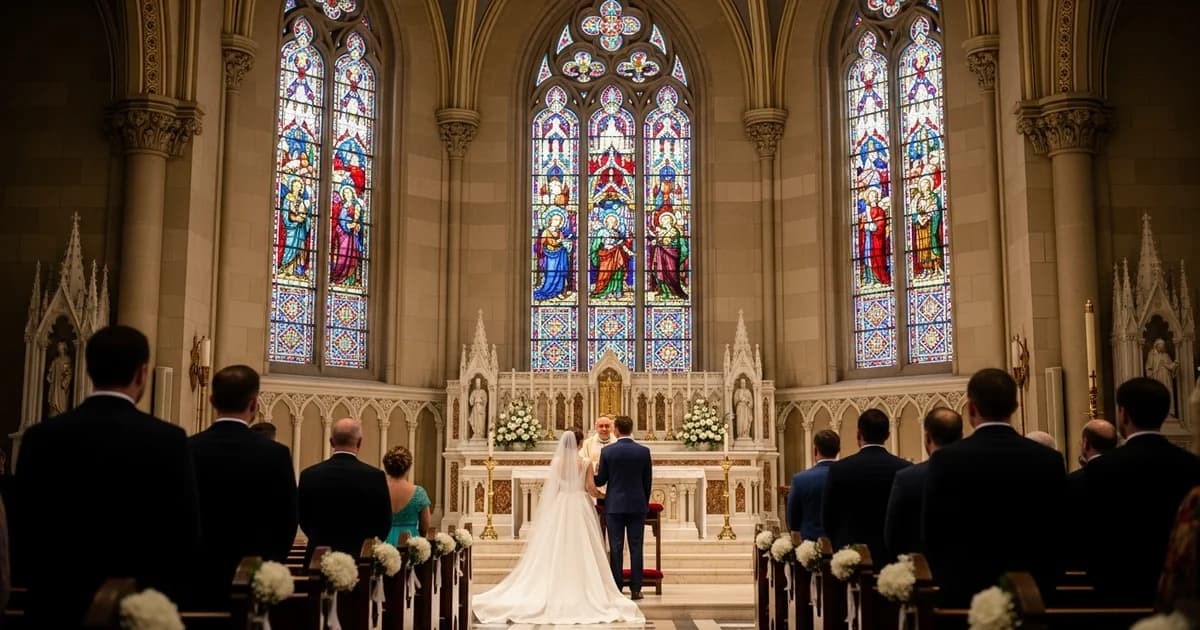
Wedding Vows Exchange: The Ultimate Guide
Discover everything about exchanging vows: their history, types, and how to write yours. Make your I do unforgettable. Everything you need to know.
Created with AI assistance and human review. Editorial standards

The moment of "I do" is, without a doubt, the heart of any wedding. It's that magical instant when two people promise eternal love in front of their loved ones. And right at the center of that moment, we find the exchange of vows, a tradition loaded with meaning and emotion that seals the couple's commitment. If you're planning your wedding, it's natural to wonder how to make this moment truly yours, unique and unforgettable.
The exchange of vows is much more than a simple formality; it's the opportunity to express in your own words what you feel, what you expect from the future, and the promises you make to each other. It's a declaration of intentions that shapes your marriage from day one. But where does this tradition come from? What options do you have? How can you write vows that truly represent you?
Don't worry, I'm here to guide you on this journey. Think of me as that older sister who's been through this and wants to help you make everything perfect. Together, we'll explore the history, different ways to exchange vows, and I'll give you practical advice so you can find the exact words you want to say to your partner on the most important day of your lives. This guide will help you understand the depth of this act and prepare you to live it with all the intensity it deserves.
What Is the Exchange of Vows?
In essence, the exchange of vows is the act in which each member of the couple makes a series of promises to the other during the wedding ceremony. These promises are the foundation of marital commitment and symbolize mutual surrender and acceptance of the responsibilities that come with living together. It's the moment when the ceremony stops being a social event and becomes an intimate and sacred pact between two people.
In Spain, this tradition has adapted over time, mixing classic formulas with a growing trend toward personalization. Today, couples have the freedom to choose between several options to make their vows a true reflection of their love story.
Types of Wedding Vows
There are mainly two ways to approach the exchange of vows: traditional or default vows, and personalized vows. Each has its own charm and suits different types of couples and ceremonies.
Traditional or "Default" Vows
Traditional vows are pre-established formulas that have been used for generations. They're those phrases we've all heard in movies and weddings, and they have very strong symbolic weight. Generally, they're recited by the officiant, and the couple responds with "I do" or repeats the key phrases.
- Religious Ceremony (Catholic): In a church wedding, the vows are defined by the marriage rite. The most common formula is the one that asks each spouse: "[Name], do you take [Name] to be your wife/husband, and do you promise to be faithful to her/him in joy and in sorrow, in sickness and in health, and thus, to love and respect her/him all the days of your life?" To which they respond: "I do." Next, explicit consent occurs: "I, [Name], take you, [Name], as my wife/husband and give myself to you, and I promise to be faithful to you in joy and in sorrow, in sickness and in health, all the days of my life." These vows are beautiful for their solemnity and profound spiritual meaning. They cannot be modified, as they're part of the official liturgy.
- Civil Ceremony: In civil weddings, the officiant (judge, mayor, or councilor) reads articles 66, 67, and 68 of the Civil Code. These articles aren't vows per se, but a description of the rights and duties of marriage, such as mutual respect, help, domestic co-responsibility, and family care. After the reading, the officiant asks the couple if they consent to marry, and both respond affirmatively. Although it's a legal and standardized formula, many civil ceremonies today allow additional space for the couple to share personal words, merging the legal with the emotional. If you decide to personalize your vows, know the differences between civil and religious wedding to understand how much creative freedom you have.
Choosing traditional vows is a beautiful way to connect with a cultural and family heritage, giving the ceremony a classic and timeless air.
Personalized Vows: Your Story Made Promise
More and more couples decide to write their own vows. This option allows you to create a unique and deeply personal moment, where you can express your feelings in a way that no pre-established formula could capture. It's your opportunity to tell your story, remember special moments, make promises that only you understand, and look to the future with your own words.
Writing your vows may seem like an overwhelming task at first. Where to start? What to say? Don't worry, it's easier than it seems. The key is to speak from the heart. You don't need to be poets or writers; you just need to be sincere.
Personalized vows can be romantic, funny, emotional, or a mix of everything. They can include anecdotes, inside jokes, references to your favorite movie, or the lyrics of "your song." The most important thing is that they represent you as a couple. Personalized vows are more common in civil weddings, while Catholic ones follow traditional formulas. This is the path for those who want their ceremony to be an authentic reflection of their relationship.
The History of Vows Exchange in Spain
To understand the value of this tradition, it's useful to look back a bit. The exchange of vows hasn't always been as we know it today, especially in the Spanish context, strongly influenced by Catholic tradition.
Historically, in Spain, marriage was primarily a religious sacrament regulated by the Catholic Church. The ceremony focused on mutual consent before God and the community. The vows were a fixed and unalterable formula, part of a sacred rite that symbolized an indissoluble pact. The idea of "personalizing" the vows was unthinkable, as the solemnity of the sacrament resided precisely in its uniformity and its connection with a centuries-old tradition.
With the arrival of civil marriage in the 19th century, a secular alternative was introduced. However, initial civil ceremonies were very brief and formal administrative acts, focused on reading the law and signing a contract. There was no space for emotionality or personal declarations. The romantic and emotional component remained, to a large extent, the domain of religious ceremony.
It was in the late 20th century and, especially, with the arrival of the new millennium, when things began to change. Spanish society became more diverse and secular, and couples began to seek ceremonies that better reflected their values and personalities. Influenced by Anglo-Saxon weddings we saw in cinema and television, where personalized vows are a common practice, Spanish couples began to demand more flexibility in their ceremonies.
Today, we live in a golden age for wedding personalization. Civil ceremony officiants are increasingly open to incorporating symbolic elements and personal moments, such as the exchange of vows written by the couple. Even in some religious ceremonies, although sacramental vows cannot be changed, sometimes the couple is allowed to read personal words at another moment of the ceremony, such as after communion.
This evolution has led us to the wonderful current scenario, where each couple can freely decide how they want to promise eternal love, combining tradition and modernity to create a perfect moment for them.
How to Write Your Own Vows: Step by Step Guide
If you've decided to take the step and write your own vows, congratulations! You're about to create one of the most beautiful memories of your wedding. I know it can be a bit daunting, but with this step-by-step guide, you'll see it's a beautiful and very rewarding process.
Step 1: Talk About It as a Couple
Before you start writing, it's important that you sit down and talk. Decide together the tone you want for your vows. Do you want them to be romantic and serious? Or do you prefer something lighter with a touch of humor? Will they be a surprise for each other or will you share them beforehand? Establishing a structure and approximate length (for example, between 1 and 3 minutes each) will help you both be on the same page.
Step 2: Brainstorming
Find a quiet moment for yourself, with a notebook and pen (or your phone!). Think about your relationship and answer some of these questions. Don't worry about the writing, just jot down loose ideas:
- When did you know this was the person for your life?
- What do you admire most about your partner?
- What's your favorite memory together?
- How has your life changed since you've been together?
- What does marriage mean to you?
- What specific promises do you want to make? (For example: "I promise to always leave you the last slice of pizza" or "I promise to always listen to you, even if I don't agree").
- How do you imagine your future together?
Step 3: Structure Your Vows
A good structure will help you organize your ideas. Here's a simple model you can adapt:
- Opening: Start by addressing your partner by name. You can begin with a statement about your love or a special memory. ("My dear [Name], I remember perfectly the day I met you...")
- Body: This is where you share what you admire about your partner and why you love them. Use details from your brainstorming. Tell a small story that illustrates your love. Your witnesses can help you review personalized vows before the ceremony.
- The Promises: This is the central part. Make your promises. Try to combine deep and meaningful promises with something lighter and personal that makes you both smile.
- Closing: End with a look to the future and a final declaration of your love and commitment. ("I can't wait to spend the rest of my life with you...", "I love you today and I will love you always").
Step 4: Write the Draft (and don't judge yourself)
With your notes and structure, start writing a first draft. Don't worry if it doesn't sound perfect. What's important is expressing your feelings. Be yourself, use your own words. If you're not a very mushy person, don't force language that doesn't represent you. Authenticity is the most moving thing.
Step 5: Read It Out Loud and Edit
Once you have a draft, read it out loud. This will help you see if it flows well and measure the time. Edit parts you're not convinced about, simplify sentences that are too long, and make sure it sounds like you. Ask a trusted friend or family member to listen to it for their opinion if you need to.
Need Inspiration? We Can Help You!
We know that sometimes the muses don't appear when you need them most. If you feel blocked or simply want to make sure your vows are perfect, remember we're here to help you. On our platform, we offer tools and examples to inspire you. We can even help you generate ideas for personalized vows that capture the essence of your love story, ensuring you have the perfect words for such a special moment.
This article was reviewed by our editorial team. How we create our content
Frequently Asked Questions
Not sure which one suits you?
Try every silhouette on your own photo with Wedded's virtual try-on. The first 5 try-ons are free.