V-Neckline: How It Flatters and Who It Suits
The V-neckline on a wedding dress: why it lengthens the figure, which bodies it flatters, how low to go and the silhouettes it pairs with best.
Created with AI assistance and human review. Editorial standards

V-Neckline: How It Flatters and Who It Suits
If there is one neckline that works in the bride's favor before she even moves, it is the V. Where a strapless cuts the torso straight across and a sweetheart rounds it out, the V does the opposite: it traces a line that drops diagonally toward the center of the chest and pulls the eye downward. That simple geometry is what lengthens the neck, opens the shoulders and makes the body read a little taller. Here we cover why it really slims, who it suits best, how far down to take it and the silhouettes you will want to pair it with.
The line that lengthens
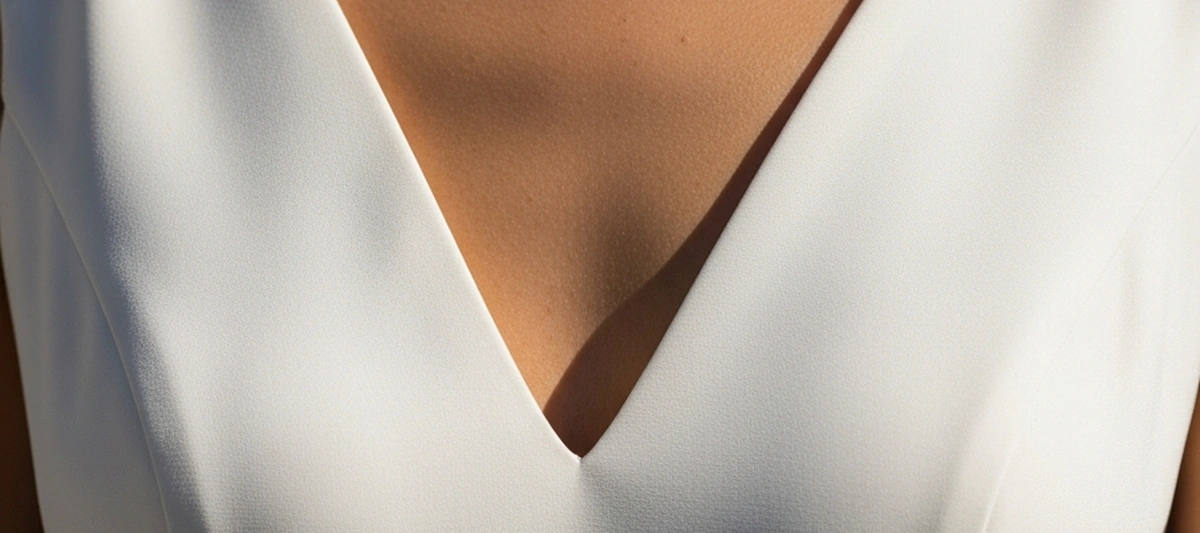
The trick of the V-neckline is optical, and there is nothing mysterious about it. Two diagonal lines start at the shoulders and meet at a point below the neckline, creating a vertical axis down the middle of the body. The eye follows that axis top to bottom, and anything that guides the gaze vertically lengthens what it touches: the neck, the torso, the whole silhouette.
That is why the V is the favorite of brides who want to gain a few visual centimeters or streamline the top half, and it is not just a feeling: in an analysis of 4,297 wedding dresses, one in four had a V-neckline, the second most common after the sweetheart. It does not add. It subtracts. It subtracts width at the shoulders, subtracts the sense of a short torso, subtracts volume where there is too much. And it does it without complicated inner structure, because the effect lives in the cut, not the corset.
Compared with the sweetheart neckline, which draws curves and lifts the bust, the V is more graphic and more restrained. One romanticizes, the other slims. They do not compete: they solve different things.
Who it really suits
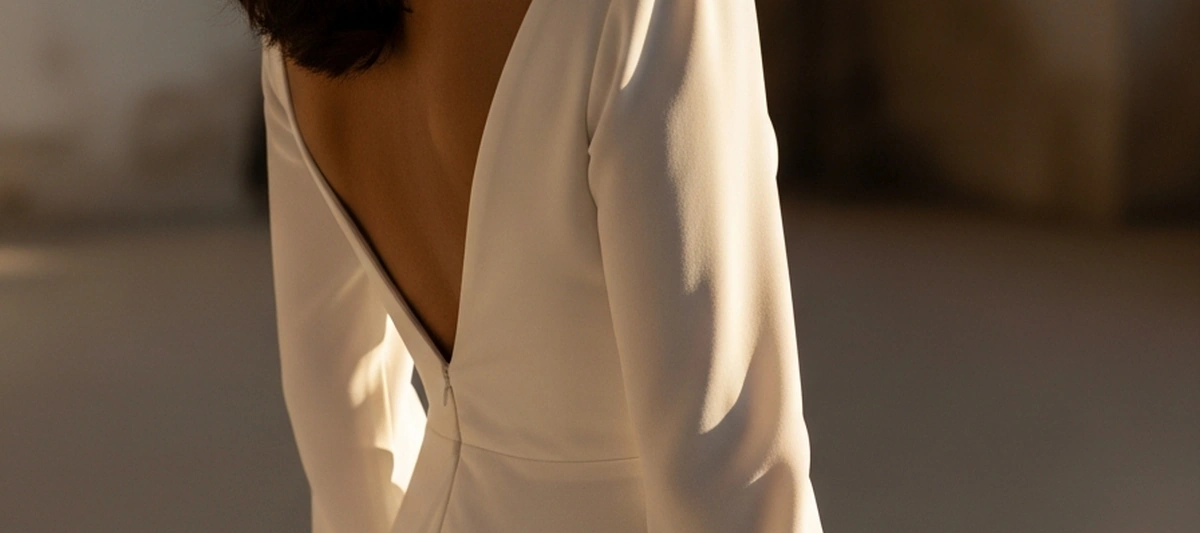
This is where the V earns its reputation as a safe bet, because it flatters profiles that other necklines handle less gracefully.
If you have a short neck, the V lengthens it by opening up space below the chin. If you have broad shoulders, the diagonals narrow them visually by pulling the line inward. And if you have a fuller bust, this is probably the shape that carries it best: instead of pushing it upward the way a strapless does, the V spreads the volume and leaves a strip of skin that breaks up the block of the chest. The result is a generous neckline that never feels heavy.
With a smaller bust it works too, though the design shifts. A very deep V over a modest chest can read flat, so it helps to close it a little or ask for a detail that adds shape: a crossover drape, a lace edge, a pleat. It creates dimension where there is none.
If you ask me, the one case I would approach carefully is the bride with a very long torso who wants to shorten it. The V lengthens, and here that works against you. It is not that you cannot wear it, it is that you will want it moderate and paired with a defined waist, not a straight column. To place yourself before getting into neckline details, the wedding dress by your body type is the best starting point.
How low to take it
The question everyone asks in the fitting room and almost no one out loud: how much is too much?
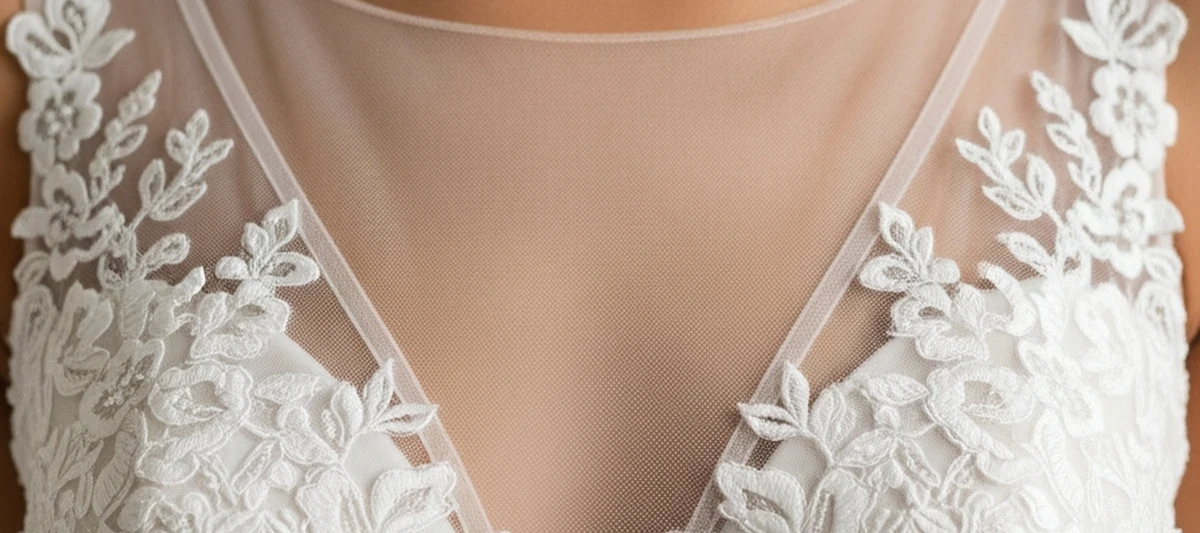
There is no number. There is a test. At the fitting, do what you will do on the wedding day. Raise your arms, hug someone tightly, bend down, laugh hard. If the neckline gapes, pulls away from the chest or asks you to adjust it, it has dropped further than your support can hold. And that has a fix: an illusion tulle panel inside holds the V without showing, and fashion tape along the edges keeps it against the skin.
The venue matters too. A deep V in a garden at eight in the evening is one thing; the same V at a morning religious ceremony is another. For a church, a moderate V or one with sheer illusion solves the coverage without giving up the shape. The quiet rule: let the neckline say the same thing as the rest of the wedding.
All included
- Banquet venue
- Wedding Planner
- Marriage Paperwork
- Photographer
- Décor
- Flowers
- Master of Ceremonies
- Deejay
- Open Bar
The variations you will see
The V-neckline is not just one thing. These are the most common versions and what each one brings.
- Classic V. Open and clean, no trim. The most slimming, and the one that looks best over smooth fabrics like crepe or mikado.
- Deep V. Drops to the sternum or lower. Striking and bold, it needs illusion inside or a crossover cut to hold it.
- Illusion V. A sheer tulle panel covers the point and sometimes rises to the neck or sleeves. It gives the V's line with coverage; ideal for religious ceremonies or winter weddings.
- Surplice V (cache-coeur). The bodice crosses over in a point, wrap-style. It slims just the same and marks the waist, so it flatters almost everyone.
- Halter V. The V rises in a point to the neck, leaving the shoulders bare. It lengthens the torso dramatically and opens up the back.
If you are torn between two, think about the fabric. A clean V over crepe is minimal and modern; the same V over lace turns romantic. The neckline matters less than you think: what changes the mood is the cloth.
Which silhouettes it pairs with
The V has a natural affinity with anything vertical. Over a column or sheath silhouette the effect multiplies, because the line of the neckline and the line of the dress point the same way and the bride reads as one long stretch. It is the most editorial pairing and the one that works best if you want something restrained.
Over a mermaid silhouette it follows the fit of the body and creates a continuous line from neck to hip. Over an empire or high-waisted cut, it softens and feminizes the top without crowding it. Where you have to judge is with very full skirts: if the bottom carries weight, a too-open V throws it off balance, so you will want it more closed. To see how each neckline fits into the whole, the guide on types of wedding dress gives you the full map.
A shortcut before you set foot in the store: try the shape in Wedded's virtual try-on, which lets you see how a dress looks on your own full-body photo before booking an appointment. Your first five try-ons are free, and they save you a whole morning on shapes you already suspect are not for you.
Conclusion
The V-neckline slims for a mechanical reason, not a fashionable one: a vertical line lengthens whatever it crosses, and that flatters short necks, broad shoulders and fuller busts almost by default. The hard part is not deciding whether it suits you, it is calibrating two things, how low you take it and which silhouette you set it on. Get those right and you will have the neckline that works hardest for you in every photo, without having to think about it for a single second of the day.
Related reading
This article was reviewed by our editorial team. How we create our content
Frequently Asked Questions
Not sure which one suits you?
Try every silhouette on your own photo with Wedded's virtual try-on. The first 5 try-ons are free.


