Mermaid Wedding Dress: Complete Guide to Choosing Well
The mermaid wedding dress: how it differs from trumpet and fit-and-flare, which body types it flatters and how to move comfortably in it.
Created with AI assistance and human review. Editorial standards
Mermaid Wedding Dress: Complete Guide to Choosing Well
Quick Answer: What It Is and Why It's So Popular
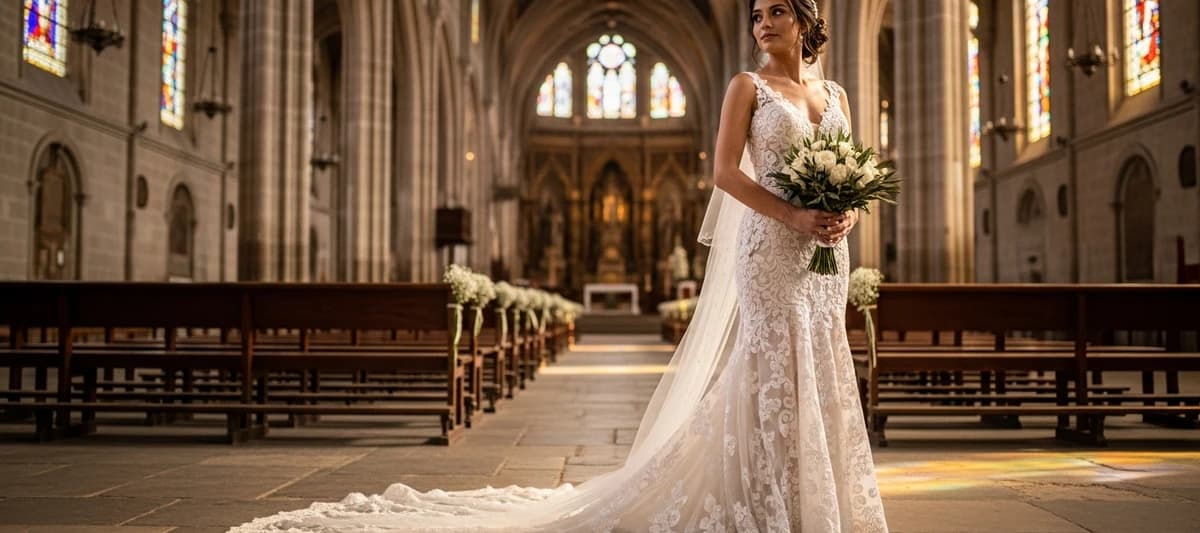
The mermaid wedding dress is the silhouette that appears most frequently in bridal searches across Spain, and it's no coincidence. Its structure hugs the body from the chest to below the knee and then releases the fabric into a flare reminiscent of a mermaid's tail. The result is a silhouette that defines the figure with precision and, when chosen well, is spectacularly photogenic at formal weddings.
Its popularity comes from its ability to create a very clear visual contrast: the torso and hips are completely defined, while the lower flare adds movement and drama in wedding photographs. It is, arguably, the bridal silhouette with the greatest visual impact per kilogram of fabric.
But it has conditions. It is not the most comfortable silhouette to move in, it requires precise construction, and it is not equally flattering with all fabric designs. This guide explains everything you need to know before making your decision.
If you want to first understand the full landscape of bridal silhouettes before focusing on the mermaid, the guide on types of wedding dresses gives you an overview of all silhouettes with their advantages and limitations.
Mermaid, Trumpet, and Fit-and-Flare: Three Fitted Silhouettes, Three Different Results
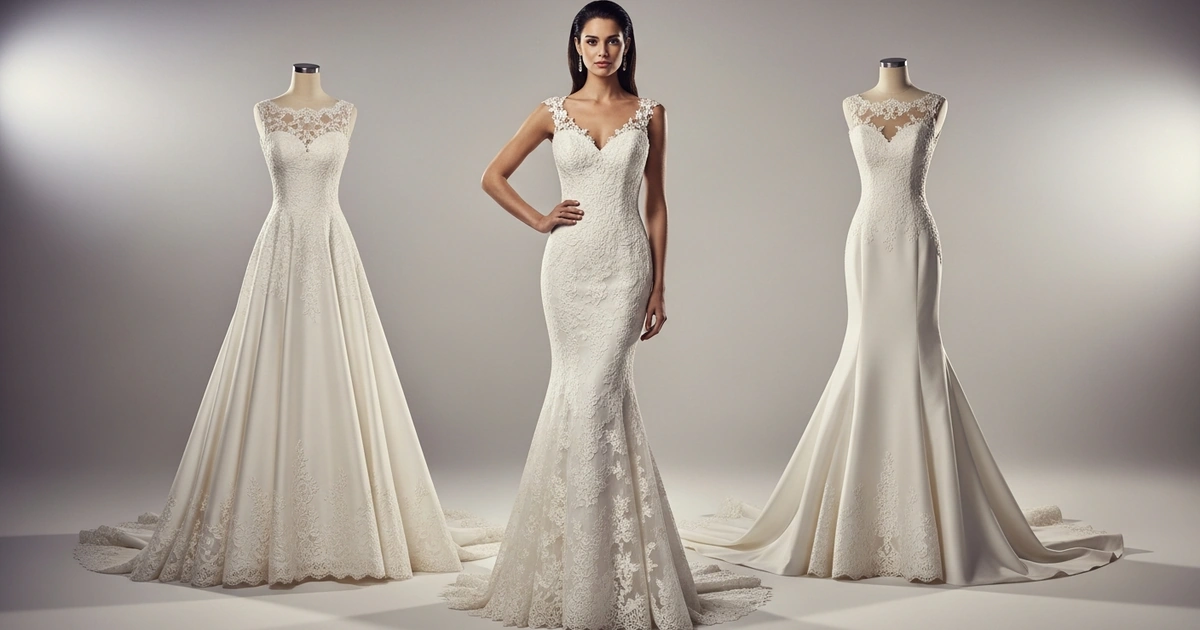
These three silhouettes share the same starting point — a fitted body — but differ in where and how the fabric opens. Confusing them is one of the most common errors during first fittings.
Fit-and-Flare: Fitted but Comfortable
The fit-and-flare, also called a column with flare, fits the body from the shoulders to the hip and then the fabric begins to open gradually, with a shape more similar to a softened A-line than a literal mermaid. It is the most comfortable of the three because it allows the legs to move normally from almost the waist downward.
Visually, the fit-and-flare elongates the figure and creates an elegant silhouette without the pressure on the thighs that characterizes the mermaid and trumpet. It is the most common choice for brides who want the fitted look but need to dance, climb stairs, or simply move without planning every step. The fit-and-flare also works well with lighter fabrics like crepe, chiffon, or georgette, which would not hold up to the extreme fit of a mermaid constructed in dense fabric.
Trumpet: The Most Spectacular Flare
The trumpet fits the body down to just above the knee and then opens the fabric abruptly and dramatically, like the bell of a wind instrument. The effect is very theatrical: the opening is wider and more visible than in the mermaid, and in photographs it creates a silhouette with a great deal of movement in the flare.
The restriction of the trumpet is considerable. The thigh and knee area is very fitted, which forces short, deliberate steps. For weddings with lots of activity — dancing, moving between spaces, long celebrations — the trumpet can become exhausting without a side vent. On the flip side, for formal ceremonies and weddings with many elaborate photographs, it is the most impactful of the three silhouettes.
Mermaid: The Balance Between Fit and Movement
The mermaid sits in the center of the spectrum. The fit runs from the chest to approximately five to ten centimeters below the knee, with minimal ease that allows walking with moderate steps. The flare begins at that point and opens more moderately than in the trumpet, though the visual effect is equally powerful.
The functional difference between mermaid and trumpet is small on paper but significant on the wedding day: the mermaid allows a little more natural movement in the knee area, and the flare does not interfere as much with the stride. For an eight-hour wedding with ceremony, photographs, and dancing, the mermaid is usually more physically sustainable than the pure trumpet.
| Feature | Fit-and-Flare | Mermaid | Trumpet |
|---|---|---|---|
| Flare begins | Hip or earlier | Below knee | Just at the knee |
| Walking comfort | High | Medium | Low |
| Visual impact | Elegant | High | Very high |
| Ideal for | Long weddings, dancing | Formal ceremonies | Photo sessions, short ceremonies |
| Recommended fabrics | Crepe, chiffon | Lace, mikado, satin | Mikado, structured satin |
The Word "Mermaid" Is Newer Than It Looks
In American fashion, the person who put a name to this silhouette was Norman Norell, the New York designer who in the 1940s started signing evening gowns that hugged the body completely, many of them covered in sequins, which he himself called "mermaid gowns." By the late 1960s those Norell mermaid gowns sold for between $3,000 and $4,000, the highest price of any dress made in the United States at the time.
The cut itself is considerably older than the word that describes it. It comes from the bias cut, the technique of cutting fabric diagonally against the grain that dominated European couture in the 1930s and allowed a fabric like satin to cling to the body without a single visible dart. The designer who worked that technique best was Charles James, whom Christian Dior called "the greatest talent of my generation" and to whom the Metropolitan Museum of Art in New York dedicated a full retrospective in 2014, "Charles James: Beyond Fashion." In 1941 he presented an evening gown in New York that he titled, plainly, "La Sirene." It is now held in the Metropolitan's own collection.
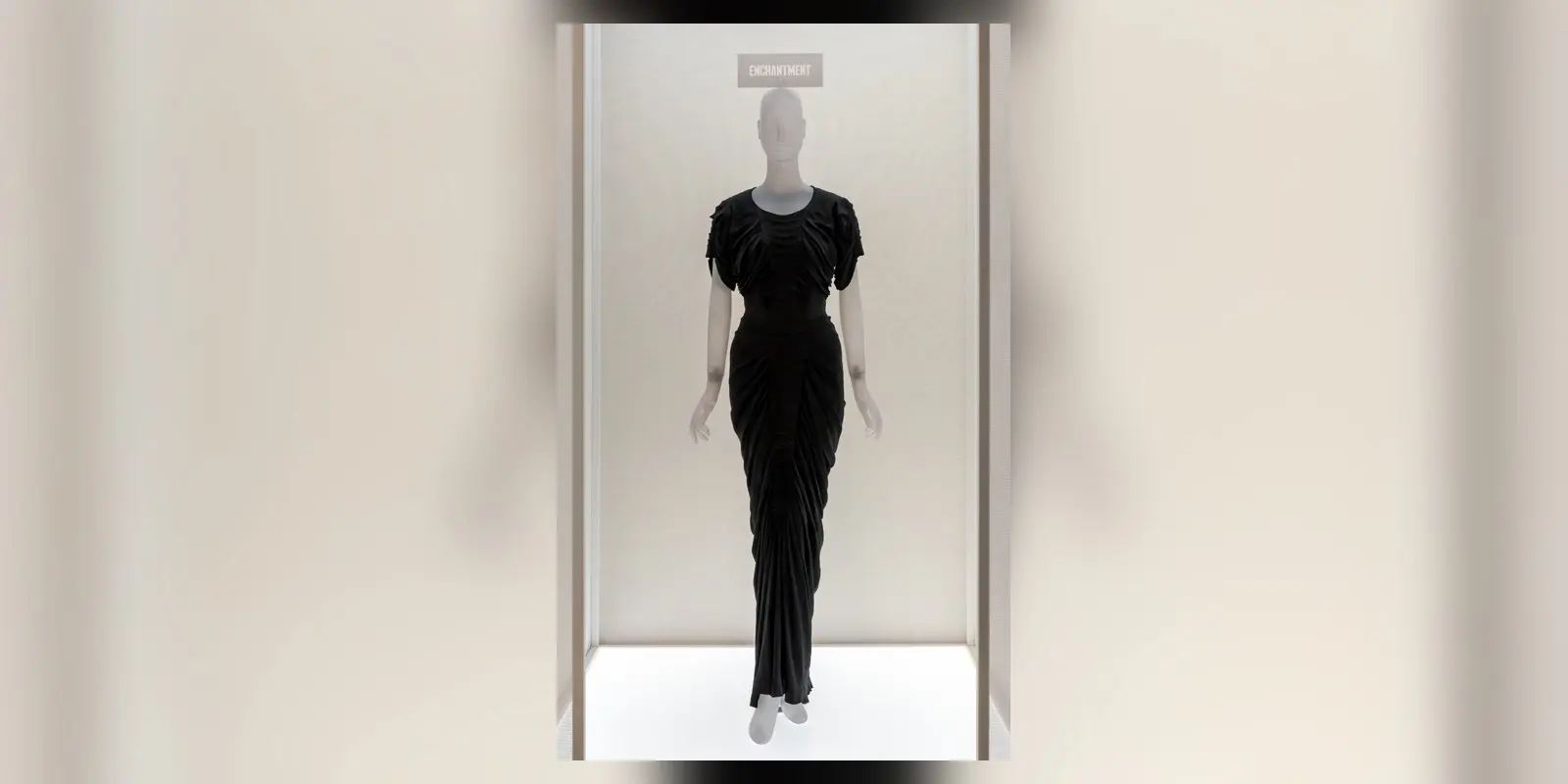
The "La Sirene" dress (1941), by Charles James, at the Metropolitan Museum of Art in New York. Photo: Rhododendrites / Wikimedia Commons, CC BY-SA 4.0.
Charles James had already been working with that exact pattern (a fully fitted body with an abrupt flare at the hem) in real wedding dresses before that. And he was not the only one. Before anyone called anything "mermaid," at least two wedding dresses from the 1930s already had that silhouette with total clarity. Both are now held at the Victoria and Albert Museum in London.
The Brides Who Wore It Before It Had a Name
Two English weddings from the 1930s, just eighteen months apart, left behind two dresses that any atelier today would instantly recognize as mermaid.
Margaret Whigham, the Bride Who Stopped Traffic in Knightsbridge (1933)
On 21 February 1933, Margaret Whigham married Charles Sweeny at the Brompton Oratory in London. She was twenty years old, one of the most photographed debutantes of her generation (years later, as the Duchess of Argyll, she would be at the center of one of the most talked-about divorces of the century), and her dress, designed by Norman Hartnell, generated so much anticipation that traffic in Knightsbridge was blocked for three hours.
The dress was made of silk satin and tulle embroidered with glass beads, with a 2.6-metre train. The pattern is pure mermaid: a fully fitted body from the neckline to the knee, flared sleeves, and an abrupt flare toward the floor that we would recognize without hesitation in any bridal shop window today. No one in 1933 would have called it that. The word did not yet exist in bridal fashion.
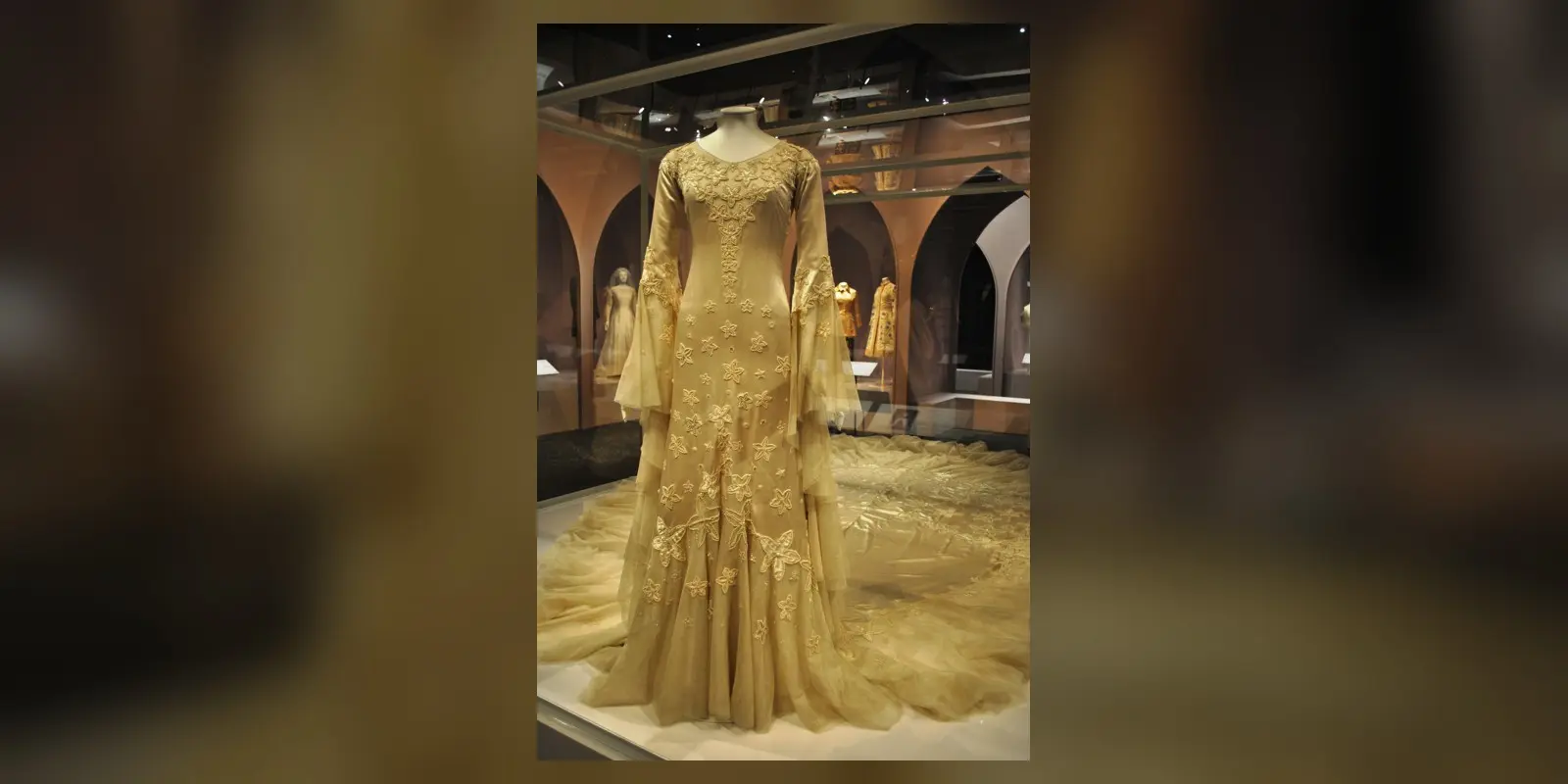
Wedding dress of Margaret Whigham (1933), designed by Norman Hartnell. Victoria and Albert Museum, London. Photo: Elisa.rolle / Wikimedia Commons, CC BY-SA 4.0.
Baba Beaton and Charles James's Golden Mermaid (1934)
Eighteen months later, in November 1934, another English debutante had an equally talked-about wedding. Barbara "Baba" Beaton, sister of photographer Cecil Beaton and one of his regular models, married Major Alec Hambro in a dress by the same Charles James behind "La Sirene." The American press of the time described the design as "a very modern interpretation of the white wedding dress," with a raised neckline and a divided train.
The result, also held at the V&A, is a gold satin gown cut on the bias that hugs the entire body (neck, arms, waist, hip) and opens into a wide train just below the knee. If I had to pick a single dress to explain where the silhouette worn at any formal wedding today comes from, it would be this one.
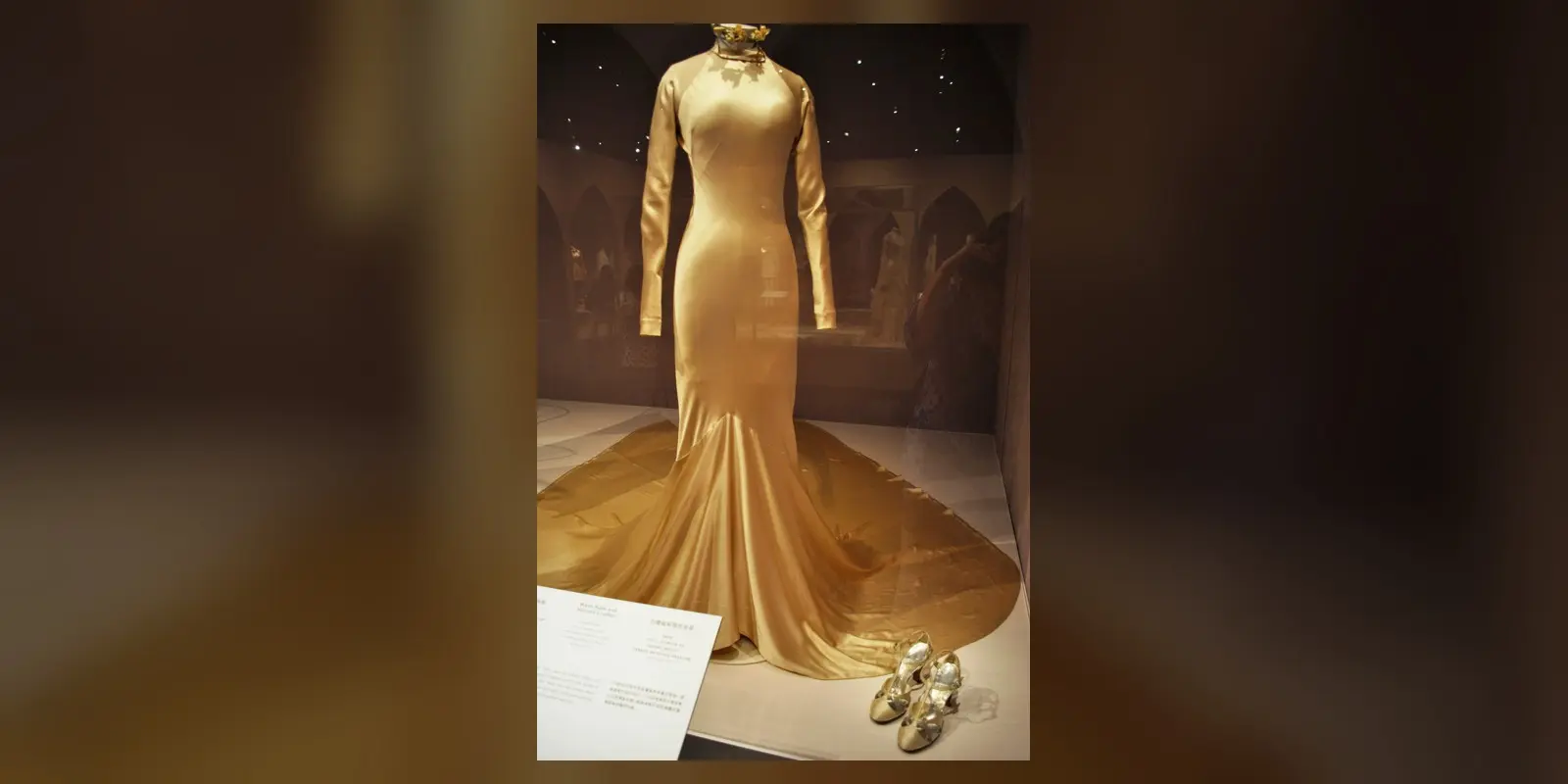
Wedding dress of Baba Beaton (1934), designed by Charles James. Victoria and Albert Museum, London. Photo: Elisa.rolle / Wikimedia Commons, CC BY-SA 4.0.
Ninety years later, the fully fitted body is still a recurring reference in high-end bridal fashion, even if the fabrics and the name have changed. Coverage of recent, widely photographed weddings, like that of Nieves Álvarez, confirms that the fitted silhouette has not lost its place.
Which Body Type Does the Mermaid Suit Best?
The idea that the mermaid wedding dress "is only for perfect bodies" is one of the most persistent and least helpful myths in the bridal world. The reality is more nuanced: the mermaid works well with many body shapes, but the specific design of the dress — the cut, fabric, neckline, position of the flare — changes radically depending on body type. If you want a full map of which cut flatters which figure before zeroing in on the mermaid, the guide on wedding dresses for every body type walks through the five main silhouettes one by one.
Hourglass Figure
This is the body type most naturally associated with the mermaid because its proportions — similar bust and hips, defined waist — are exactly what this silhouette showcases. The full-length fit of a mermaid on an hourglass body creates a sculptural effect that is hard to achieve with other silhouettes.
For this body type, virtually any version of the mermaid works: lace with a fitted bodice, satin with a long train, structured mikado with moderate vent. The only precaution is to verify that the dress does not flatten or compress the bust excessively, especially if the upper size is larger.
Straight or Athletic Figure
Bodies with fewer natural curves can also wear the mermaid, but the design needs to work harder to create the visual effect. The key is the corset: a mermaid bodice with a well-structured corset in the waist area visually creates the curve that does not exist naturally in the figure. Stiffer fabrics, such as mikado or high-density satin, help in this effect.
Another strategy is to choose a mermaid with decorative volume in the chest area — ruching, draping, three-dimensional details — that creates contrast with the hip. The goal is for the eye to perceive a difference between the torso and the lower part even when the underlying figure is straight.
Pear or Triangle Figure
Women with hips wider than shoulders need to think carefully about the mermaid. A full-length fit from the chest that reaches very snugly to the hips can accentuate the contrast between the upper and lower body in a way that not all brides find flattering. The most common solution is a mermaid that begins to fit from the waist rather than the chest, which technically approaches the fit-and-flare, but the final effect is still clearly mermaid.
Necklines with volume — boat neck, sweetheart with ruching, with shoulder details — also help to visually balance the shoulders with the hips.
Plus Size
A mermaid wedding dress in plus sizes is not only possible: it can be absolutely spectacular. The full-length fit that defines the figure works just as well in any size if the dress is well-constructed and adjusted to the individual body of the wearer. The difference from a smaller size is not in the visual result but in the importance of the fit: with plus sizes, every millimeter of adjustment matters more because the garment carries more fabric and any excess or deficit is more noticeable.
The recommendation for plus sizes is always the same: do not buy a standard dress and alter it, but start with an adapted pattern or order the dress bespoke. The cost is higher but the difference in the final result is considerable.
All included
- Banquet venue
- Wedding Planner
- Marriage Paperwork
- Photographer
- Décor
- Flowers
- Master of Ceremonies
- Deejay
- Open Bar
Which Trains Pair Best with the Mermaid Silhouette
A train is not just a decorative element: it changes the visual proportion of the ensemble and directly affects comfort during the celebration. With the mermaid, the choice of train has more practical consequences than with other silhouettes because the fitted structure of the dress already imposes movement restrictions.
Sweep Train
This is the shortest train: it extends between 15 and 30 cm behind the feet. It is almost invisible in motion but appears very elegantly in static photographs. For long weddings with a lot of movement, or for brides who want the visual elegance of a train without the practical complications of a long one, the sweep train is the most balanced choice.
With the mermaid, the sweep train works especially well because it adds no weight or volume to a silhouette that already has some movement restriction. The overall look is easy to manage and photographs show a very clean line.
Chapel Train
It extends between 90 and 120 cm from the waist. It is the most popular train in medium-format Spanish weddings: long enough to have visual presence in ceremony aisles and formal photographs, but manageable during the subsequent celebration if gathered with a loop or clasp.
The chapel train with a mermaid is a classic combination because the contrast between the fitted body and the rear extension creates a very cinematic silhouette. The only drawback is that it requires attention when turning and sitting, especially in ceremonies with movement.
Cathedral Train
More than 150 cm from the waist. It is the most formal option and the one that creates the greatest visual impact in the aisles of grand ceremonies: churches, cathedrals, palaces. For the mermaid, the cathedral train is the natural complement in large-scale weddings because the drama of the fitted body is extended by the length of the train.
The practical management of a cathedral train combined with a mermaid requires very specific planning: you will need help sitting down, turning, and managing the train during dancing. Most brides who choose this combination designate someone specifically to help with the train during the ceremony.
Watteau Train
The Watteau train is unique: it flows not from the hem of the dress but from the upper back or shoulders, falling like an independent cape behind. With the mermaid, it is a very interesting option because it adds volume and visual movement without interfering with the fitted body structure or complicating leg movement.
It is the most photogenic train of the fitted options because in motion it creates flowing effects that conventional trains cannot replicate. Its only limitation is that it requires more careful construction at the point of attachment to the back.
For a more detailed analysis of each train type and how to choose based on your venue, see the guide on wedding dress train types and how to choose.
Fabrics for a Mermaid Dress: What Works and What Doesn't
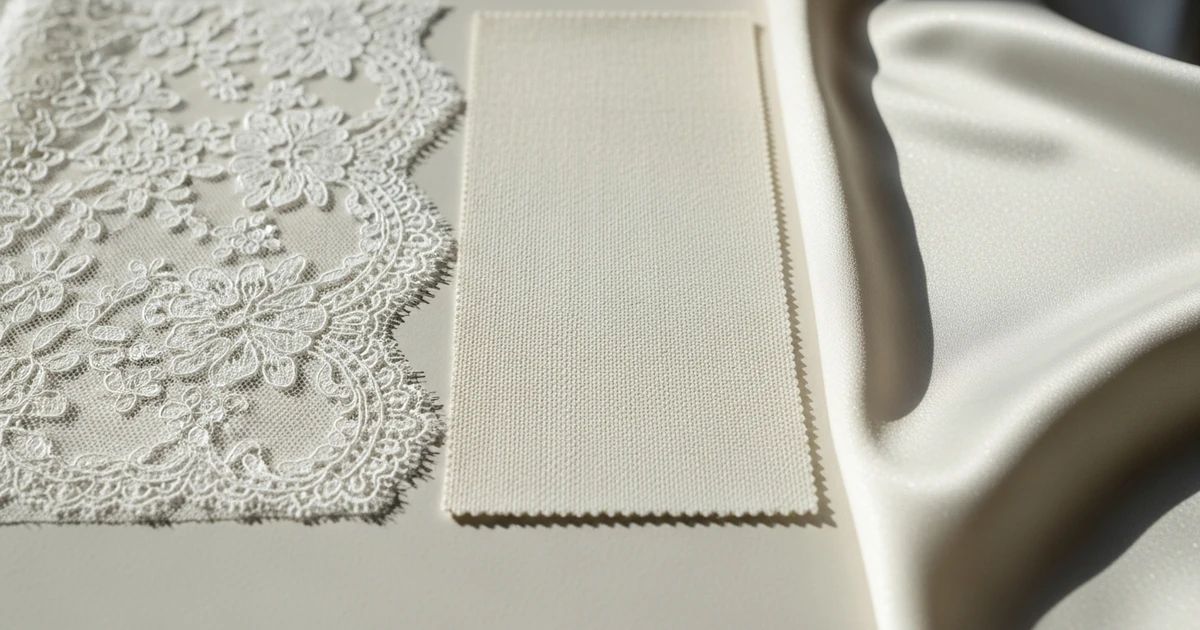
The fabric of a mermaid wedding dress is not just an aesthetic question: it directly determines how well the fit holds, how the flare falls, and what comfort you will have wearing it for hours. The guide on wedding dress fabrics goes deeper into texture, weight, and how each material behaves if you want to look beyond the mermaid.
Fabrics That Work Very Well
Lace is the material most associated with the mermaid in the Spanish bridal imagination. Its semi-rigid structure holds the fit well, adapts to curves without creating unsightly wrinkles, and in the lower flare creates a romantic effect with great visual depth. Higher-quality laces — Chantilly, Calais, Alençon — also provide controlled transparency that works especially well in a mermaid, particularly in areas like the back or arms.
Mikado is the most structured fabric available in bridal fashion. Its consistency makes the mermaid's fit perfectly precise and gives the flare presence without needing additional layers. It is the fabric of choice for very defined silhouettes and for brides with straighter bodies who need the fabric to "do the work" of creating the curve.
Satin provides shine and drape. In the mermaid it works well when the body has pronounced natural curves because satin's shine highlights exactly what is beneath. On straighter bodies, satin tends to reveal every detail of the silhouette, which can be as advantageous as it is problematic depending on the desired result.
Fabrics That Don't Work Well
Tulle in large quantities is not compatible with the mermaid because it lacks the consistency needed to maintain the fit. It can appear in decorative details, light overlays over lace, or in the flare section, but as the base fabric of a fitted mermaid it does not deliver the structural result this silhouette requires.
Very fluid fabrics such as chiffon or georgette also do not hold up well to the full fit of the mermaid. They tend to mark too much or wrinkle in friction zones like the thighs. That said, in versions closer to fit-and-flare or with a very soft mermaid, these fabrics can work very well for brides who want a more lingerie-inspired, less structured result.
How to Move Comfortably in a Mermaid on Your Wedding Day
This is the practical aspect that most concerns brides considering the mermaid silhouette, and with good reason. A very fitted mermaid with no vent can make climbing a step or getting into a car an operation that requires planning.
A side or back vent is your best ally. If your dress is very fitted around the knees, ask your atelier before finalizing the fit to add a vent of between 15 and 25 cm. This vent is nearly invisible when you are standing but radically changes the ease of movement. Many ateliers incorporate it as standard in mermaid styles; if yours does not, ask for it explicitly.
Practice before the day. Wear the dress (or a similarly fitted garment) for at least two hours before the wedding, doing the movements you will make that day: sitting and standing, climbing stairs, getting in and out of a car. This rehearsal will give you confidence and help you identify any point in the fit that needs adjustment.
Shoes matter more than you think. A thin stiletto heel is much harder to manage alongside the short steps the mermaid imposes. A more stable heel — block, kitten heel, wedge — gives you a more secure base and makes short steps feel more natural and less tense. If you want a thin heel, choose one with a front platform that reduces the effective height difference.
Plan how you will sit during the ceremony. When you are about to sit down in a very fitted mermaid, lean your body slightly forward, guide the fabric to the sides with your hands, and sit slowly. It is a gesture that feels strange practiced at home but becomes completely natural after two or three repetitions.
The transformer dress as a practical solution. If you love the mermaid look for the ceremony and photographs but know you want to dance for hours at the reception, consider a transformer dress with a detachable overskirt. The ceremony and group photographs are done with the full mermaid silhouette; for dancing you remove the overskirt and are left with a mini or midi that allows complete freedom of movement.
Before you decide, you can also get a realistic sense of how a mermaid looks on you without setting foot in an atelier. Wedded's free virtual try-on generates an image from a single full-body photo of you, and the first five try-ons are free.
Finding Your Mermaid Dress in Spain
The ateliers that work best with the mermaid silhouette in Spain are, in general, those with experience in bespoke dressmaking with their own patterns. The mermaid does not forgive a poorly calculated fit, and the difference between a mermaid dress bought in a standard size and one fitted or made to measure is visible from meters away.
Bridal trade shows — especially Barcelona Bridal Fashion Week each spring — are a good way to see on the runway which labels work this silhouette best. For weddings in 2026 or 2027, attending shows well in advance (at least twelve months ahead for bespoke dresses) is essential.
In independent ateliers in cities such as Barcelona, Madrid, Valencia, or Seville, the complete process — selection, pattern, fittings, final adjustment — typically takes between six and nine months. For a mermaid with extensive lace work or special fabrics, some ateliers ask for up to twelve months.
If budget is the other big unknown, the guide on how much a wedding dress costs breaks down price ranges by fabric and pattern complexity. And if the atelier is just the first name on a long vendor list, how to choose wedding suppliers helps you organize the rest without losing your mind.
Conclusion
The mermaid wedding dress is a silhouette that rewards enormously when chosen with criteria and when the fit is worked with precision. It is not the most comfortable option in the bridal catalogue, but it is arguably the one that produces the most spectacular wedding photographs when the body structure and dress design align correctly.
The difference from the trumpet and fit-and-flare is not only visual but functional: choose based on how many hours the celebration will last, what type of activity you will have, and what priority you give to comfort versus visual impact. With that clarity, the decision is much simpler.
Related Reading
This article was reviewed by our editorial team. How we create our content
Frequently Asked Questions
Not sure which one suits you?
Try every silhouette on your own photo with Wedded's virtual try-on. The first 5 try-ons are free.


