Wedding Dress for Civil Ceremony: Complete 2026 Guide
Choosing a wedding dress for a civil ceremony: silhouettes for courthouse and hall, trouser suits, accessories and real budgets. Practical 2026 guide.
Created with AI assistance and human review. Editorial standards
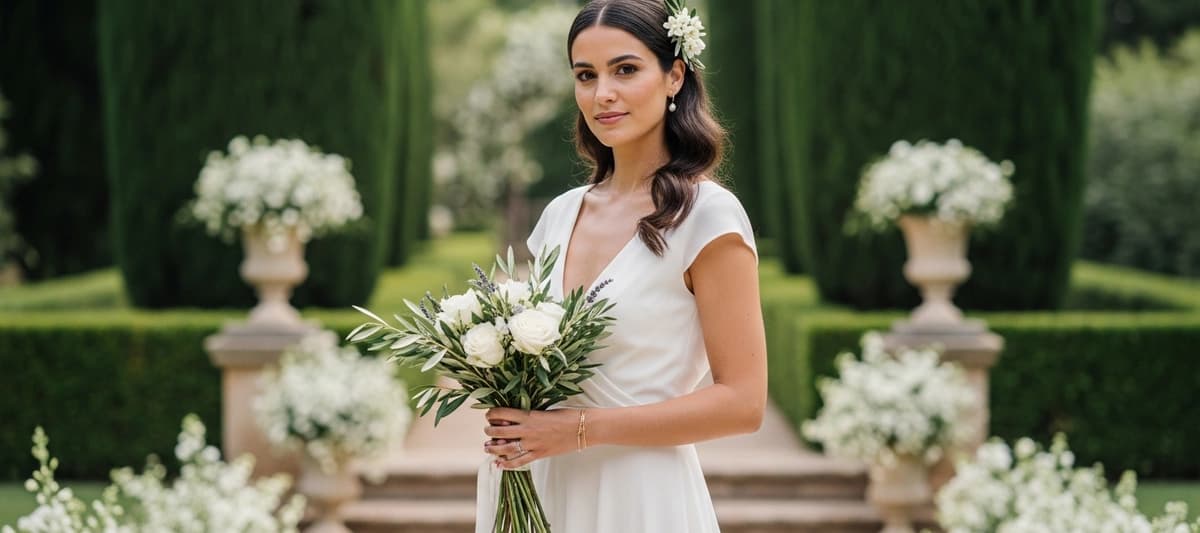
Wedding Dress for Civil Ceremony: Complete 2026 Guide
Quick Answer
A wedding dress for a civil ceremony has no single rulebook, but there are clear criteria that simplify the search. The civil format — courthouse, register office, municipal hall, estate garden — calls for silhouettes proportionate to the space, fabrics that allow easy movement, and a level of formality consistent with the number of guests and tone of the celebration. The fluid midi, the floor-length dress without a train, and the trouser suit are the three options that most often succeed.
In Spain, more than 79% of marriages are celebrated in a civil format (INE, 2022). That means the vast majority of brides are dressing for a very different context from the one that dominates shop windows and bridal magazines. Here is everything you need to choose well.
Why the Civil Format Changes the Rules
It is not about protocol, but about scale and context. A religious wedding takes place in an architectural space designed for visual spectacle: high naves, long aisles, light filtering through stained glass. The high-volume gown with train and cathedral veil was born for that environment.
A civil ceremony takes place in human-scale spaces: a town hall room, a private garden, an estate reception room, a seafront terrace. In those settings, wearing a two-metre train creates practical discomfort and a visual imbalance that detracts from the moment. The point is not to give up elegance, but to calibrate it to the setting.
The Difference Between Courthouse and Estate Hall
Scale matters. For a civil ceremony at a courthouse or register office — normally small spaces with few witnesses — the most appropriate silhouette is compact: midi, jumpsuit, or trouser suit. For a civil wedding in an estate hall or large garden with more than a hundred guests, a floor-length dress without a train, or with a small sweep train, fits perfectly.
The practical rule is simple: match the volume and length of the dress to the smallest space you will pass through during the ceremony.
The Silhouettes That Work Best for Civil Weddings
Before going into the specifics of each option, it is worth understanding how each bridal silhouette behaves in different contexts. If you want a full review of all available cuts and styles, the guide on types of wedding dresses covers everything from the mermaid to the mini, with silhouette recommendations by body type and wedding format.
Simple Midi Dress
The midi — between knee and ankle — is the civil silhouette par excellence. Its advantages are multiple: freedom of movement, adaptability to both outdoor and indoor settings, and impeccable photographic results from every angle. The most common fabrics are crepe, matte satin, and lightweight mikado.
The key is in the cleanliness of the design: simple necklines (straight, boat neck, soft V), absence of excessive ornamentation, and a silhouette that requires no internal structure. A crepe midi with a straight neckline and open back is one of the most effective and versatile civil looks of recent years.
Floor-Length Dress Without a Train
A floor-length A-line, fit-and-flare, or slip style is perfectly valid for a civil wedding, as long as the fabric is fluid and the silhouette adds no unnecessary volume. Slip dresses in satin or artificial silk, very present in the 2025–2026 collections, suit civil afternoon and evening weddings especially well.
What to avoid: the ballgown skirt, the heavily structured corset, and any train longer than half a metre. A long dress with a fluid drape and without excessive embellishment is, in many cases, more elegant than an overly detailed one.
Bridal Jumpsuit
The bridal jumpsuit has moved from being a curiosity to a genuine alternative, especially for city brides or celebrations in modern spaces. Spanish brand collections now include jumpsuits in white crepe, ivory satin, and lightweight lace that function as bridal wear without literally being a dress.
Their practical advantages are obvious: complete freedom of movement, ease of dancing later, and the possibility of rewearing without it looking like a costume. The wide-leg trouser jumpsuit with a structured top is the most elegant variant for a civil wedding with guests; the straight-leg version with a fluid top is the most relaxed option for intimate celebrations.
Bridal Trouser Suit
The tailored suit in white or light tones is probably the option that best captures the spirit of the contemporary civil wedding. It conveys architectural elegance without the symbolic weight of the traditional gown and adapts perfectly to both courthouses and estates.
The most elegant versions combine wide-leg trousers with a clean-cut jacket in a premium fabric (double crepe, duchesse satin). More modern takes play with transparency in the blouse or discreet embellishment on the neckline. The trouser suit also has an unbeatable practical advantage: it is the most reusable bridal look after the wedding, whether worn as a full ensemble or as separate pieces.
Mini Dress
For very intimate civil celebrations, beach weddings, or afternoon events with few guests, the mini dress is a completely legitimate option. Brides who choose the mini typically offset the informality of the length with the quality of the fabric (mikado, organza, lace) or with a ceremony coat that adds structure and formality.
It is not the most common option for weddings with more than forty guests, but in small, intimate celebrations it can be exactly the tone being sought.
Colours: Full Freedom with Criteria
White and its variations remain the most popular choices, but the civil wedding is the format that allows the most colour freedom.
Whites and Their Nuances
Pure white, off-white, ivory, champagne, cream: each has a different colour temperature that interacts differently with each skin tone. Pure white works best on very fair or very dark skin; ivory and champagne are more flattering on medium and olive skin tones, which are the most common in Spain.
Practical tip: always look at fabrics in natural light, never just under atelier lighting. The difference can be significant.
Non-White Colours That Work
Nude, dusty rose, pale blue, sage green, and lavender are the most common non-white colours in 2025–2026 civil weddings. They share soft, low-saturation tones that do not break with the bridal aesthetic but do mark a clear visual difference.
Some civil brides opt for a colour detail rather than a fully coloured dress: discreet floral embroidery, a contrasting bow, a waist ribbon. 3D flowers and oversized bows have been trending in recent seasons and suit simple dresses especially well, where the detail is the star.
A Note on Black
Black at a civil wedding generates debate in the Spanish bridal context. For a second wedding, a very intimate celebration, or a deliberately modern evening event, it can work perfectly. For a first wedding with many guests and family traditions, it is worth considering more carefully and communicating in advance.
Accessories for a Civil Wedding
Accessories at a civil wedding follow the same logic as the dress: proportion and context.
Headpiece and Hair
The long veil is the accessory most often set aside at civil weddings. Its association with religious ceremony is so strong that at a register office it can feel out of place. The most common alternatives are a flower or jewel clip, a pearl or crystal headband, a fabric bow (a current trend), or simply well-finished up or loose hair.
If you want to keep the bridal nod of the veil, the short version — to the shoulder or waist — is the most appropriate for the civil format.
Shoes
The classic court heel remains the most popular choice, but civil weddings allow more freedom: a low-heeled mule, a strappy sandal, or even a low-ankle boot at autumn or winter weddings are completely coherent with the format. What to avoid is the stiletto heel on outdoor grass or gravel.
Jewellery and Bag
Jewellery tends toward minimalism at civil weddings: pearl or small diamond earrings, a fine bracelet, without excessive layering. The small clutch or mini bag are the most common formats. Minimalist brides often let the cut of the dress be the sole protagonist and do without statement jewellery.
All included
- Banquet venue
- Wedding Planner
- Marriage Paperwork
- Photographer
- Décor
- Flowers
- Master of Ceremonies
- Deejay
- Open Bar
Budget: What to Expect at Each Level
Dresses for civil weddings tend to be more affordable than those for religious ceremonies because they require less fabric, less internal structure, and fewer hours of construction.
| Price range | What is available | Where to look |
|---|---|---|
| €150–400 | Midi and long dresses in mid-quality fabrics | Accessible bridal fashion brands, ASOS, H&M Conscious |
| €400–900 | Bridal ready-to-wear, civil collections from specialist brands | Bridal outlets, national ready-to-wear brands |
| €900–2,000 | Simple atelier lines, specialist chains | Ateliers with civil collections |
| €2,000–4,000 | Bespoke construction, premium fabrics (silk, Italian crepe) | Independent ateliers, designer labels |
Practical tip: For a civil wedding, the dress budget is typically 20% to 40% lower than for an equivalent religious wedding. If you have a clear limit, always start with bridal ready-to-wear collections before visiting ateliers: for simple silhouettes, the perceived quality difference does not always justify the price difference.
What the Partner Wears at a Civil Wedding
The partner's look at a civil wedding has fewer established references than at a religious one, which generates almost as much uncertainty as the wedding dress.
Versatile Option: Dark Suit
A navy blue or charcoal grey suit with a white shirt and tie — or without a tie — is the most versatile civil look. It works indoors and out, in any season, and does not visually compete with any style of wedding dress. It is the option least likely to go wrong.
For Outdoor or Informal Civil Weddings
A light-coloured suit (beige, sand, pearl grey, sky blue) with an open-collar or linen shirt is the alternative that has grown most in garden or estate civil weddings. The key is that the suit fits well: a poorly cut light suit can look careless even in an informal context.
Coordination Without Uniformity
The partner does not need to match the bride exactly, but there should be tonal coherence. If the dress is in warm tones (champagne, ivory, nude), a suit in earthy or beige tones creates more harmony than navy blue. If the dress is pure white or has blue details, navy or grey works better.
Before Choosing: Helpful Tools
One of the real difficulties when searching for a civil wedding dress is that visual references abound for the religious format and are scarce for the civil one. Bridal magazines and social media still fill up with high-volume gowns that do not suit the majority of civil ceremonies.
To narrow down the options before visiting ateliers, Wedded allows you to explore civil, midi, and minimalist silhouettes through a visual preferences system — swipe to indicate what you like and what you do not — that learns your style. With that clarity, atelier appointments become much more efficient.
Conclusion
The wedding dress for a civil ceremony has one clear advantage over a religious one: greater freedom of choice. The fluid midi, the jumpsuit, the trouser suit, the floor-length dress without a train, and the mini dress are all equally valid options, as long as they are well-proportioned to the space and tone of the celebration.
The three variables worth clarifying before you start looking are the scale of the space, the level of formality of the celebration, and the available budget. With those three parameters well-defined, the dress search stops being overwhelming and becomes what it should be: an exciting decision.
Related Reading
This article was reviewed by our editorial team. How we create our content
Frequently Asked Questions
Not sure which one suits you?
Try every silhouette on your own photo with Wedded's virtual try-on. The first 5 try-ons are free.


