A-Line Wedding Dress: The Most Versatile Silhouette
The A-line wedding dress, also called evasé, is the most versatile bridal silhouette: which body types it flatters, the best fabrics, and the weddings it suits.
Created with AI assistance and human review. Editorial standards

A-Line Wedding Dress: The Most Versatile Silhouette
Ask any bridal boutique which silhouette rarely disappoints, and the answer is almost always the same: the A-line. Also called evasé, it is the cut that fits lightly at the body and then lets the fabric fall into a clean A shape toward the floor, without tightening around the hips or thighs. It does not chase the extreme impact of the mermaid or the volume of the princess gown; it aims for comfort, effortless dancing, and photographs that still turn out spectacular.
It is also the easiest silhouette to fall back on when you are torn between two options. We go through what really sets it apart from mermaid, trumpet, and princess, which body types it flatters most, and which fabrics make it fall the way you want.
A-Line vs. Mermaid, Trumpet, and Princess: Where the Line Is Drawn
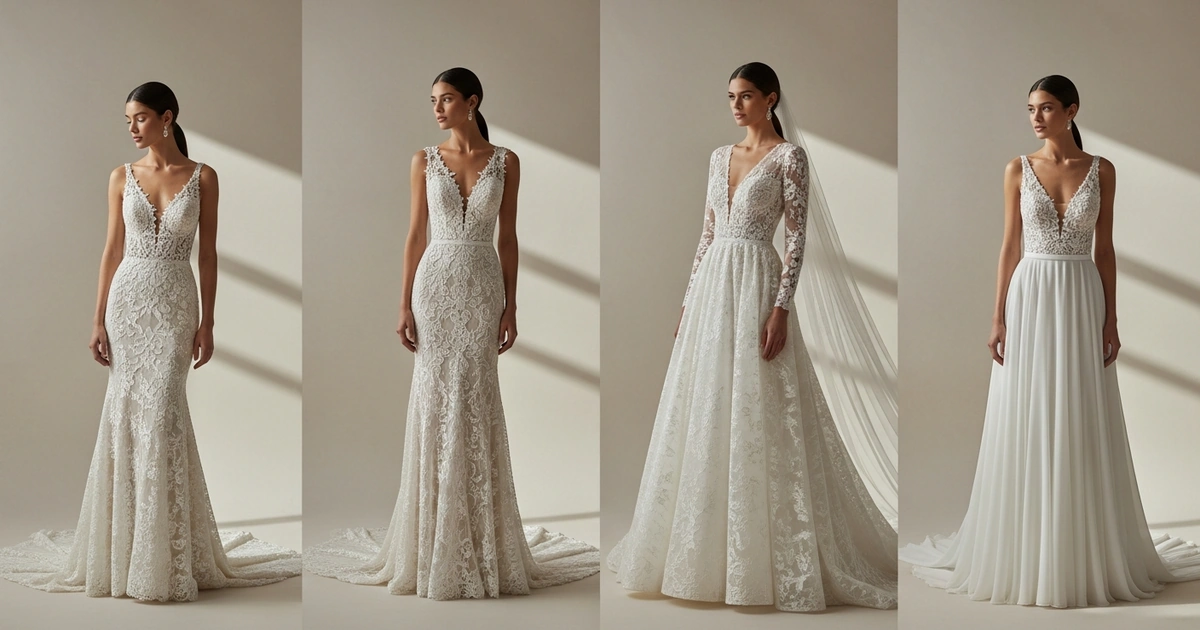
The four most searched bridal silhouettes share one question: where does the dress start to open? For the A-line, the answer comes early. The fit happens at the bust or, at most, the waist, and from there the fabric falls in a soft, continuous angle to the hem. There is no abrupt turning point, as in the trumpet, and no second skin following the hip and thigh, as in the mermaid.
We've already covered the trumpet and mermaid in detail in our mermaid wedding dress guide: both silhouettes prioritize visual impact over comfort and require short steps and some planning to sit down or climb stairs. The A-line starts from the opposite premise. Because it doesn't grip anything below the waist, it lets you walk normally, sit without help, and dance all night without needing a detachable overskirt.
With the princess gown (or ball gown), the resemblance runs deeper than it first appears: both open from the top and give a romantic feel. The difference is volume. The princess adds layers of tulle or crinoline under the skirt to achieve a pronounced bell shape; the A-line stays in a single layer of fabric with a natural fall, no structure underneath. The result is a lighter, less cumbersome version of the same idea, something brides marrying in summer or in smaller venues particularly appreciate.
| Feature | A-line / Evasé | Princess | Mermaid | Trumpet |
|---|---|---|---|---|
| Flare begins | Bust or waist | Waist | Below knee | Just at the knee |
| Volume | Low, natural fall | High, layered | Minimal to the knee | Medium, concentrated below |
| Walking comfort | High | Medium | Medium | Low |
| Ideal for | Any wedding, last-minute decisions | Large ceremonies, religious weddings | Formal ceremonies | Photo sessions, short ceremonies |
If you're still not sure which of the main silhouettes suits your wedding, the guide on types of wedding dresses covers all of them together, with their strengths and their limits.
Which Body Type Suits the A-Line Best
Why does it end up being the choice even for brides who were convinced they wanted something else? Because it demands almost nothing from the body wearing it.
Pear or Triangle: The Shape That Gains Most from the A-Line
If your hips are wider than your shoulders, the A-line is probably the option that will give you the fewest second thoughts. The flare beginning at the waist distributes volume evenly from top to bottom, so the eye stops fixating on the contrast between narrow shoulders and wider hips. Of the common body shapes, this is the one that comes out best with this cut, with no neckline tricks or internal structure required. It wins without trying.
Hourglass and Rectangular: Two Different Bodies, One Flattering Result
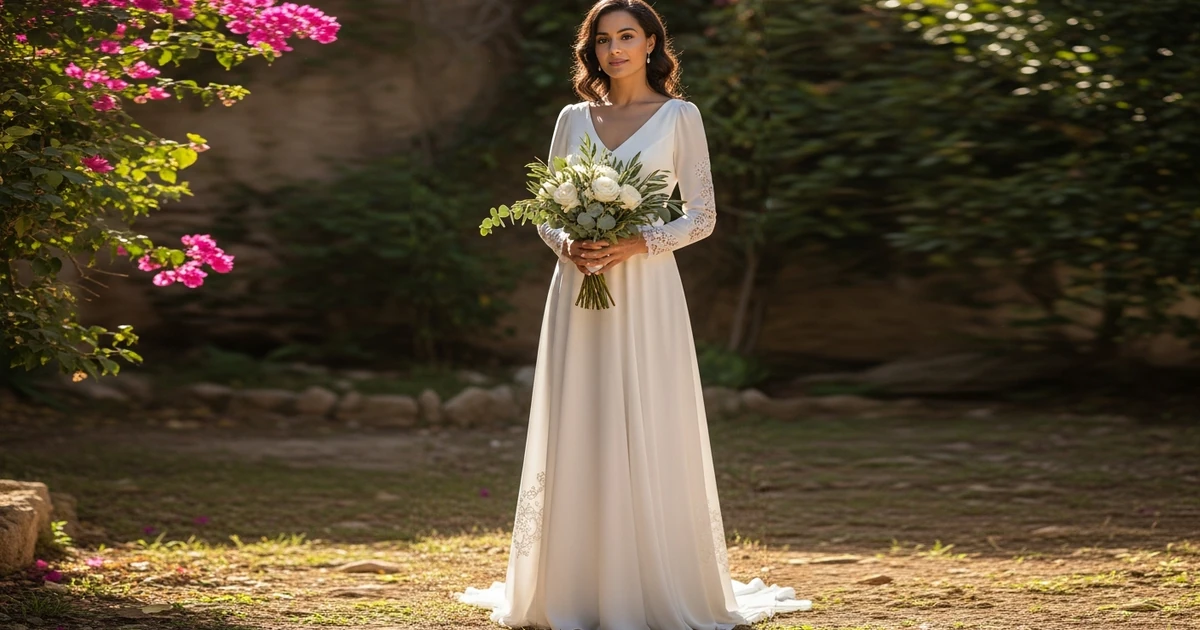
With balanced proportions between bust and hips, virtually any A-line works, though it helps to define the waist a little (a thin belt or a low empire seam) so that proportion doesn't disappear under the fall of the fabric. On straighter bodies with fewer natural curves, something close to the opposite of the mermaid happens: no structured corset is needed here. The flare of the dress itself, starting from the bust, visually creates the curve the figure lacks, with nothing forced.
Apple Shape or Fuller Bust: Lightness as an Ally
For bodies carrying more volume through the torso, the A-line is one of the most forgiving silhouettes in the bridal catalogue. Because it doesn't define the waist rigidly, it doesn't compress or create the tight feeling a very fitted bodice can produce. A V-neck or sweetheart neckline visually elongates the torso, and the fabric falls freely from there without needing shapewear or reinforcement.
If you want to go deeper into how each body shape responds to different silhouettes, not just the A-line, the guide on wedding dress for each body type has a full comparison table.
Fabrics and Flare: What Makes an A-Line Look Light or Formal
Fabric decides whether your A-line reads as an elegant beach dress or something fit for a cathedral wedding. Unlike the mermaid, which needs fabric with body to hold the fit, the range of options here is much wider, and that's part of what makes this silhouette so versatile.
Crepe is, if you ask me, where an A-line delivers the most for the least effort: it falls with just the right weight, doesn't cling excessively, and holds up equally well through a morning ceremony and a twelve-hour dance floor without needing constant touch-ups. Chiffon and georgette go a step further in lightness: they're the natural choice for beach weddings, gardens, or any outdoor ceremony where the wind is part of the scenery. With these fabrics, the flare moves on its own.
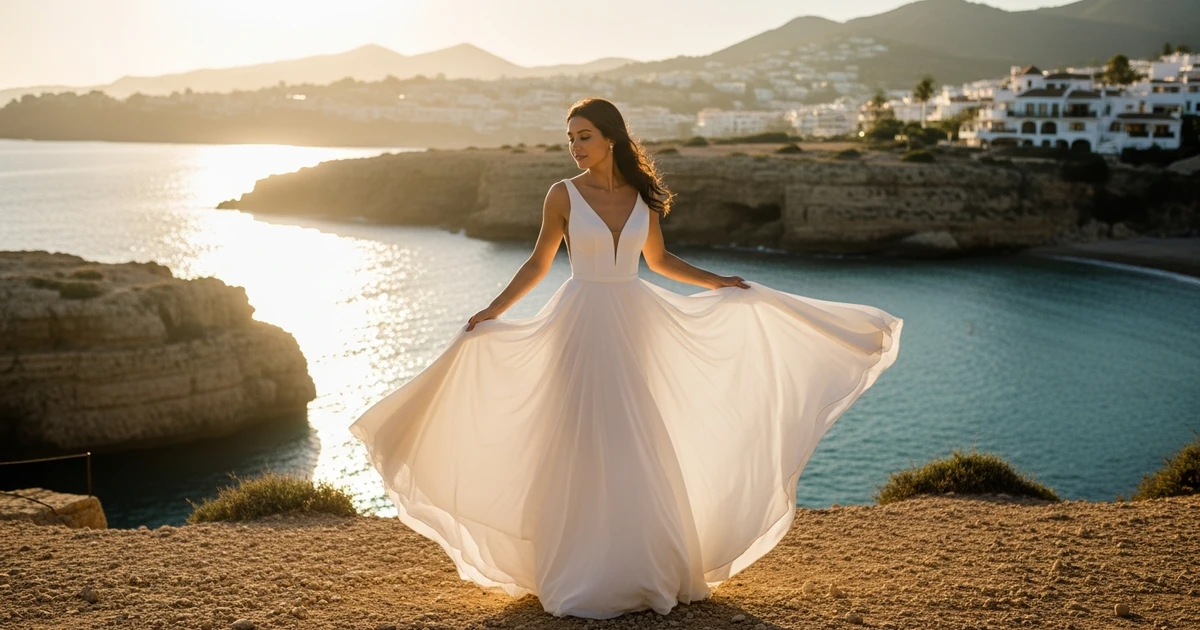
For a more formal result, organza adds volume without weight, with that slightly crisp fall that gives presence walking down the aisle of a large church. Mikado, even more structured, works best in less flowy A-line versions, almost straight through the bodice, for a more architectural look. Tulle, which barely has a place in the mermaid, can be added here as a single layer under the skirt for a subtle lift without tipping into princess-gown volume.
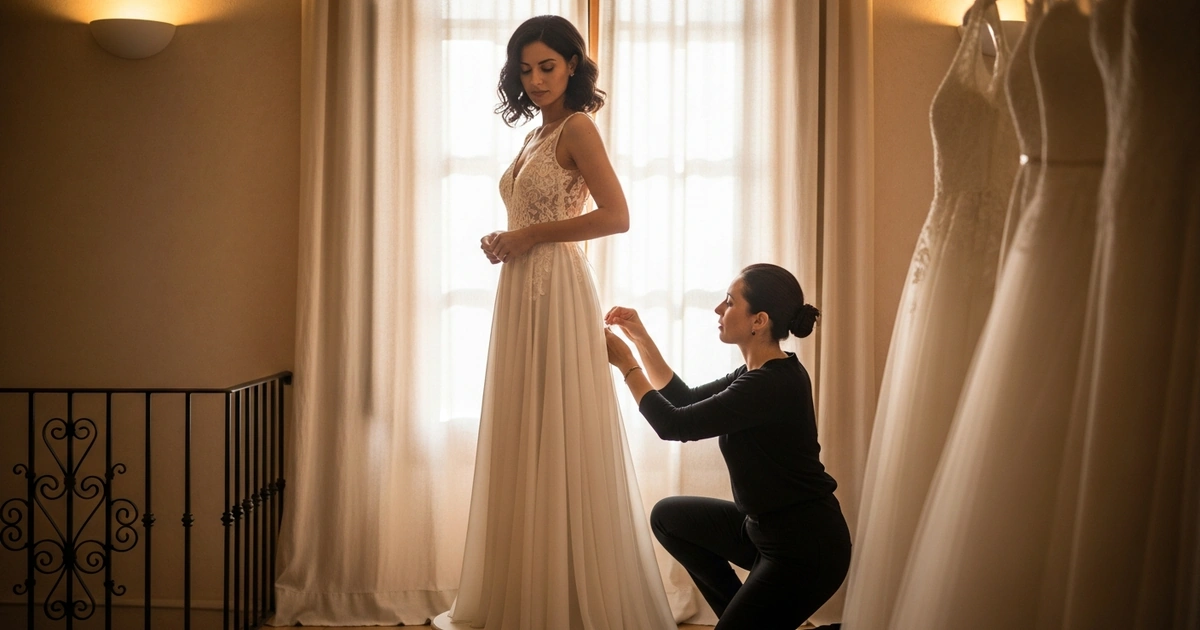
One thing many brides discover too late, usually at the final fitting, with the seamstress pinning the waist while you turn slowly in front of the mirror: the lighter the fabric, the sooner you need to try it on with your actual shoes and in the day's real temperature, because chiffon and georgette react very differently to heat and humidity than crepe or mikado do. For a detailed comparison of every bridal fabric, including the best season for each, the guide on wedding dress fabrics goes through them one by one.
Which Wedding Suits an A-Line Best
The A-line doesn't demand a specific type of wedding, precisely because it is the least demanding of the four silhouettes. Even so, some contexts show off its advantages more clearly.
For daytime civil ceremonies, especially in summer, it's probably the most practical option: it doesn't weigh you down, it needs no help to sit in, and it handles heat well in a lightweight fabric. For outdoor weddings (gardens, vineyards, beaches) the soft flare adapts to uneven ground without the tripping risk of a mermaid train or an overly voluminous princess skirt.
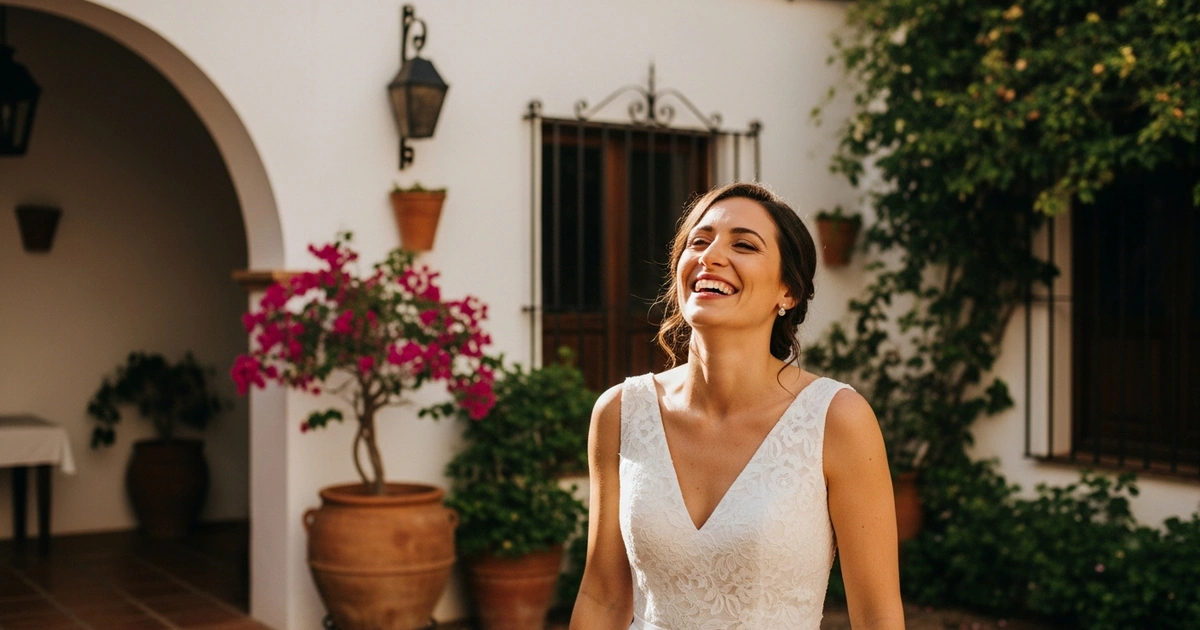
It's also the sensible choice when the party runs long and you know you'll actually be dancing. You don't need a transformer dress or a detachable overskirt: the silhouette itself already lets you move freely from the very first moment.
And there's one last group of brides for whom the A-line is nearly a lifesaver: the ones who reach the final fitting with nothing decided. It's the silhouette that almost never misses, so if you're torn between two completely different styles and time is running out, betting on a well-made A-line rarely goes wrong.
Not sure which one suits you?
Try every silhouette on your own photo with Wedded's virtual try-on. The first 5 try-ons are free.
Dior Coined the Name in 1955
The A-line isn't a term some trend blog invented last week. Christian Dior coined it to name his spring 1955 collection, the one the Paris press of the time described as "the most sought-after silhouette in Paris." That first version, to be fair, wasn't quite what you'd recognize in a bridal window today: it was a long, fitted jacket falling to the fingertips, worn over a dress with a very full, pleated skirt. The A shape lived in the whole outfit more than in the dress alone.
The version you'd actually wear arrived three years later, in 1958, from a 21-year-old Yves Saint Laurent who had just taken over the house after Dior's sudden death. His "Trapeze" collection pushed the idea to its extreme: a defined shoulder, minimal fit, and a skirt flaring out dramatically from there. That collection, the trapeze, is what fixed the pattern we now call A-line. It stayed fashionable through the 1960s and 70s, all but disappeared in the early 1980s, and came back with the retro wave of the late 1990s.
Letizia Ortiz: The Royal Bride Most Often Cited as an Example
If you're looking for a royal wedding dress described over and over as A-line, it's Letizia Ortiz's. Manuel Pertegaz designed it in Valencian silk embroidered with silver and gold thread: fitted at the waist, with long sleeves, a corolla-shaped neckline, and a full skirt finished with a four-and-a-half-metre train embroidered with heraldic motifs. Nearly twenty years later, it's still the reference the Spanish fashion press reaches for when it wants a real example of what an A-line actually looks like at a state wedding.
The Counter-Example: Beatrix of the Netherlands, 1966
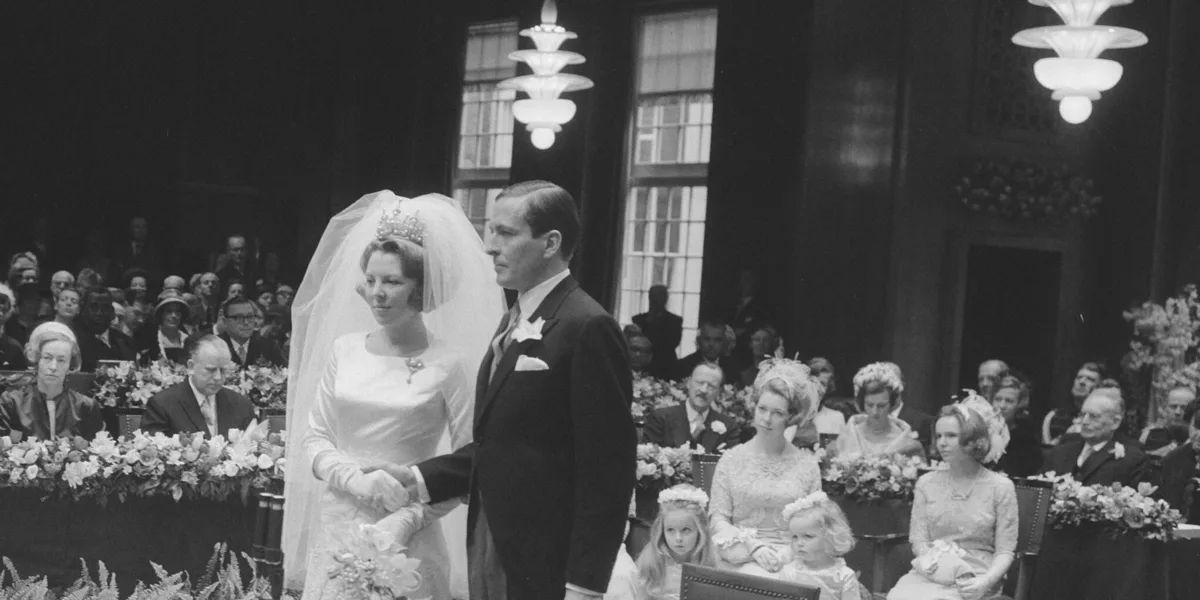
Credit: Bob van Dam / Anefo, Nationaal Archief (Netherlands). CC0, public domain.
Not every royal wedding of the 1960s went A-line, and this one is a useful case for understanding the difference by contrast. Beatrix, then heir presumptive and future queen, married Claus von Amsberg in a white silk duchesse gown designed by Caroline Bergé-Farwick of Maison Linette (Beatrix herself was involved in the design). The result was close to the opposite of an A-line: a straight, fitted cut from top to bottom, with almost no flare, ending in a long train. Today we'd call it a column dress. It's worth keeping in mind precisely because, at first glance, it looks like the thing it isn't.
Finding Your A-Line Dress in Spain
In terms of pattern-making, the A-line is one of the simplest silhouettes to construct and fit, which translates into shorter timelines and more options within the same budget. While a mermaid or a princess gown with heavy lacework can take up to twelve months at an atelier, an A-line in lightweight fabric usually wraps up in a four-to-six-month process, including fittings and final adjustments.
That also makes it the most common silhouette in ready-to-wear bridal collections, where you'll find standard sizes ready to wear with minimal alterations. If you prefer something more personal, ateliers in cities like Barcelona, Madrid, or Valencia typically offer bespoke A-line dresses at a lower cost than an equivalent mermaid in the same fabric, simply because the pattern requires fewer hours of work.
Conclusion
The A-line isn't the silhouette that's going to headline every magazine spread, and that's fine. Its strength isn't impact, it's the absence of risk: it works with more bodies, more types of weddings, and more budgets than any other option in the bridal catalogue.
If you're choosing between two silhouettes and one of them is the A-line, that's usually the safe bet. Not because it's the most spectacular, but because it's the one that leaves the fewest regrets after the wedding, once you've danced, sat down a hundred times, and climbed in and out of a car with the dress on.
Related Reading
This article was reviewed by our editorial team. How we create our content
Frequently Asked Questions
Not sure which one suits you?
Try every silhouette on your own photo with Wedded's virtual try-on. The first 5 try-ons are free.


